Discover
Thailand
Fish,
folklore and tunnels in Songkhla
'Shopped out' in Hat
Yai? Time to enjoy the southern province's other side
Jarunee Taemsamran
 Songkhla
may be considered the capital city of the South, as significant
as Chiang Mai is to the North and Nakhon Ratchasima to the Northeast. Songkhla
may be considered the capital city of the South, as significant
as Chiang Mai is to the North and Nakhon Ratchasima to the Northeast.
But it has long been overshadowed by Hat Yai, a district in Songkhla
province that is seen as thFor those who want to see the other
side of Songkhla, though, there are many sites of natural, historical
and cultural interest.
A good place to start is Ko Yo, an island in the inland sea known
as the Great Songkhla Lake. Here there is a thriving cotton-weaving
cottage industry, where visitors can observe local artisans and
listen to the clacking sound of the hand-operated wooden looms.
At the northern end of the island at Ban Ao Sai is the Institute
of Southern Thai Studies, a division of Sri Nakharinwirot University
and one of the most interesting museums in the country.
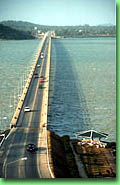 The
folklore museum on Ko Yo, 10 kilometres from Songkhla, opened
in 1991 and is the largest museum in the South. The
folklore museum on Ko Yo, 10 kilometres from Songkhla, opened
in 1991 and is the largest museum in the South.
The museum guide told us that the facility was considered an international-standard
museum with the finest collection of ancient artifacts from all
over southern Thailand.
Built in a complex of Thai-style pavilion houses, it has a collection
of southern Thai arts exhibits grouped into a Shadow Play Garden,
Ancient Beads Garden, Traditional Medicine Garden and Bamboo Culture
Garden. Various household, agricultural and fishing implements
are also on display.
One
especially appealing collection features coconut-grater seats
carved into various animal and human shapes that show off local
wisdom and humour. If you look out from the window of the museum,
you can see the fishing villages that form an exotic backdrop
along the lake.
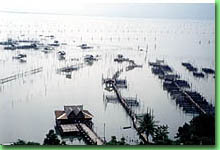
The Great Songkhla Lake is the country's largest freshwater lake,
extending some 80 kilometres north from an estuary that flows
into the Gulf of Thailand. Boat tours of fish farms, operated
by the Fishery Department, allow visitors to see how the fishermen
earn their living.
And as long as you're in Ko Yo, be sure not to miss the fresh
seafood offered by several large restaurants overlooking the lake.
Another attraction not yet widely known among local visitors,
but drawing curious foreign tourists, is the Piyamitr tunnel.
 Many
people are aware of the network of tunnels in Vietnam, excavated
by Viet Cong fighters during the war 30 years ago. Far fewer are
aware that a similar attraction exists in Thailand-even the Lonely
Planet guidebook doesn't mention it. Many
people are aware of the network of tunnels in Vietnam, excavated
by Viet Cong fighters during the war 30 years ago. Far fewer are
aware that a similar attraction exists in Thailand-even the Lonely
Planet guidebook doesn't mention it.
Hidden in the jungle in Khao Nam Khang national park in Na Thawi
for decades, the tunnel was opened for tourism just a few years
ago.
The site is a popular attraction for Malaysian tourists, because
it has a significant connection to the history of their country.
The Piyamitr tunnel was once a shelter for Chinese Malaysian Communists
who had first migrated to southern Thailand during the Second
World War.
"We have lived here for 40 years now," said our guide,
Loo Fooi Ying, a cheerful, strong 74-year-old woman.
"At that time, we were with the Malaysian Communist Party,"
she explained in Thai with a strong Chinese accent.
"I was with the eighth army group that headed to the forest.
We had a strong will to fight for our country.
"In
our case, we all were university students, sent up here to seek
the independence of what was still a British colony. The first
10 years were periods of torture and hardship.
"Still, the British army could not liquidate us although
four leaders took turns trying.
 "We
were attacked continuously, especially when the Malay government
joined forces with the British army, so finally we had to sneak
into Thailand and began digging this tunnel." "We
were attacked continuously, especially when the Malay government
joined forces with the British army, so finally we had to sneak
into Thailand and began digging this tunnel."
The excavations took two years to complete amid fierce attacks.
"But we were safe in this tunnel," Mrs Ying said.
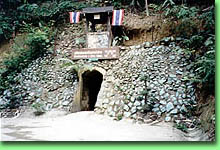
The entrance of the tunnel was renovated when the idea of making
it a tourist attraction took hold. Stepping inside, we could feel
the coolness as we ascended 54 steep stairs.
The tunnel itself is a marvel of human achievement and endurance.
Some parts are so rocky that it's hard to imagine the effort needed
to dig by hand, using only simple tools.
The 1,000-metre-long tunnel was divided into several sections.
There are bedrooms, a kitchen area, meeting room, emergency room,
communication room and shooting range. There was even a motorcycle
training area.
In total, the tunnel complex contained more than 100 rooms, and
more than 200 people lived in it at any one time.
Outside the tunnel, there is a basketball court, kitchen, wedding
room and residence for comrades. In the main meeting hall there
were pictures of Stalin, Karl Marx, Lenin and Mao.
Originally, the tunnel had three entrances. Later, it was extended
to 16 entrances with three floors, linked to each other by stairs.
It is said that this is the most perfect and longest tunnel of
its kind in Thailand. What really makes a visit memorable, though,
is the first-hand accounts of the guides who endured such privations
fighting for their beliefs.
So you don't have to go to Vietnam just to see such an attraction.
The local guides are aware of the site's strong appeal to Malaysian
visitors, and a bit surprised that so few Thai people acknowledge
its existence.
Once you've seen the high points of Songkhla, a side-trip across
the Malaysian border to Penang is also worthwhile. The crossing
at Dan Sadao is just 60 kilometres from Hat Yai.
Penang today is a modern commercial and industrial centre, but
it retains considerable charm in areas where its colonial architecture
has been preserved.
The highway in Malaysia is smooth with shady trees making for
pleasant scenery along the way. It takes about three hours to
reach Penang, so an overnight stay is a good idea, unless one
departs Hat Yai very early in the morning to make a long day trip.
Hat
Yai aims to broaden its appeal
Tourism in Hat Yai has changed a lot over the past three decades,
though not always for the better.
Thai people know Hat Yai as the best place in the South to shop,
while many Malaysian and Singaporean tourists come to Hat Yai
for its nightlife.
However, the city is beginning to lose it appeal as a single destination,
according to industry sources. The solution lies in efforts to
promote Hat Yai as the hub of the South. The Tourism Authority
of Thailand is working to create regional routes using Hat Yai
as the centre, and many travel agents have responded with new
packages.
"Unless we do so, Hat Yai might not be able to survive,"
said Pichit Boonpalamlert, managing director of Sunny Tours Co
Ltd.
On the shopping front, Thai shoppers have tightened their belts,
and many are finding that prices in Hat Yai are now almost the
same as in Bangkok.
At the Kim Yong market, the largest in Hat Yai, the electrical
goods section that used to draw crowds from around the country
had few shoppers, even on a weekend.
According to Mr Pichit, the southern attractions that now draw
many Thai tourists include Pattani, where people go to pay respect
to the famous Lim Ko Niew goddess. Some also cross the Malaysian
border to visit Penang, but most return to Hat Yai at night due
to its wide selection of accommodation.
Hat Yai has more than 10,000 hotel rooms, with 700 new ones added
last year. Stiff price competition has forced changes in the business,
said Chokdee Wisansing, general manager of the Central Sukhontha.
In the past, he said, most hotels were going after the same tourist
markets. But as more new hotels sprouted, it became important
for some properties, especially upmarket ones, to be more creative
in their marketing to avoid competition.
The Central Sukhontha is an example, he said, explaining his niche
market approach: "We are looking mainly at the upmarket segment.
Our golf packages target Malaysian and Singaporean tourists. Among
the local market, we aim at corporate guests."
Hat Yai has three standard golf courses that are being promoted
as an alternative to the nightlife attractions that seem to draw
most Malaysians.
Travel industry people believe Hat Yai has succeeded in changing
its image away from a place only for single men. They say more
family groups are arriving.
Cruise tourists from Singapore and Penang are also big business.
Within the past six months since Star Cruises began calling on
Hat Yai, at least 50,000 tourists had visited the city, said Pichai
Raktakinha, director of the local TAT. They do not stay overnight
but they are big spenders at 5,000 to 6,000 baht each, he added.
Travel
tips
 Getting
there: THAI (tel. 628-2000) has several daily flights
to Hat Yai. The State Railway of Thailand (Hua Lamphong tel. 223-7010,
223-7020) has daily train services to Hat Yai. For bus schedules,
call the Southern Bus Terminal in Bangkok at 435-1199-200. Getting
there: THAI (tel. 628-2000) has several daily flights
to Hat Yai. The State Railway of Thailand (Hua Lamphong tel. 223-7010,
223-7020) has daily train services to Hat Yai. For bus schedules,
call the Southern Bus Terminal in Bangkok at 435-1199-200.
Attractions:
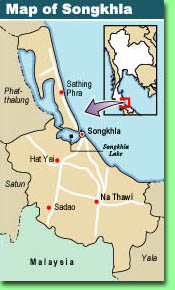
The tunnel at Nam Khang Mountain is located in Moo 1, Tambon Klong
Kwang, Nathawee district, Songkhla, four kms from Khao Nam Khang
national park. Tourists can visit the tunnel by following a 92-km
route that takes in Hat Yai, Nathawee, Ban Prakop and Khao Nam
Khang. Alternatively, go to Sadao and then take the 26-km route
to Khao Nam Khang.
The entrance fee is 70 baht per person with a guide and 40 baht
without. For English-speaking visitors, the fee is 100 baht and
advance booking is needed.
Admission to the Institute of Southern Thai Studies is 50 baht
for foreigners and 30 baht for Thais. It is open daily from 8:30
a.m. to 5 p.m.
Accommodation: Central Sukhontha
Hat Yai (tel. 074-352222, e-mail: [email protected].
Border crossing: The border
crossing at Dan Sadao is open daily until 9 p.m. There is a bus
from Hat Yai to Penang every day at 25 ringgit (about 210 baht)
per person. Many travel agents also arrange tours to cities in
Malaysia. For more information, contact Sunny Tours at (074) 231258,
235085-6.
(October
28, 1999.)
|