








 |
 |
 |
 |
 |
|
Discover Thailand Pride
blooms at revived Doi Tung Jarunee
Taemsamran Two decades ago or more, who could have imagined that the vast mountain range of Doi Tung, which had come to resemble a bald-headed man, would one day be covered in abundant green forests? And in the fields where opium grew, bright and colourful cold-climate flowers would be blooming all year round? That a dead forest would be brought back to life after years of shifting, slash-and-burn farming? All these dreams have come true at Doi Tung in Mae Fah Luang district, which now tops the list of "must see" attractions in Chiang Rai. The revival of Doi Tung was due in great part to the dedication of the late Princess Mother. In the final decade of her life she worked tirelessly on reforestation and other projects designed to restore the area to health. The work began in 1987 when the Princess Mother expressed her intention to assist His Majesty the King in efforts to protect endangered watershed areas in Chiang Rai. The Mae Fah Luang Foundation was set up to help the Princess Mother oversee various development projects. The construction of a Royal Villa atop Doi Tung as a base to oversee the reforestation projects, signalled the start of a long-term campaign to solve the social, environmental and economic problems in the area. The once-degraded area has since been turned into a lush, beautiful landscape. Her Royal Highness the Princess Mother was said to have remarked that Doi Tung reminded her of a small village in the Swiss countryside where she had spent a lot of time in her earlier years. Looking to the east, she could see the rice paddies in Mae Chan, Mae Sai and Chiang Saen. When they were flooded during the rainy season, she said, they resembled the quiet waters of Lake Geneva. Development of the area was divided into three phases. The first, from 1988 to 1993, aimed to stop people from growing opium and using shifting cultivation practices, to improve the standard of living by educating them about alternatives. The second phase began in 1994 and will continue until 2002, with a focus on creating jobs that are suited to the area, and promoting concern for environmental preservation among local residents. It aims to raise the annual per capita income to at least 30,000 baht. A cornerstone of the second phase is to develop Doi Tung as an international standard tourist attraction. The emphasis will be on ecotourism, which strives to maintain the local cultures and way of life of hilltribe people. Evidence of the ecotourism philosophy can be found at the Mae Fah Luang Garden, which was completed in 1992. Located near the Royal Villa, the 12-rai plot is one of the most beautiful spots on earth in the eyes of some visitors. The garden is filled with countless brilliant red, white, violet and yellow flowers-more than 70 species in all, rotated regularly to promote infinite variety. The foundation was honoured for the high standards it had achieved, winning the Pacific Asia Travel Association (Pata) Gold Award in 1993 as an outstanding tourist destination. The garden has since been expanded to 25 rai, with plans for a rockery and water garden along with palm trees and more ornamental flowers. The second phase of work at Doi Tung can be seen as another successful step toward sustainable tourism. However, more is being done. Recently, the foundation completed another attraction to be called Suan Rukhachart Mae Fah Luang (Mae Fah Luang Arboretum). Begun in 1992, the arboretum occupies a 250-rai site. Located on the slopes of Doi Chang Moob, the highest peak in the Nang Non range (lagoon of the sleeping beauty) at 1,509 metres above sea level, the arboretum is the best place to enjoy the panorama of the surrounding peaks and valleys. Inside are rare species of plants and different varieties of kularb phan pee (rhododendron), the favourite flower of the Princess Mother. Today, kularb phan pee from Europe, North America, Asia and Australia are flourishing at the site.
There are now six ventures operated by the Cottage Industries Centre: carpet making, fabric weaving, saa paper production, coffee planting and production, gem polishing and cutting, and the latest venture, mushroom growing, established in 1997. The centres provide job opportunities for local people of all ages. The carpet centre, for example, employs mainly young people aged 15-20. Elderly people aged 65 to 70 are in demand at the weaving centre. A visit to the Cottage Industries Centre can be fun as well as educational. At the saa paper centre where most of the workers are Tai Yai, for instance, visitors will learn about the entire process. One soon gains an understanding of the labour involved, and why saa paper is quite expensive. Souvenirs and products made from the paper are available at an adjacent outlet. Nearby is the coffee project, where high-quality Arabica beans are tended and processed. Even those who do not drink coffee find the aroma irresistible, and many visitors buy samples to take home. The premium blend is 350 baht for a bag. At the fabric-weaving centre, many elderly women and housewives show off skills and patterns learned through the generations. Their handiwork can also be purchased. More work is planned to build on the successes of Doi Tung. The third phase, to run from 2003 through 2017, has the goal of creating self-sufficiency among local inhabitants. Ultimately, it is hoped that the people around Doi Tung will have an income level that will enable them to pay taxes, raising funds for further development. "Everything
can be achieved with the continuity of work," Her Royal Highness
the Princess Mother was fond of saying. The achievement involved
in turning a once-arid land into a fertile attraction that all
can enjoy is a glorious legacy. |
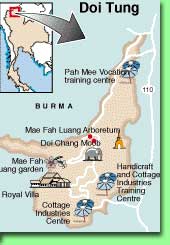 Apart
from the magnificent floral attractions at the garden and arboretum,
Doi Tung is also home to projects designed to improve the living
standard of hilltribe people, in the form of the Handicraft and
Home Industries Training Centre.
Apart
from the magnificent floral attractions at the garden and arboretum,
Doi Tung is also home to projects designed to improve the living
standard of hilltribe people, in the form of the Handicraft and
Home Industries Training Centre.


 |
A place unlike any other |
|
Harvest of delights |
|
Pride blooms at revived Doi Tung |
|
Finely crafted fun |
|
Fish, folklores and tunnels in Songkhla |