Discover
Thailand
Finely crafted fun
Watch artisans at work, or
try your own hand at crafts and cuisine
Jarunee
Taemsamran
"Fun."
"Interesting." "I enjoyed myself very much."
These are but a few of the comments recorded by participants in
the ceramic painting class at the Mae Sa Valley Craft Village.
I certainly agreed after an attempt to paint a ceramic dish of
my own. It took me almost three hours to complete.
"You
can't take it away now because it needs to be fired in the kiln
first. But don't worry, you can take it before you leave the next
day," said Uan Somchai Chalongkitskul, head of the craft
village that opened a few months ago at the resort in Mae Rim
district of Chiang Mai.
I was curious to know how my creation would look after being fired,
though I knew it would be no artistic masterpiece.
It was the first ceramic painting I'd ever tried, but I could
console myself with the fact that my "ugly duck in the garden"
was unlike anything else in the world. I was proud of it.
Ceramic painting is just one of many activities provided to visitors
at the Mae Sa Valley resort, located on the Chiang Mai-Mae Rim-Samoeng
route, a 40-minute drive from Chiang Mai International Airport.
Other pursuits include batik dyeing, parasol and fan painting,
and saa paper-making. All represent the rich traditions of the
North's highly-skilled artisans.
Normally, tourists can only shop for these products or watch artisans
at work, but at Mae Sa Craft Village, visitors are encouraged
to create their own designs and make their own souvenirs.
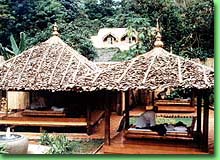
The artisans at the village live in traditional thatched-roof
wooden houses. Each hut has a different specialist in silverware,
woodenware, batik, ceramic painting and saa paper-making. New
graduates from the Technology Institute of Chiang Mai, their skills
have been well-honed.
Resort owner Chinda Charungchareonvejj said she conceived the
Thai Craft Village as a way to encourage visitors to stay longer,
as most used to stay just one night.
 "Chiang
Mai has a lot of handicraft products that are well-known among
tourists. So we saw that if we can encourage them to participate
in the making of their own products with their own imaginative
designs, it could be lots of fun, and that's how the Thai Craft
Village came to be. "Chiang
Mai has a lot of handicraft products that are well-known among
tourists. So we saw that if we can encourage them to participate
in the making of their own products with their own imaginative
designs, it could be lots of fun, and that's how the Thai Craft
Village came to be.
"This
way, visitors will not be bored, and they will have something
that they can be proud of as well."Mrs Chinda said many overseas
resorts were also offering extra activities to encourage visitors
to prolong their stay.
"We do this to respond to changing tourist behaviour. They
are more sophisticated and more demanding. Our job is to serve
their needs."In addition, her intention is also to provide
job opportunities for new graduates in each field. "This
way, they can enhance their skills in making handicraft products."A
class usually takes up to three hours for an individual piece,
though the time can be extended for an additional fee if more
painting is desired.
Guest feedback has been good since the project began, Mrs Chinda
said. Retirees with a lot of free time, especially retirees from
Japan and Europe, will be the resort's core target market.
Apart from the craft courses, the village also offers a Thai cooking
class and a health centre with a herbal steam room and Thai traditional
massage.
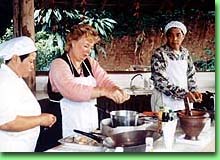
Participants in the cooking classes can learn in a fully equipped
kitchen set against a beautiful scenic backdrop. All materials,
menus and ingredients will be prepared. There are several dishes
to choose from such as som tam, pad Thai, spicy ground meat, pork
toast, spring rolls and of course, tom yam kung.
Each session will begin with a visit to the resort's farm to study
the ingredients required for each recipe such as lemongrass, pea
aubergines, holy basil and lime leaves.
The chef instructor will demonstrate each dish and then guide
the participants as they make it themselves. As the end of the
session, everyone eats what they have made. A cooking class can
cater to eight to 10 people at a time.
Even those who are not interested in cooking but want to know
more about northern agricultural traditions and techniques can
buy a package to tour the working farm.
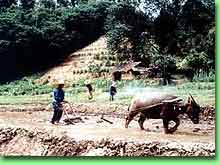
With the Farmers' Cottage at its heart, the site is a place where
visitors can learn about the rice farming using water buffaloes,
along with vegetable growing and fish farming. Guests are even
welcome to join in the ploughing, planting and harvesting if they
want.
 The
farm is far more than a tourist attraction, though. The
farm is far more than a tourist attraction, though.
"We try to follow His Majesty the King's policy of self-sufficiency,"
Mrs Chinda says.
"Our farm has proved that we can sustain ourselves. Products
from our farm are used at the resort's restaurant. And if we produce
enough additional food, we sell it too."If painting, crafts,
cooking and farm tours leave a guest a little worn out, the answer
to weary muscles or stress can be found at the resort's health
centre. There are six massage beds and four steam rooms along
with skillful masseurs.
Ms Chinda said that since travellers were becoming more health-conscious,
she planned to take a close look at developing more aspects of
the resort's health centre.
The Mae Sa Valley Resort claims to be the first mountain resort
in Thailand, having been established almost 20 years ago. Mrs
Chinda said her love of nature was the original inspiration.
The resort has steadily and adjusted over the years to meet rising
competition from the new resorts mushrooming in the same area.
"Some have closed their operations because they couldn't
shoulder the rising costs," Mrs Chinda said. "But we
have strived to maintain this resort because we love nature and
we want to live close to it."The attractive setting contains
thatched-roof wooden houses sloping downward on the hills. The
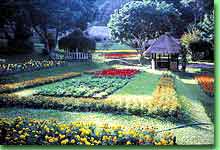
area is festooned with beautiful cold-climate flowers.
The resort has more than 30 rooms that can accommodate 80-90 visitors
at a time. In addition to the many guest activities, it also organises
lunch and khantoke dinners for visitors from outside.
With so many activities, a stay at the resort can be great fun
for families as every member will have something to do. Mother
can to learn Thai cooking, father can indulge in traditional massage
and children can enjoy themselves at the craft village. Swimming
in the pool amid the hilly background rounds out a very pleasant
day in Chiang Mai.
Travel tips
 Getting
there: Thai Airways International (628-2000) has hourly
flights to Chiang Mai every day. The Mae Sa Valley Resort is on
the Chiang Mai-Mae Rim-Samoeng route, about a 40-minute drive
from the airport. Getting
there: Thai Airways International (628-2000) has hourly
flights to Chiang Mai every day. The Mae Sa Valley Resort is on
the Chiang Mai-Mae Rim-Samoeng route, about a 40-minute drive
from the airport.
Visitors not staying at the resort can still book a package of
activities at the Craft Village. Choices include crafts, Thai
cookery school, health centre, working farm and khantoke dinner.
For information and reservations from Bangkok, call 251-1704,
656-9175-7.
Chiang Mai highlights: A good
road system makes getting around the large northern province convenient.
From the airport, you can reach Mae Rim district within a 30-minute
drive, and it is about 40 minutes to San Kamphaeng district.
Local people consider the Chiang Mai-Mae Rim-Samoeng route the
most beautiful with its unspoiled mountain views. Along the way
there are several private resorts and tourist attractions. The
shady Chiang Mai-San Kamphaeng route is famous for handmade product
factories. Some are regular attractions on packaged tours.
Other recommended places for sightseeing
include:
Doi Suthep: Phra That Doi
Suthep is as sacred to Chiang Mai as the Emerald Buddha temple
is to Bangkok. Located in Muang district, it can be reached by
shuttle bus service from nearby Chiang Mai University.
Mae Sa Elephant Camp is probably
the most popular attraction on the Mae Rim-Samoeng route. Elephant
shows are staged twice daily, at 8 and 9:40 am, and admission
is 80 baht a person. You can also make arrangements at the camp
to try elephant riding in the jungle.
Queen Sirikit Botanical Garden,
also on the Mae Rim-Samoeng route, features rare plants from around
the North. The first true botanical garden in the country, it
was founded for scientific purposes to collect, research and preserve
indigenous flora. It is open daily from 8:30 am to 5 pm, with
an entry fee of 20 baht per person and 50 baht per car.
San Kamphaeng Hot Springs
offer a natural source of hot mineral water beneficial to health.
Bathing is recommended, and traditional massage is available for
a modest fee.
(January 20, 2000)
|