|
PAZ:
Light and Salt
Rey Luis Banagudos
 In
1996, the most emotional issue that Zamboanga City, and most
of Mindanao, was facing was the creation of the Southern
Philippines for Peace and Development (SPCPD), as had been
provided for the in the newly-signed peace agreement of the
government with the Moro National Liberation Front (MNLF). In
1996, the most emotional issue that Zamboanga City, and most
of Mindanao, was facing was the creation of the Southern
Philippines for Peace and Development (SPCPD), as had been
provided for the in the newly-signed peace agreement of the
government with the Moro National Liberation Front (MNLF).
The city, along with some
others as well as 14 provinces were to form the Special Zone
of Peace and Development (SZOPAD) and would be placed under
the quasi-control of the council. Most Christian residents in
the SZOPAD equated the move to surrendering themselves to
Muslim governance and authority. Christian protests and
reactions were nearly physical and hysterical.
The situation placed the then
two-year old Peace Advocates Zamboanga (PAZ) in a real
dilemma. Like its president, Fr. Angel Calvo, most members
saw SPCPD as an opportunity for the restoration of peace in
the island. Yet it had to grapple with the overwhelming,
long-held prejudices of their fellow faithful against
Muslims. PAZ drafted a manifesto in favor of SPCPD – “to give
peace a chance” – that eventually was credited to the bishops
of Mindanao only. Fr.
Calvo himself was vilified in public for his lonely
endorsement of SPCPD.
“It was a clear test that PAZ
had to undergo, to concretize the principles upon which it was
created,” he now recalls. Like other tests of will to follow,
it required of PAZ members “ a lot of healing, reflection, and
in some way to suffer,” he said. If the organization has
weathered well all of such storms and grown into the wider
acceptance of a good segment of the local population today, it
can only be because it was founded on solid Christian values
and principles.
By 1994, Christians in Western
Mindanao were beginning to feel that their religious and lay
leaders as well as ordinary Church members have become the
particular targets of extremists and bandits. Priests were
kidnapped and released only after payment of ransom, while
Church workers were ambushed and killed and still others
kidnapped and abused. The bishops of the district comprising
of the dioceses of Zamboanga, Ipil, Basilan and Sulu (to
include Tawi-Tawi) called for a consultation on the situation.
The consultations were coached
by two prominent resource persons – Fr. Neil O’Brien, head of
Pax Christi and who had worked for many years with the
sacadas of Negros provinces, and then director of the
Gaston Z. Ortigas Peace Institute and now Peace Secretary
Teresita Quintos-Deles.
What emerged was a decision by
the Zamboanga Group to form PAZ as a “solid diocesan group for
the consolidation and inner strengthening of the Catholic
Church towards the enrichment of the Muslim-Christian
relations (and) solidarity with other non-Catholic groups in
the pursuit of peace.” The new non-government organization’s
vision statement was signed on December 10, 1994.
To Fr. Calvo, who was quickly
appointed by Archbishop Francisco Cruces as its president,
PAZ’s mission was to seek peace in the context of social
justice, though that line of action was still vague to most
members at that time. What they were conscious of then was
that its mission was in response to the Gospel’s demand and
traditional Church mandate to work for peace and justice,
especially “for the little ones.” Amid the swirl of violence
in the region, the local Church, against the all-too human
tit-for-tat inclination of many members, saw that the Gospel
response to violence was through the non-violence of justice,
healing and reconciliation. Soon after, PAZ as a new member of
the National Peace Coalition, became deeply engaged in the
more developmental work of the Social Reform Agenda (SRA).
Through it, it conducted a series of consultations with the
local basic sectors – housewives, fishermen, laborers and the
rest. Almost inadvertently, it was coming to grasp with the
dictum of Pope John Paul that “peace is about people.”
At that time, by 1996, PAZ saw the need to work closely with
Muslim partners or counterparts, and thus emerged the SALAM
Peace Foundation, with whom it signed a “historic” covenant.
For many years thereafter, SALAM was synonymous with PAZ.
Through SALAM, PAZ has been engaged in a continuing,
constructive dialogue with local Muslims. Fr. Calvo surmised
that the improved relationship between local members of the
two faiths helped soften the impact on the local
community of the 9/11 terror
and prevented a widening of any local Christian-Muslim
cleavage or so-called “clash of civilizations”, as has
occurred in many other societies.
One of the more dramatic
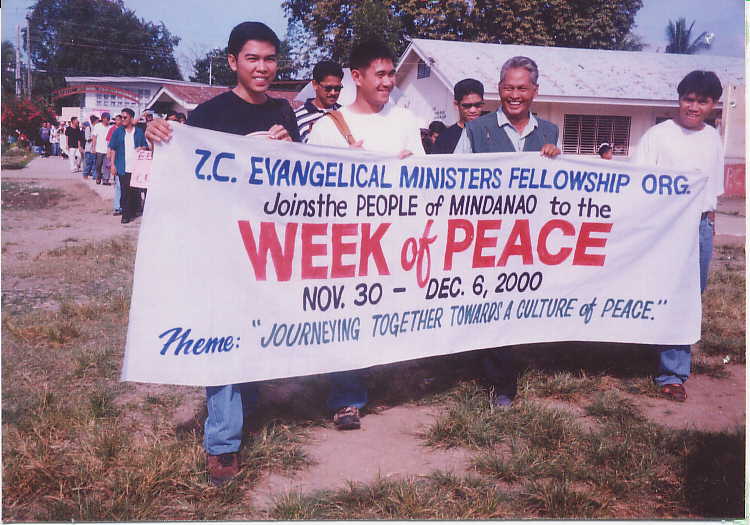
accomplishments of PAZ is the Week of Peace celebration, which
it started hand in hand with SALAM in 1997. Fr. Calvo said
the Week has created a real grassroots movement for peace –
and gave it a face – not only in the city but throughout Mindanao, after the
Bishops-Ulama Conference adopted it in 2000.
The Week, along with other PAZ
activities, have crystallized the basic advocacy principle
that peace-building is not just the responsibility of
community leaders, but one which belongs to every citizen.
Through it, people have been motivated to express their
involvement in peace-building by finding reasons and instances
to do so – as against sinking in apathy, or losing hope in the
face of massive violence. The youth especially, said Fr.
Calvo, have creatively displayed how this peace may be
rediscovered and enjoyed.
Two years ago, PAZ spun off with the creation of the
Inter-Religious Solidarity Movement for Peace, which Fr. Calvo
equates with the lighting
of little candles from the big
candle.
Among PAZ’s other regular
projects are the yearly peace camps for children and the youth
(since 1997), holding regular seminars on the Culture of Peace
and Conflict Transformation for professionals, students,
soldiers, teachers, barangay officials and others; a weekly
newsletter and radio program for peace advocacy; and
networking with other peace building organizations.
As Fr. Calvo would say it,
peace is not some romantic dreams but a parable of the
Scripture’s light and salt, something that is given by God to
people and, with a little help from them, sustains their
life. In its task as advocate and educator, Fr. Calvo sees
PAZ as their ever present light and salt, the embodiment of
agape that “enlivens justice, brings forth compassion,
forgiveness and reconciliation.”
Home -->
|