|
Hola! Zamboanga
By
Sarita Hernandes, City Tourism Officer
 Zamboanga,
the City of Flowers, Orgullo de Mindanao, is known for its
romantic, scenic and natural beauty. More than its aesthetic
value, Zamboanga is proud of its heritage and glorious past.
It has a colorful, multifaceted culture and history, which
reflects the convergence of several distinct and separate
cultural strains which have produced a unique “cosmopolitan”
nature of the city and people. Zamboanga has a land area of
1,421 square hectares, with a population of over 600,000
blessed with a warm tropical climate, situated outside the
typhoon belt and earthquake area. Zamboanga,
the City of Flowers, Orgullo de Mindanao, is known for its
romantic, scenic and natural beauty. More than its aesthetic
value, Zamboanga is proud of its heritage and glorious past.
It has a colorful, multifaceted culture and history, which
reflects the convergence of several distinct and separate
cultural strains which have produced a unique “cosmopolitan”
nature of the city and people. Zamboanga has a land area of
1,421 square hectares, with a population of over 600,000
blessed with a warm tropical climate, situated outside the
typhoon belt and earthquake area.
It
is located at the tip of Zamboanga Peninsula; surrounded by
the Sulu Sea on the west; the Moro Gulf on the east and in the
south, Basilan Strait and Celebes Sea. It is the gateway to
Southeast Asia.
At about
1380-1490, Arab missionaries and teachers arrived in Sulu and
introduced a new religion called Islam. In Mindanao it was
introduced by Sherif Kabungsuan. With Islam came a
monotheistic form of religion and a new form of government the
sultanate.
Sixty-four
years after the founding of Manila, the Spaniards in their
quest to spread Christianity sent expeditions to colonize and
evangelize the native of Mindanao. Zamboanga was chosen as
the site of the Spanish garrison because of its strategic
location. On June 23, 1635, the cornerstone was laid;
signaling the founding of the fort called “Real Fuerza de San
Jose,” and in 1719 renamed “Real Fuerza de Nuestra Señora del
Pilar de Zaragoza.” It also marked the birth of the “Pueblo
de Zamboanga” and the start of Christianization.
The Spanish
American war of 1898 saw the decline of the Spanish prestige
and power in the Philippines, likewise in the Zamboanga. On
November 16, 1899, Fort Pilar the symbol of power and
sovereignty surrendered to the Americans. Thus, ushering in a
new culture, and partly led to the Aericanization of the
Zamboangeños. The public system of education and a democratic
form of government were introduced.
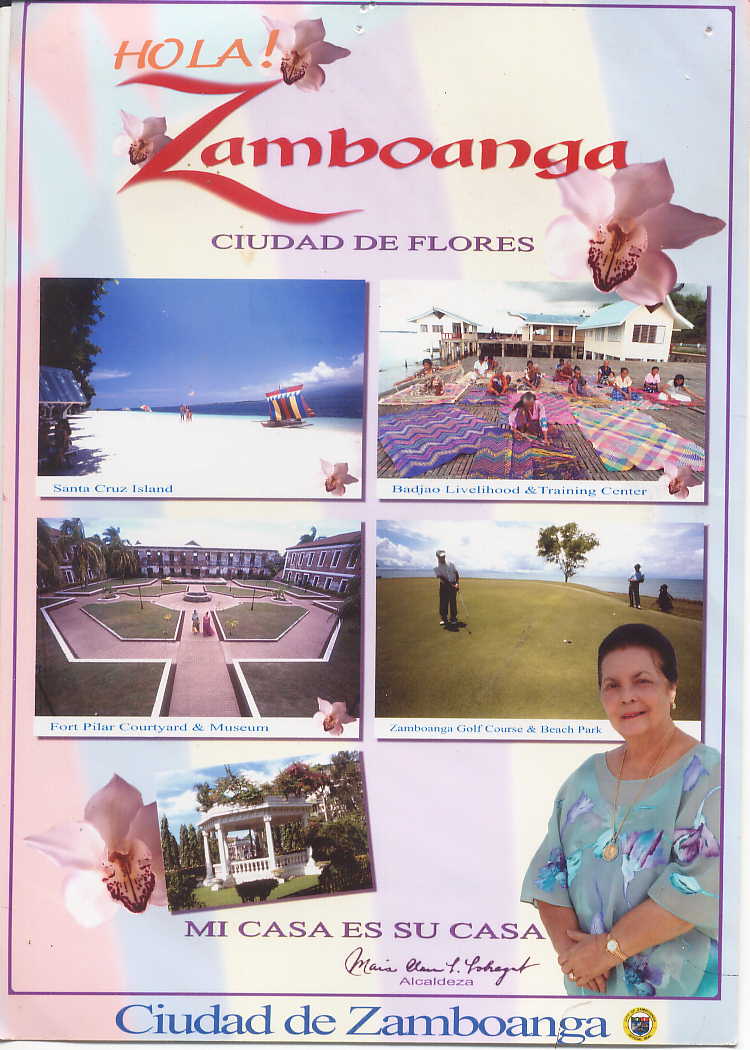
Zamboanga’s rich historical legacy and tourist attractions are
the pride of the Zamboangueños like the Fort Pilar. Built in
June 23, 1635 it is a silent witness to many battles fought by
the Spaniads against the Moros. A witness to the heroic
courage of Zamboangueños against the Spaniards for their love
of freedom. It is a home to legions of devotees who pay
tribute to the miraculous Blessed Virgin of Pilar.
The
Provincial capitol, presently the City Hall, was
constructed in 1905 under General Wood’s administration and
completed in 1907. It was designated as the seat of
government for the Moro Province, and later transfer to the
Provincial government, during World War II, the building was
occupied by the Japanese Imperial Army, until its liberation
by the U.S. Forces in 1945’
One of the
country’s premier attractions is the
Pasonanca
Park, located at the outskirt of the city, about six
kilometers from the city proper. It is referred to as the
Little Baguio of the South. The park was developed in 1912,
under Pershing administration with one swimming pool. Added
to the beautiful park is the famous Tree house built in 1960
through the initiative of the late Mayor Cesar C. Climaco.
Many tourists, foreign visitors, famous actors and actresses
were fascinated by the house on top of the Acacia Tree, and
experienced the trill of staying for a night or two for free
in a most civilized way. A trip to
Pasonanca
Park is incomplete without visiting Abong-abong Park which is
located on upper Pasonanca with a panoramic view of the city.
Going up the hills one can see the fourteen Stations of the
Cross. Today, it is the most popular site to spend the Lenten
Season.
Sta. Cruz
Island is known for its pinkish sand beach, with an extensive
and varied underwater life coral, rocks and colorful tropical
fish. The beach is ideal for swimming, scuba diving,
snorkeling, and sunbathing.
Zamboanga has always occupied a prominent
position as the political and cultural seat of government from
the Spaniards and American era, up to the present. Today,
Zamboanga City is a Cosmopolitan City, progressive with sound
finances. Visitors and tourists can enjoy all the comforts
and conveniences of a modern city efficient airport, good
shipping port, modern communication facilities, first class
hotels, land, air and sea transportation and banking
institutions. For the comfort and convenience of our visitors
and tourists, the city has facilities that will make you feel
at home away from home, and your stay memorable and
meaningful. Come and experience Zamboanga!
Home -->
|