|
A tale
of talaba
(or
the Kabasalan convergence success story)
by Joy Magdayao
Kabasalan’s talaba is about to
enter the Guinness Book of World Records.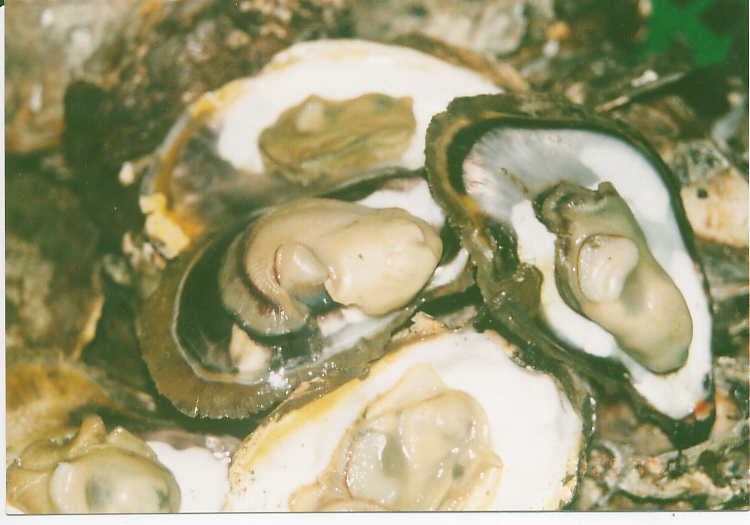
Early last year, the provincial
government of Sibugay sponsored the longest talaba
grille. Up the hill of the capitol site on a warm evening,
Sibugaynons enthusiastically baked over red hot coals about a
kilometer of talaba. On hand were media men and tourism
officials to authenticate the event.
Sourced from the town of
Kabasalan, Zamboanga Sibugay, the oyster is a succulent blend
of slighty salty and sweet meat, a delicious and distinctive
flavor found only on the coast fed by the winding Sibuguey
River.
There are four kinds of talaba,
but it is the “kukong kabayo” or oblong shaped (scientific
name saccosrea malabonensis) that grows best in Kabasalan.
Protected by hardy shells, kukong kabayo is now marketed by
local fisherfolks at P10 per kilo, bringing an additional
daily income of P200 to P300 pesos for about a hundred
families in Barangay Concepcion.
This bivalve, grown in brackish
water, means more than just added livelihood to a community.
For the people of Concepcion, Kabasalan, it is sweet reward
after a long struggle to find an income source that would at
the same time protect and preserve an environment already
stripped of its natural resources.
It is the story of how a people, a local government unit, and
a non-government organization shared resources to culture not
only an oyster but a synergistic relationship, with the aim of
marketing a brand name exotic delicacy – the Kabasalan talaba
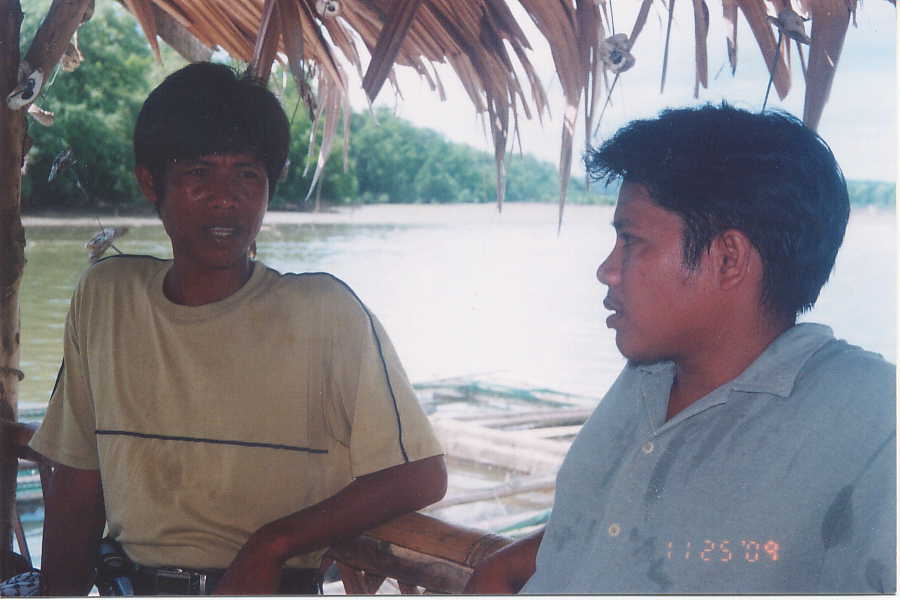
Roberto Ballon is more forward
looking than others.
While his neighbors in the
watery coast of Kabasalan town harvested whatever was offered
by the brackish water like there was no tomorrow, Bert’s
immediate concern was the preservation of his source of
livelihood. “I saw that our resources were dwindling.
There were lesser fish, lesser shells,” he says in the
Visayan dialect.
 When he was yet to be introduced to the concept of sustainable
development and other big words in the NGO lingo, Bert
organized Kahugpungan sa Gagmayng
Mangingisda sa Concepcion (KGMC).
The people’s organization attracted an initial 36 members in
1986. Their main objective was to preserve the resources left
and to spread the alarm over depleted marine life among
fisherfolks to adjacent coastal towns. When he was yet to be introduced to the concept of sustainable
development and other big words in the NGO lingo, Bert
organized Kahugpungan sa Gagmayng
Mangingisda sa Concepcion (KGMC).
The people’s organization attracted an initial 36 members in
1986. Their main objective was to preserve the resources left
and to spread the alarm over depleted marine life among
fisherfolks to adjacent coastal towns.
KGMC embarked on mangrove reforestation, but the effort soon petered
out. Their number went down to 18 in 1999. Between the eleven
years that KGMC struggled to survive, Bert became convinced
that there was something very important if he wanted to stay
in the business for the long haul. “We must protect the
coast first, then develop available resources. Business must
come last if we want to earn more,” he said, realistically
assessing an ironic situation.
He did just that. In the next
three years, he eschewed get-rich-quick methods that destroyed
environment and contented himself with shell gathering, and
fishing using either net, hook and line, or cages.
In 2001, Western Mindanao
Community Initiatives Project (WMCIP), a national program
funded by the International Fund for Agricultural Development,
entered Concepcion. The barangay qualified in the program
precisely because of Ballon’s KGMC.
“We often work with existing
organizations,” says Felix Badon, community organizer of
Xavier Agriculture Extension Service, the NGO commissioned by
WMCIP for the work in Concepcion.
XAES started by strengthening
the organization, providing capability building trainings.
The net result was a jump in membership, from a forlorn 18 to
a vigorous 120 members, many of them returnees. The number
enabled them to push for the creation of a Barangay
Development Council in Concepcion, giving them the opportunity
not only to chart their roadmap to progress, but also the
power to access local funds.
The local government of
Kabasalan fully supported Concepcion’s efforts. In 2001, the
LGU appropriated half a million for Coastal Resource
Management, with the barangay being one of its recipients.
The town officials also established a marine protected area.
Within this 10 hectares of absolutely no fishing activity,
marine life is allowed to flourish and proliferate.
Last year P300,000 was given to
Concepcion as support fund for their talaba livelihood
program. Quedancor also entered the picture offering a loan
of half a million for close to 40 recipients. Another P200,00
was appropriated by the LGU to give teeth to their marine
protection ordinance through its Bantay Dagat program.
Technology
 Fertilization of spawned oyster
eggs takes place in the water in the months of January to
February, and May to September. After hatching, a plankonic
larva emerges and remains in the waters for two to three weeks
before settling down. Called spats, these baby oysters are
about the size of a grain of sand. They attach themselves to
logs, stones, shells, or others. After a growth of period of
one month, the juvenile oysters measure about 1.27 cm long.
They normally mature after 6-10 months from seeding. Fertilization of spawned oyster
eggs takes place in the water in the months of January to
February, and May to September. After hatching, a plankonic
larva emerges and remains in the waters for two to three weeks
before settling down. Called spats, these baby oysters are
about the size of a grain of sand. They attach themselves to
logs, stones, shells, or others. After a growth of period of
one month, the juvenile oysters measure about 1.27 cm long.
They normally mature after 6-10 months from seeding.
Oysters are usually planted
using any of these three methods: (1) hanging (spats are hung
on strings tied to bamboo poles); (2) staking; and (3)
broadcasting (spats are thrown, in the same way rice seeds are
thrown). All three do not work on Sibugay’s coast.
From his long struggle with
sea farming, Ballon discovered that the best way to do the job
was to simply plant the oyster in the mud. Ballon also
discovered that when he did this, the maturation period is
shortened. After only six months, the oyster is ready for
harvest, having grown 4-6 inches. The resulting talaba meat is
white, not at all muddy looking.
Oyster food consists of
microorganisms, plankton and organic matter which they strain
or filter out of the water from their gills. So they also act
as cleansing agents for Concepcion’s coast.
Recognition
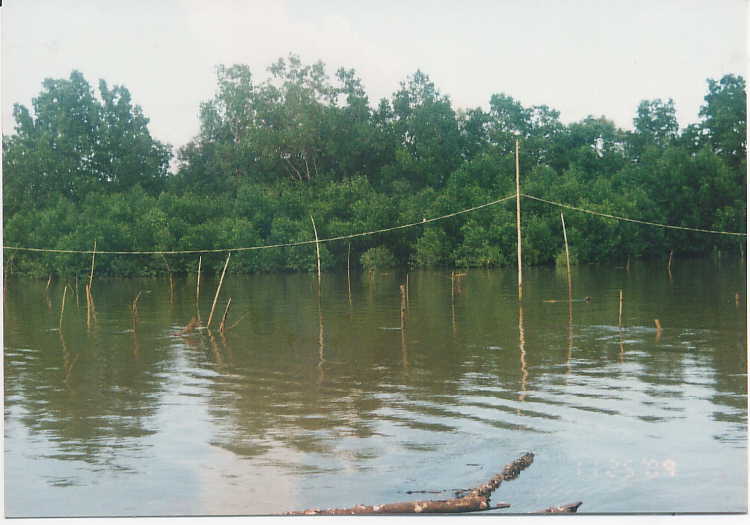 The actual talaba production area can be reached from the town
hall by a tricycle ride into Concepcion, a short walk into the
river entrance, and another short banca ride to four floating
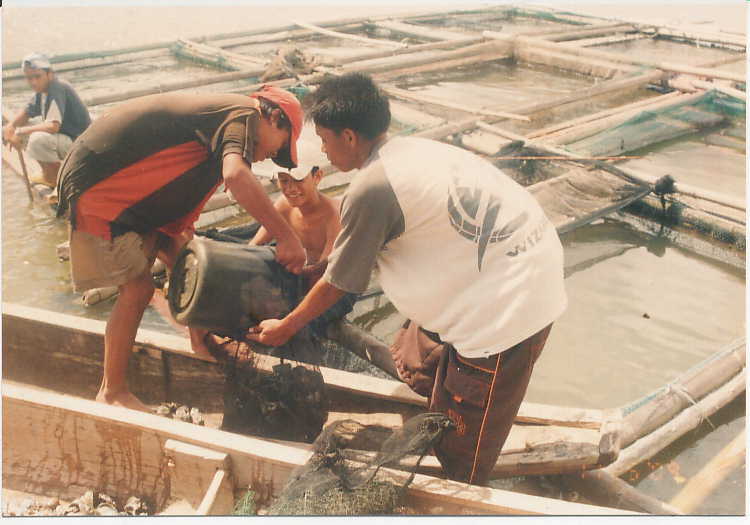
structures in the coast. The bigger
one serves as “market place.”
Here, harvested talaba is sorted, weighed and recorded. The actual talaba production area can be reached from the town
hall by a tricycle ride into Concepcion, a short walk into the
river entrance, and another short banca ride to four floating
structures in the coast. The bigger
one serves as “market place.”
Here, harvested talaba is sorted, weighed and recorded.
The association discourages too
early harvesting of smaller meat, with the intention of
keeping a fine reputation in the markets they have already
opened in Zamboanga City, Cagayan de Oro, and Cebu.
“Our members sell only to
the association,” says Ballon. “This will insure both
quality and price control of our product.” It also
insures a profit for the association, which is plowed back
into marketing. In addition, the system allows the
association officials to monitor payment of loans by members.
Ballon’s leadership
has propelled the group to recognition. In 2002, KGMC was
recognized as most outstanding fisherfolk association in the
provincial level. A year later, the group clinched the same
award from regional heads.
While acknowledging that many
hands have helped to put Kabasalan’s talaba out in the market,
Ballon still believes in the principle of self-help when it
comes to creating a better life for one’s self and family.
“Ang kinahanglan kaugalingong
kugi para molambo,” says Bert Ballon, as he welcomes in his
floating raft young boys delivering the harvest of the day.
For them, Ballon sees a brighter future. “Maski dili dako,
pero makadugang na para sa panginahanglan sa pamilya.”
(The income may not really be that big but it can help meet
the needs of the family.)
After the boys’
talaba haul were recorded by Ballon, they silently paddle
away. For them, the day’s meal at least has been secured.
Thanks to the oysters that silently flourish beneath the
greenish waters of Kabasalan.
Home -->
|