Comparison
of Kate Chopins Stories
With
Outside Sources
Women
from Louisiana’s pre-civil war Creole and Cajun
societies were of a special ilk. On the outside, many
were confined by the color of their skin or their social
class. They were thought to be simplistic; however, author
Kate Chopin reveals otherwise. Women of the South were
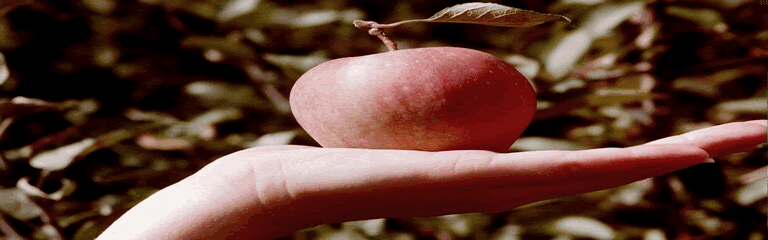
not delicate flowers; they were much more. In Chopin’s
short stories “The Storm” and “Story
of an Hour,” she illustrates the common thread that
runs between married women in the South, their married
lives, and their lust for more.
In
Chopin’s stories there are strong sociological differences
between women of color and white women. Differences are
the reason that Calixta could not originally marry Alcee.
She is a woman of “color” and in an excerpt
from “The Storm” her style of speaking indicates
that she is of a lower class “’It this keeps
up, Dieu sait if the leaves goin’ to stand it’”
(859). Alcee Laballière is more refined, which
is reflected in his gentler way of speaking, “‘May
I come wait on your gallery till the storm is over, Calixta?’”
(858). Asking to come in would be considered presumptuous
and even rude. His traits draw the line between the two
classes even more clearly. Mrs. Mallard, despite her higher
class and heart condition, is similar to Calixta in how
she takes advantage of life when it allows. In “Overview”
Mrs. Mallard is described “as a young woman whose
wrinkles portray ‘repression’ and ‘strength’”
(1). Mrs. Mallard is most defiantly strong. She takes
the news of her husband’ death with grace but would
not have submitted to her lust as Calixta did.
Often,
women do not marry for love. They marry for other securities.
In “The Storm,” Bobinôt has provided
Calixta with a comfortable home. Chopin sets the scene
“There they were in the dinning room — the
sitting room — the general utility room. Adjoining
was her bed room, with Bibi’s couch along side her
own. The door stood open, and the room with its white
monumental bed, its closed shutters, looked dim and mysterious”
(The Storm 859). It is obvious that Bobinôt cares
for her because after the storm he offers a gift out of
kindness, “’ I bought you some shrimps Calixta,’”
(861). It is clear that Calixta is not married for shrimp,
but for the securities that a husband brings. A woman
in the 1800’s would, frequently, go directly from
her father’s home to her husband’s. Often,
the marriage is arranged for some sort of profit. The
young woman has little choice as to marrying or not. This
makes love an after thought. Louise in “Story of
An Hour” reflects that she loved her husband —sometimes
but with the new presences of self assertion little else
mattered (863). Jennifer Hicks, published by Gale Research,
explains that “marriage was considered a sacred
institution” and “divorce was quite rare in
the 1800’s”. “If [a divorce were] to
occur, men were automatically given legal control of all
property and children” (1). This made Louise’s
new self assertion even sweeter. Often, after the marriage
has taken place, then love grows. In “Story of an
Hour,” “[Louise] knew that she would weep
again when she saw the kind, tender hands folded in death;
the face that had never looked save with love upon her,
fixed and gray and dead” (863). Louise’s husband
treated her well, and she would weep for his death, but
it is clear that she did not love him with the affection
thought mandatory in a marriage today. Chopin gives the
reader more insight into Calixta’s marriage with
the homecoming of Bobinôt. “Calixta felt him
to see if he were dry, and seemed to express nothing but
satisfaction at their safe return” (The Storm 861).
Calixta also reflected the gentle love one had for a man
that she had married for security.
The
women portrayed in Chopin’s stories have a strong
desire for more. Women wanted independence from the men
that ruled their lives. Hicks reveals that some of Chopin’s
stories were rejected for publication on moral grounds.
Editors perceived in them an unseemly interest in female
self-assertion and sexual liberation (1). “Story
of an Hour” and “The Storm” are ripe
with female self assertion. In “Story of an Hour,”
Mrs. Mallard’s thoughts race through her, “There
would be no one to live for her during those coming years:
she would live for her self. There would be no powerful
will bending hers in that blind persistence with which
men and women believe they have a right to impose private
will upon a fellow creature” (863). Mrs. Mallard’s
thoughts progress further: “’Free! Body and
soul free!’ [Louise] kept whispering” (863).
While Mrs. Mallard’s position is clearly expressed
in the text, Calixta expresses her feelings of freedom
from her desires with laughter, “He turned and smiled
at her with a beaming face; and she lifted her pretty
chin in the air and laughed aloud” (The Storm 860).
Other women want a love that they can not obtain. The
man Calixta wants is taken, and she as well. In the short
story, “At the ‘Cadian Ball” Chopin
describes Calixta the night Alcee decided to marry Clarisse,
“Calixta [is] like a myth now. The one, only great
reality in the world [is] Clarisse standing before him,
telling him that she loved him” (5). The storm brings
old feelings of Alcee’s back to the surface; but
when Alcee Laballière wrote to his wife, Clarisse,
that night the letter was full of tender solitude (The
Storm 861). Unfortunately, he revealed to the readers
that he cared not for his wife’s pleasure, but the
time to perhaps visit Calixta again. In Clarisse’s
response, though devoted to him as she was, their conjugal
life was something that she was more than willing to forge
for a while, so that she may restore the pleasant liberty
of her maiden days (861). What Calixta and Alcee had between
them was a lust that they did not have with their own
partners. Although both husbands love their wives, the
women desire more.
Despite
the social differences in Kate Chopin’s characters,
the women shared the same desires. Chopin’s themes,
controversial for their time, are universal. Times have
changed and women are still faced with similar circumstances
to those in her stories. While women are not viewed as
delicate flowers any more, the lust for love and life
remain strong.
Works
Sited
“Overview:
‘The Story of an Hour’.”
Short Stories for Students, Gale Research (1997): Literature
Research Center—Author Resource Page. Houston Community
College Library, Alief, TX. 10 October 2004.
http://0-galenet.galegroup.com/librus.hccs.edu
.
Chopin,
Kate “The Storm.” Making Literature Matter:
An Anthology for Readers and Writers. Ed. John Schilb
and John Clifford. 2nd. Ed. Bedford/St. Martin’s.
858 – 861.
- - - “Story of An Hour.” Making Literature
Matter: An Anthology for Readers and Writers. Ed. John
Schilb and John Clifford. 2nd. Ed. Bedford/St. Martin’s.
862 – 863.
-
- - “At the ‘Cadian Ball.”
About. 10 October 2004
http://classiclit.about.com/library/bl-etexts/kchopin/bl-kchop-atthecad.htm
.
Hicks,
Jennifer. “An Overview of ‘The Story of an
Hour’.”
Short Stories for Students, Gale Research (1997): Literature
Research Center.
Houston Community College Library, Alief, TX. 10 October
2004.
http://0-galenet.galegroup.com/librus.hccs.edu
.