John
Whitman “Covered”
John Whitman is a talented local ceramic artist and founder
of Twin Pines Pottery, which he established in1988. He
became a member of the Houston Potters Guild in 1998 and
has been shown at Waugh Gallery, Houston Center for Contemporary
Craft, Lawndale Art Center, and recently at The Water’s
Edge Studio and Gallery in Galveston Texas, during the
“ArtWalk” produced by Galveston Arts Center.
His work was most currently shown at the Houston Potters
Guild as the featured artist in a show entitled “Covered”.
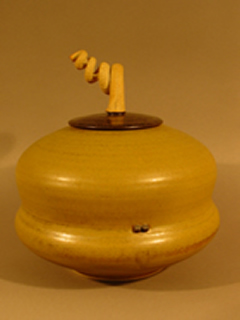 His
pieces are simple, but have a distinct style. They range
from pots to vase like shapes and all have lids of some
sort. The vessels have a sturdy appearance yet smooth
look to them. Many of his round pots have a unique dimpled
shape that gives the illusion that the pot is fashioned
from two separate pieces. The smooth looking forest green
glazes render soft curves giving each piece an organic
feminine feel. This organic look is further expressed
in the hand built handles on the vessels. The handles
range from round triangular shapes with circular centers
to a flat spiral look. The triangular shapes give the
impression of being hardy stems like that of a pumpkin
and the more whimsical spiral shape is reminiscent of
a vine. Both figures give the round curvy pieces the distinct
appearance of a gourd. The top rims of the bowls without
lids were darker color in a brown and black glaze. The
insides of both the lidded and un-lidded round stockier
vessels were a dark matt black.
His
pieces are simple, but have a distinct style. They range
from pots to vase like shapes and all have lids of some
sort. The vessels have a sturdy appearance yet smooth
look to them. Many of his round pots have a unique dimpled
shape that gives the illusion that the pot is fashioned
from two separate pieces. The smooth looking forest green
glazes render soft curves giving each piece an organic
feminine feel. This organic look is further expressed
in the hand built handles on the vessels. The handles
range from round triangular shapes with circular centers
to a flat spiral look. The triangular shapes give the
impression of being hardy stems like that of a pumpkin
and the more whimsical spiral shape is reminiscent of
a vine. Both figures give the round curvy pieces the distinct
appearance of a gourd. The top rims of the bowls without
lids were darker color in a brown and black glaze. The
insides of both the lidded and un-lidded round stockier
vessels were a dark matt black.
Other round containers by Mr. Whitman had soft ripples
that enveloped the bulbous area of the pot. These ripples
had a soft zigzag shape and most were glazed with a tan
color that had areas of red in it. Despite the zigzag’s,
the figure contained a silky appearance, as if the texture
was done when the piece was still very wet.
The
taller vessels have a more utilitarian feel. The lids
do not have handles and are firmly secured by twine. The
twine is tightly held to the piece by notches made on
either sides of the lid and vessel body. A few are not
completely covered in glaze. One piece was waxed partially
so that the glaze gave a dripping look as if it were poured
over the piece without completely covering it. This particular
piece had a rich maroon like glaze that gave the appearance
of thick blood or an elixir that had happened to fall
over the piece. The leftover exposed clay body gave a
rough natural experience. In addition to the twine a few
of the pieces are adorned with ornamental handles and
round dotes of clay.
The layout of the show space was appropriate. Due to the
fact that Mr. Whitman’s work was the main exhibit,
it was suitable that his pieces be displayed in the center
of the guild. The work that was displayed on his shelf
was obviously not part of his exhibit “Covered”
(because most did not have lids) but was enjoyable to
see. His daily use pieces such as his mugs, had a more
masculine look-complete with large, sturdy, handles, and
rich use of color for glazes. One vase on his shelf was
a large cylinder where he had taken one of his fingers
and fashioned it into a squarer piece. I thought this
was so interesting because it looked as if he chose to
leave his finger markings, giving the vase more contour
and curvature.
I enjoyed the exhibit. At first glance the pieces looked
exceptionally plain but when taken into perspective what
we have learned in class, Mr. Whitman’s shapes take
on a more delicate and dynamic feel. His pieces may give
the allusion of simplicity due to the soft lines and the
curvature, but upon further examination are very complex.