| D�Arena Giuseppe [c. 1643-1719]
There are still doubts to whether D�Arena was Maltese or Italian but he is documented to have lived in Malta from a very early age. His art is definitely Maltese. He was the son of Matteo and Appolonia (ref: Porto Salvo archives). He appeared to have studied under Mattia Preti and he managed to acquire his technique and style. He was known as Il Romano, perhaps because he spent a long time in Rome. In 1666 he married Olympia, daughter of the well-known painter Silvestro Querio and had three sons. Olympia died in 1681 and he remarried in 1685 to Theresa Mancini. He lived for some time in Zekka Street, Valletta, opposite the Carmelite Church. He died on the 7th of July 1719 after a long illness, which left him blind. He was buried in the Valletta Carmelite Church. Works: [Malta] Cospicua. Lija. Luqa. Marsaxlokk. Imdina. Mqabba. Naxxar. Qrendi. Rabat. St.Julians. Siggiewi. Valletta. Vittoriosa. Haz-Zabbar. Zejtun. [Gozo] Nadur. Victoria. |
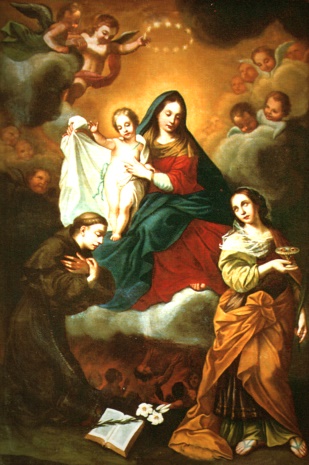
| Modonna of Graces with St.Anthony and St. Lucy (1704) Cospicua Parish Church Cospicua |
 |
| De Domenico Francesco [active 16 century]
Francesco was the brother of Sour Maria De Domenico about whom we know little. Only that he studied art under Mattia Preti. Works: [Gozo] Nadur. Zebbug. |
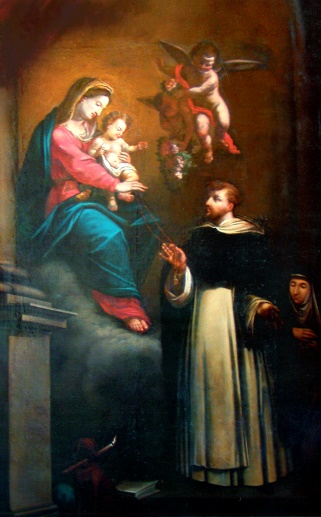
| Madonna of the Rosary (1711) Nadur Parish Church Nadur- Gozo |
 |
| De Domenico Suor Maria [1650-1708]
Born in 1650, daughter of Onofrio and Giovanna, a rich Neapolitan family who had settled in Malta. When she grew up she joined the Carmelite Theresian Order. Her parents were friends of Mattia Preti and she started her artistic career studying under this famous artist guidance. . She even helped him paint the female figures in the Cathedral of St. John in Valletta and did several pieces, on her own in other churches. She had an ambition to go to Italy, and when Don Carlo from Rosella was in Malta in 1682 he persuaded her to go with him and his wife to Rome to further her studies. She studied under Maratta in the Accademia di San Luca where she also did some sculptures. She died in Malta and was buried in the Chapel of St. Catherine at St. Lawrence church, Vittoriosa. Works: [Malta] Attard. Cospicua. Qrendi. Valletta. Haz-Zebbug. Zurrieq. [Gozo] Marsalforn |
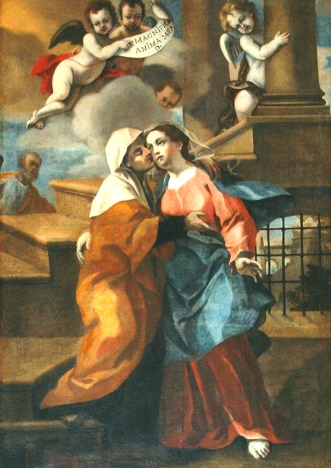
| The Visitation Haz-Zebbug Parish Church (Sacristy) Haz-Zebbug |
 |
| Dingli Filippo [active first half 17th century]
This talented artist was ahead of his time and carried convincingly the Mannerist influences well into the 17th century. . Dingli was possibly the key to the development of Maltese art in the 17th century but his artistic personality needs further research to be understood properly. His influence certainly left a mark on Stefano Erardi. Works: [Malta] Gharghur. Lija. Luqa. Mosta. Naxxar. Haz-Zebbug. |
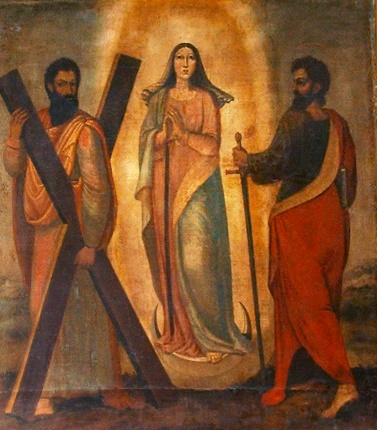
| Saints Andrew and Paul Luqa Parish Church (Sacristy) Luqa |
 |
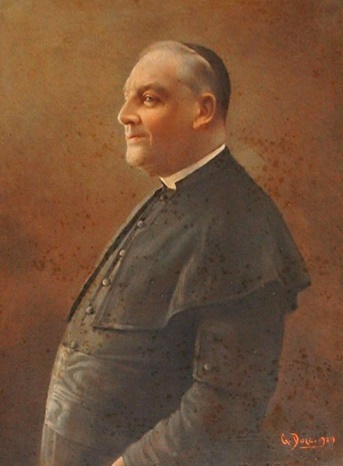
| Duca Guzeppi [1871-1948]
A painter and also a classical singer. He was born in Qormi on the 21st of January 1871. Between 1885 and 1889 he studied design under Giuseppe Calleja. He eventually taught art in Cospicua in 1890 and later at the Lyceum where he taught until he retired in 1925. A good portrait painter of many famous Maltese and foreign personalities. He was commissioned to paint a series of portraits of the English Civil Commissioners and Governors and most of them can still be admired at the Presidential Palace in Valletta. He did also work in churches. He was also a locally famous baritone and his voice was very appreciated during church concerts. In 1915 he married Marianna Agius. He died in San Pawl il-Bahar on the 24th of October 1948. Works: [Malta] Gharghur. Gzira. Hamrun. Qormi. Paola. Siggiewi. Valletta. . |
| Parish Priest G. Muscat (1929) Hamrun Parish Church Hamrun |
 |
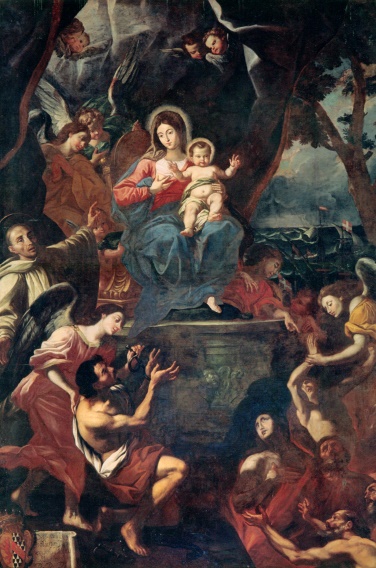
| Erardi Alessio [1669-1727]
Son of Stefano Erardi. Born on the 5th of December 1669 and christened Giuseppe. Although his work is rather stiff he appears to have understood the principles of the Neapolitan artistic trends of the 17th century. He was much better than his father and for some time many of his works were attributed to the former. He is mentioned in his father�s wills and in other public documents. Like his father he had commercial investments. It seems that his wife was a very wealthy woman. Anna Fumucelli, whom he married on The 7th of August 1712, was of a much higher class than him. He fathered three boys and lived in Valletta in a big house in Saint Ursula Street, opposite the Monastery of the Franciscan Minors. He died on the 22nd of March 1727 and was possibly buried in the family grave in the Carmelite Church, Valletta. Works: [Malta] Cospicua. Lija. Mdina. Mellieha. Mosta. Valletta. Vittoriosa. Haz-Zabbar. [Gozo] Victoria. |
| Modonna of Graces (1715) Haz-Zabbar Parish Church Haz-Zabbar |
 |
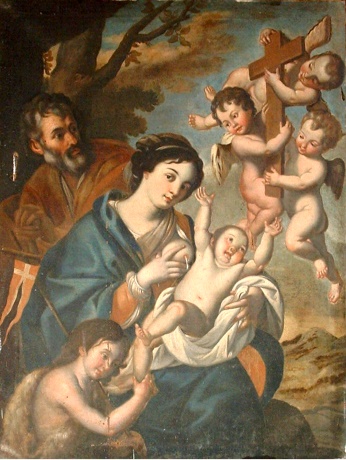
| Erardi Stefano [1630-1716]
Born in Valletta in 1630, son of Sebastiano Erardi and Paulica Xerri who were married in the church of Saint Paul�s Shipwreck, Valletta on the 25th of January 1629. They had four children. Stefano was born to a rich family originating from France. He began his artistic career as a mannerist when this style had already became redundant. Probably spent some time in Italy and although he tried to imitate Mattia Preti he never came very close. On the 4th of February he married Katrina Buttigieg who died young on the 17th of December 1676. Stefano remarried, this time to Angelica Caruana, the widow of Raffaele Paolucci who had left her very well off. He died on the 6th of June 1716 and was buried in the Church of the Franciscan Minors (Ta� Giezu), in Valletta. In his will, he left his painting tools and some finished canvases to his son Alessio. Works: [Malta] Birkirkara. Floriana. Kirkop. Imsida. Mdina. Mellieha. Mosta. Naxxar. Qormi. Qrendi. Rabat. Safi. Senglea. Valletta. Vittoriosa. Haz-Zabbar. Haz-Zebbug. Zurrieq. [Gozo] Victoria. Sannat. Commino |
| Modonna of Graces Zabbar Sanctuary Museum Haz-Zabbar |
 |
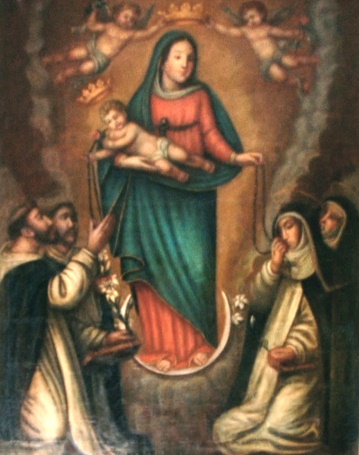
| Failla Valerio [1604-1653]
The Failla family originated from Cospicua and continued in Senglea and Valletta. Among the artists that came out of it we find Salvatore (b.1509), Valerio, Giovanni Domenico [1613-c.1670] who is primarily known as an ex-voto painter, [ref: Curia Episcopalis Melitensis. Mdina Cathedral Museum AO.560 1670 ff. 205-220: come si puo vedere in un quadro fra l-altri, posto per voto nella chiesa Parrochaile di Cas. Zabbar ] we also find Nicolo [b.1625] and Giovanni Maria [b1636]. Valerio is the better known and his work is still being identified. Works: Luqa. |
| Modonna of the Rosary Luqa Parish Church Luqa |
 |
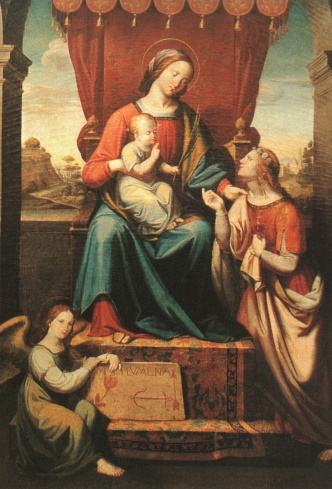
| Falzon Antonio [1805-1865]
Born in Floriana and studied under Giuseppe Hyzler in Malta and Tommaso Minardi in Rome. Very self opinionated, he bragged with the Mdina Cathedral Chapter that he often corresponded with Overbech and Minardi and that they even had some of his pictures that they really treasured. Nevertheless his work is very good and exiting. Works: [Malta] Attard. Birzebbuga. Floriana. Gudja. Kalkara. Imsida. Luqa. Mellieha. Qormi. Rabat. St.Julians. Valletta. Wardija. Haz-Zabbar. Zejtun. [Gozo] Victoria. Xaghra. Xewkija. |
| Saint Philomena Floriana Parish Church Floriana |
 |
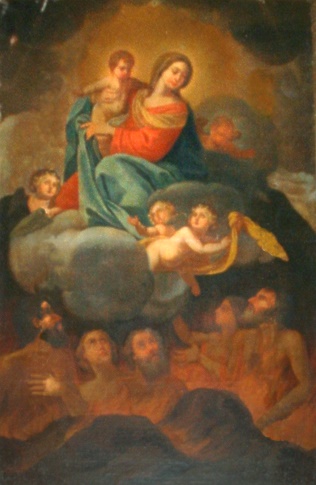
| Farrugia Demitrius [active mid 18th century]
What we know about this artist is what has been written by Padre Pelagio who mentioned that Demitrius worked wIth Mattia Preti. The elements proving that Farrugia studied under Preti are not evident because his work is commercial and his colours are more vivid and free than what we are used to in baroque art of the Maltese seicento. He was probably influenced more by Alessio Erardi and other painters of the post Preti era, that is, after 1710. Works: [Gozo] Nadur. |
| Madonna of Charity Nadur Parish Church Nadur |
 |
 |
 |
|
| Dar-Far |
| D.E.F |