


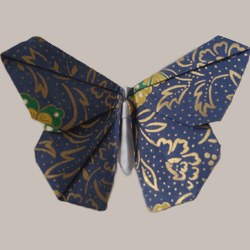
Origami is an art form that involves folding paper into intricate patterns. For me, origami is a meditation. The patience and attention to detail that it takes to fold an origami figure calms my mind. It is both simple and complex, and one of the most elegent art forms there is. Below, you'll find a brief history of origami, as well as some origami figures that I've folded.
The History of Origami
The craft of paper making, which was introduced into Japan from China during the early seventh century, underwent considerable changes in its manufacturing process in Japan giving rise to a type of paper possessing dual qualities of resilient sturdiness and softness which prevents tearing when it is handled. Washi, a unique and distinct type of Japanese paper, kindled many forms of cultural creativity - among them, origami.
Unfortunately, it is not clear when origami in Japan first originated. It is known that both letters and paper used to wrap items were folded. A regulated lifestyle came with the advent of samurai society, which then gave rise to the art of paper folding for practical and formal purposes. However, from the onset of the Showa period (1926-1989), the art has rapidly passed into oblivion. A vestige of its former use can still be seen in the noshi, a decoration of folded red and white paper attached to a gift.
Origami which assumes concrete shapes such as a crane or boat is regarded as origami for pure enjoyment. But these figures were probably once made for the purpose of bearing the illnesses and misfortunes that befell a person.
Japan's origami was greatly influenced by Friedrich Wilhelm August Fröbel (1782-1852), a mid-nineteenth century German educator whose method of teaching was derived from European traditional origami. This further developed the Japanese folding to make various geometrical shapes, and was widely adopted particularly in the Japanese kindergartens.
During the Meiji period alone, there were many new origami creations conceived by numerous unknown inventors. Because origami required following precise directions, it was not well received during the Taishou period (1912-1926), a time when educators placed importance on originality and creativity. Origami was deemed as lacking in these qualities. However, braced by a long history, origami once again regained its popularity.
Not only are there now many imaginative and novel origami creations, but its educational value and immense potential for creativity have been also reconsidered and recognized. Origami has gained a widespread following as a hobby among adults. There are now many origami associations that have been formed by origami enthusiasts.
The technique of paper making was introduced into Europe in the twelfth century, producing a distinct form of origami. However, origami was not taken up by a large number of people as it was in Japan.
They began to be made sometime around the beginning of the Edo period (1600-1868) which coincided with an age in which mass-produced, low-priced paper came to be widely used among the people of Japan.
During the Genroku era (1688-1704), origami of the crane and several varieties of boats used as designs on clothing became fashionable, and they were also reproduced with great frequency in Ukiyoe prints. Origami came to have a wide following during this period.
About a hundred years later, books and printed matter devoted exclusively to origami were published, creating a diverse and advanced form of origami. Origami gradually became a respected art form. Many of the figures were difficult to make and incorporated many complicated steps.
During the Meiji period (1868-1912), origami was used as a teaching tool at the kindergarten and elementary school levels.