
In Chinese Folklore of Wong Tai Sin :
There were 2 legends.
(1) At the end of Qing Dynasty, the 23rd year of the reign of Emperor Kuang Hsu ( about 1897 ), a group of students always tried to spend their spare time by playing Taoist divination called
" Fu Ji "
.
Contacting a fairy through the supernatural process of " Fu Ji ",
the students not only asked for some things about chores but the would-be questions in the coming mandarinate examinations.
Once they were playing " Fu Ji ", the Fairy, Wong Tai Sin
taught them the principle of " Benevolence and Beneficence " via this process of " Fu Ji ".
Then they believed in Wong Tai Sin and became the disciples of Wong Tai Sin.
(2) At the end of Qing Dynasty, people who lived in China were very poor.
When they got ill, they could not afford to see a doctor. Therefore they tried to get some prescriptions of herbs from a Fairy via the supernatural process of " Fu Ji ".
It was said the prescriptions of herbs obtained by this method were very useful and effective for illnesses.
Even some of rich people, when they got ill, they preferred to consult " Fu Ji " rather than a doctor.
Once some patients asked for prescriptions of herbs via this process of " Fu Ji ", the Fairy, Wong Tai Sin inscribed prescriptions to them.
After taking the herbs, they recovered from their illnesses. Gradually, a lot of people believed in Wong Tai Sin.
The mutual similarity of the 2 legends was that the deeds of Wong Tai Sin appeared via the process of " Fu Ji " at the end of Qing Dynasty so people living in China started to worship Wong Tai Sin.
Gone through Hardships on Arrival of Wong Tai Sin:
In 1901, the temple, Pu Hing Tan, which was dedicated to Wong Tai Sin, was built at Rengang Village in Xiqiao Mountain located at Nanhai City, Guangdong Province. The Taoist priest,
Liang Renan
who took charge of the temple, received Wong Tai Sin's divine guidance via the process of " Fu Ji ". He was advised that the temple could not be maintained there and must be removed towards the south. Thus
in 1915, during the ninth lunar month, Taoist priest, Liang Renan and his son,
Liang Junzhuan
brought a portrait of the Taoist Fairy, Wong Tai Sin from Guangdong Province to Hong Kong.
On arrival, they set up a small shrine to worship Wong Tai Sin in Wan Chai district. Then the shrine had to be removed twice around the district in six months. Eventually the shrine was set up at the back portion of their herbal shop. Unluckily, in 1918, during the eleventh lunar month, the shrine was destroyed by fire. Taoist priest, Liang Renan felt disappointed and returned to his village to look after Pu Hing Tan again. However he was strongly requested by some Taoist members of Pu Hing Tan,
the people trading in Hong Kong. Taoist priest, Liang Renan came back to Hong Kong and set up another small shrine called " Jinhua Bie Dong " ( literally : the Jinhua Other Cave ) to worship Wong Tai Sin at a flat in Wan Chai on Hong Kong Island.
Identify a Site for the Temple:
In 1921, during the fourth lunar month, 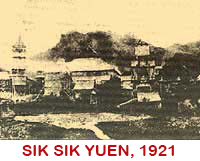 Taoists obtained divine guidance from Wong Tai Sin that a new shrine should be built near Kowloon City. Taoist priest, Liang Renan and his Taoist fellow were advised to start walking from Kowloon City Pier towards the north with 3,000 steps. When they arrived at Chuk Yuen Village,
they put a piece of bamboo into the ground as a mark. Then they consulted Wong Tai Sin via the process of " Fu Ji ". They were told that it was a good site. Wong Tai Sin also taught them to determine the would-be centre of the Temple by 3 Chinese feet ( approximately 1 metre ) on the right and 3 Chinese feet ( approximately 1 metre ) backwards of the mark and the would-be temple was named as " Chik Chung Sin Shrine " ( literally : the Red Pine Fairy Shrine ). The Taoist priests were also asked to start the construction of the shrine on 24th of the sixth lunar month by one of the Taoist Gods, Wen Chang Di via the process of " Fu Ji ". Taoists obtained divine guidance from Wong Tai Sin that a new shrine should be built near Kowloon City. Taoist priest, Liang Renan and his Taoist fellow were advised to start walking from Kowloon City Pier towards the north with 3,000 steps. When they arrived at Chuk Yuen Village,
they put a piece of bamboo into the ground as a mark. Then they consulted Wong Tai Sin via the process of " Fu Ji ". They were told that it was a good site. Wong Tai Sin also taught them to determine the would-be centre of the Temple by 3 Chinese feet ( approximately 1 metre ) on the right and 3 Chinese feet ( approximately 1 metre ) backwards of the mark and the would-be temple was named as " Chik Chung Sin Shrine " ( literally : the Red Pine Fairy Shrine ). The Taoist priests were also asked to start the construction of the shrine on 24th of the sixth lunar month by one of the Taoist Gods, Wen Chang Di via the process of " Fu Ji ". 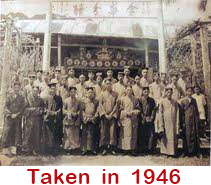 Eventually the shrine was completed and was officiated on the 20th of the seventh lunar month. In the same year, on the 23rd of the eighth lunar month, during the celebration of the birthday of Wong Tai Sin, the altar was named as " Pu Yi Tan " by the most superior Taoist God, Yu Di via the process of " Fu Ji ". Later on, the other Taoist God, Wen Chang Di gave the name of the premises as " Sik Sik Yuen " via the process of " Fu Ji ". Meanwhile, the managing body, Sik Sik Yuen was established. In 1925, the shrine was renamed as " Chik Chung Wong Sin Hall " ( literally : the Red Pine Wong Fairy Hall ) by Taoist Fairy, Lu Ju through the process of " Fu Ji ". Since then, the name " Chik Chung Wong Sin Hall " has replaced the original name.
According to the then regulations, Sik Sik Yuen used to be a private shrine and only Taoists or their family members were allowed. It was not until
1934, Sik Sik Yuen formally applied to the government for opening the Temple to the public during the 1st lunar month of every Chinese New Year. However, in 1956
Sik Sik Yuen was allowed to open completely to the public .
Eventually the shrine was completed and was officiated on the 20th of the seventh lunar month. In the same year, on the 23rd of the eighth lunar month, during the celebration of the birthday of Wong Tai Sin, the altar was named as " Pu Yi Tan " by the most superior Taoist God, Yu Di via the process of " Fu Ji ". Later on, the other Taoist God, Wen Chang Di gave the name of the premises as " Sik Sik Yuen " via the process of " Fu Ji ". Meanwhile, the managing body, Sik Sik Yuen was established. In 1925, the shrine was renamed as " Chik Chung Wong Sin Hall " ( literally : the Red Pine Wong Fairy Hall ) by Taoist Fairy, Lu Ju through the process of " Fu Ji ". Since then, the name " Chik Chung Wong Sin Hall " has replaced the original name.
According to the then regulations, Sik Sik Yuen used to be a private shrine and only Taoists or their family members were allowed. It was not until
1934, Sik Sik Yuen formally applied to the government for opening the Temple to the public during the 1st lunar month of every Chinese New Year. However, in 1956
Sik Sik Yuen was allowed to open completely to the public .
Reconstruction of the Temple:
After the Temple being open completely to the public, 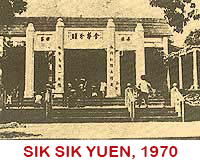 people visiting the Temple or paying their respects to Wong Tai Sin increased quickly. people visiting the Temple or paying their respects to Wong Tai Sin increased quickly.
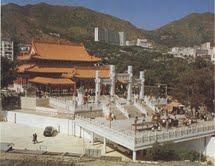 In order to convenient to the pilgrims, it was necessary to rebuild the Temple. At the end of 1968, the members of Sik Sik Yuen planned to rebuild the Temple. Next year, they were ordered to start the task at the beginning ( 11:00 p.m.- 1:00 a.m.) of the 3rd of the fourth lunar month by Wong Tai Sin via the process of " Fu Ji " .
The son of the late founder of Sik Sik Yuen - Taoist priest Liang Junzhuan was invited to attend this solemn ceremony. Then the reconstruction of the Temple was started at once. Eventually the new and magnificent Temple was completed at the orginal place in 1973. In order to convenient to the pilgrims, it was necessary to rebuild the Temple. At the end of 1968, the members of Sik Sik Yuen planned to rebuild the Temple. Next year, they were ordered to start the task at the beginning ( 11:00 p.m.- 1:00 a.m.) of the 3rd of the fourth lunar month by Wong Tai Sin via the process of " Fu Ji " .
The son of the late founder of Sik Sik Yuen - Taoist priest Liang Junzhuan was invited to attend this solemn ceremony. Then the reconstruction of the Temple was started at once. Eventually the new and magnificent Temple was completed at the orginal place in 1973.
Change of Sik Sik Yuen :
As Hong Kong has developed rapidly, nowadays Hong Kong becomes one of modern cities all over the world. Sik Sik Yuen has also changed from a private shrine into a well-organised group gradually which gives help to the poor very much every year in Hong Kong. Although there are a lot of members of Sik Sik Yuen, actually they are not Taoist priests. So some of the traditional religious activities will miss out gradually. For example, the most important " Fu Ji " operation are no longer provided as the Taoist priest, Wei Zhongyu who could perform the process of " Fu Ji " passed away in the early 1975. Now no Taoist priests stay in Sik Sik Yuen. During special occasions, all Taoist priests will be employed from anywhere outside Sik Sik Yuen. In retrospect, at the very beginning, Sik Sik Yuen was a primitive private shrine. Now it is not only one of the open and magnificent temples under the supervision of Chinese Temples Committee but a charity body as well.
Edited by :
H . T. LEUNG
BSc. ( Hons )
back to the top
|