The Definition of ' Fu Ji '
( Translation )
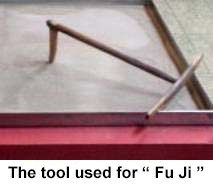 The process of writing some characters with a divine tool on the sand inside the divine pot as shown is termed as " Fu Ji ".
The writing on the sand is termed as the inscription of " Fu Ji ".
At the font of a altar, holding the rack, someone ( normally a speical Toaist priest ) consults a fairy for his client, a divine tool ( fairy's stationery ) will move automatically on the sand inside the divine pot. During the process of " Fu Ji ", he or a member of his team reads the inscription of " Fu Ji " loudly. Then the other person jots it down in the book called " Inscription of Fu Ji ". When the process of " Fu Ji " stops, the record of inscription has to be confirmed by the " Fu Ji " operator. Then a true copy of the inscription of " Fu Ji " written on the paper will be given to his client. One ( normally a speical Toaist priest ) can get the directions / meanings from the fairy through the explanation of the inscription of " Fu Ji ".
Of course, the prescription of herbs for curing illness or the description of the happening in future will be obtained.
Note :
Not everyone can perform "Fu Ji " process
and / or understand the inscription of " Fu Ji ".
Edited by :
H . T. LEUNG
BSc. ( Hons )
返 回 頁 首 ( Back to the top )
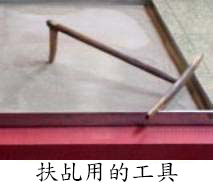 扶乩又叫扶鸞,是一種古代的占卜術,扶乩始於何時,頗難稽考。