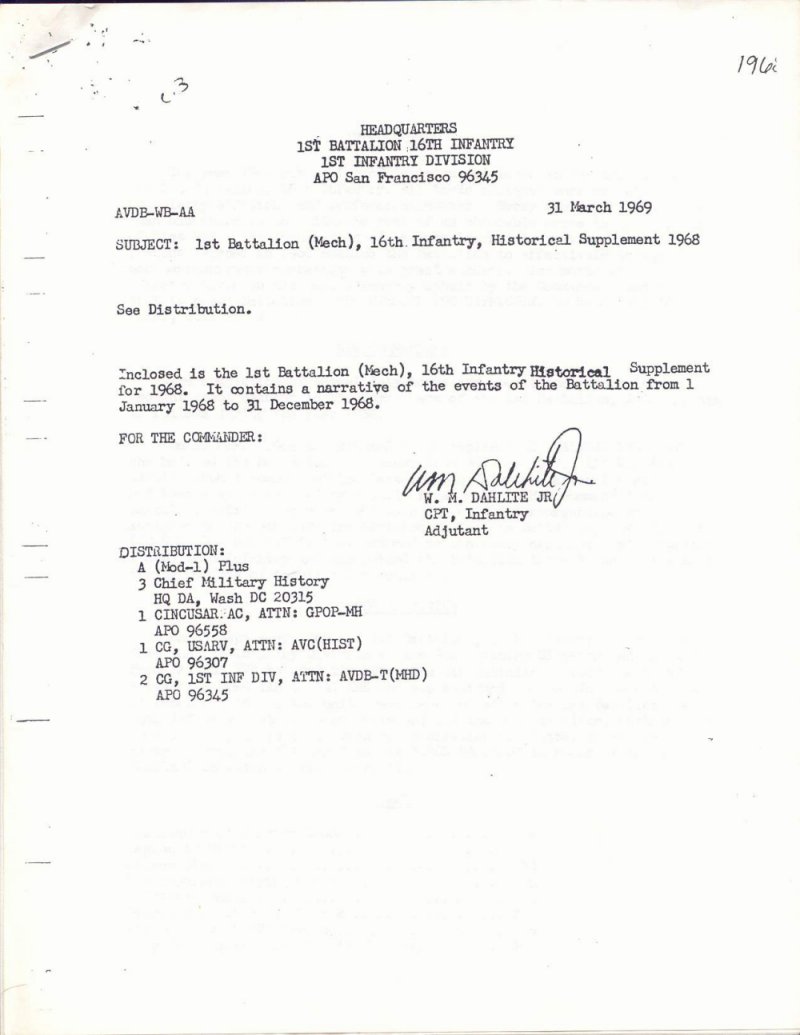
History
On 10 October 1965, the 1st
Battalion 16th Infantry arrived in Viet Nam with the 1st Brigade, 1st Infantry
Division and was stationed initially at Bien Hoa. BUSHMASTER I was the first
major operation that the battalion was involved in. Its mission was to clear a
zone along Highway 13 between Lai Khe and Ben Cat in Phouc Vinh province. The
unit conducted numerous air assaults during BUSHMASTER and earned a reputation
for flexibility, mobility, and aggressiveness. This was followed closely by
BUSH MASTER II and the battalion's mission changed to "search and destroy."
Operations centered around the Michelin Rubber Plantation, an area with which
the battalion would become intimately familiar over the next four years. In
the first two months of operations, the battalion had killed or captured over
1600 NVA or VC soldiers.
In January 1967, the 1st Battalion participated in Operation CEDAR FALLS. This
operation was a joint effort by the 1st and 25th Infantry Divisions, the 173rd
Airborne Brigade and the 11th ACR to imposed severe casualties on VC units in
Military Region 4, the "Iron Triangle." This was followed by Operations TUCSON
in February, BILLINGS in June, and SHENANDOAH in October. The year 1968 was
also an eventful one for the 1st Battalion. It accounted for over 300 enemy
KIA or captured and thousands of weapons and several tons of equipment and
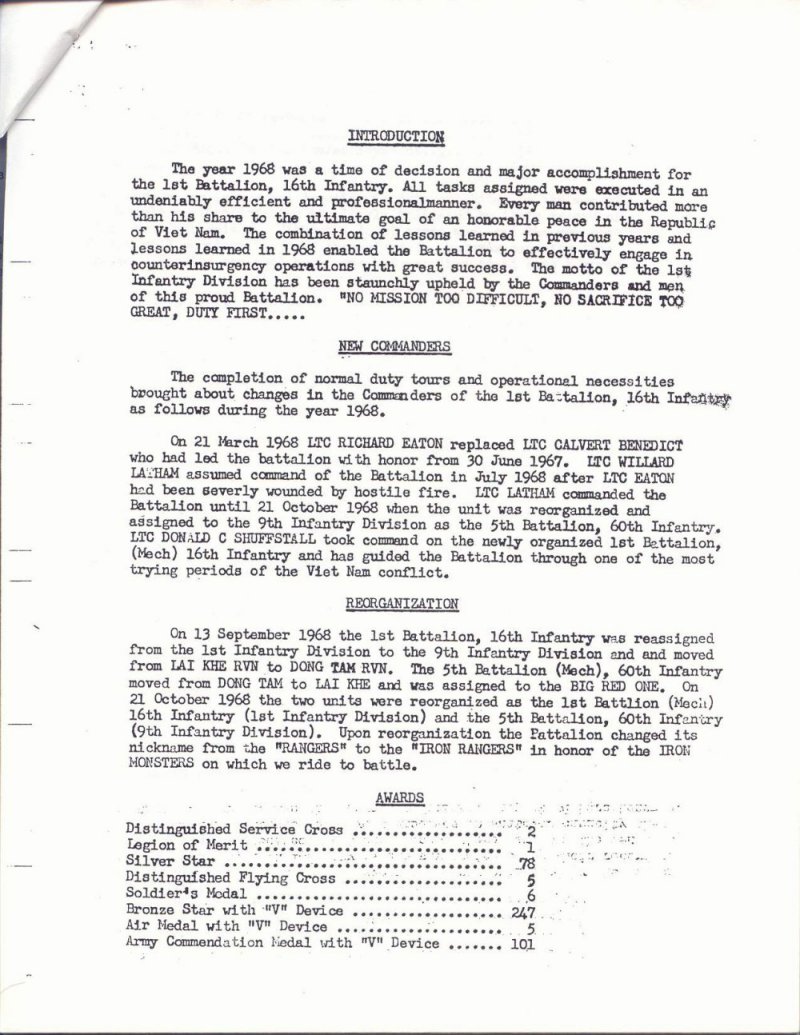
food destroyed or captured. Additionally in October 1968, the battalion was
reorganized as mechanized infantry and adopted the nickname "Iron Rangers."
The Battalion nickname of
"Rangers" was adopted from the Regiment when the Germans mistakenly reported
the 16th Infantry to be Ranger units in their dispatches to higher
headquarters during the Normandy Campaign during World War I.
The Battalion nickname of
"Rangers" was changed to "Iron Rangers" in Vietnam on 21 October, 1968 (not
1966 like reported on another web site) in
honor of the Armored Personnel Carriers when the 5th Battalion
(Mechanized), 60th Infantry Regiment, 9th Infantry Division was swapped with
the 1st Battalion, 16th Infantry Regiment, 1st Infantry Division.


In 1969, the "Iron Rangers" were
involved the Vietnamization process, yet combat in and around areas like the
Iron Triangle, Michelin Rubber Plantation, the Catcher's Mitt, Ben Cat and Lai
Khe, and participation in Operations BEAR TRAP, FRIENDSHIP, KENTUCKY COUGAR,
IRON DANGER, and TOAN THANG IV accounted for an additional 426 enemy soldiers
killed or captured. Ambush patrols and the sealing off of villages
characterized operations during the year.
The last four months in Viet Nam saw the battalion working closely with its
ARVN counterparts as it concurrently prepared to redeploy to Fort Riley.
Combat activity did not abate, however, as the "Iron Rangers" conducted 690
ambush patrols in January, and 803 in February. March 3, 1970 saw the
cessation of combat activities in the Republic of Viet Nam for the 1st
Battalion, 16th Infantry. The battalion stood down and the personnel headed
home. The battalion remained nominally active as the colors and records were
shipped to Augsburg, Germany where it was reorganized at full strength as part
of the 3rd Brigade, 1st Infantry Division in April 1970. The battalion
remained there until its participation in Desert Storm in 1991, after which it
returned to Fort Riley, Kansas where it remains today, the only active element
of the 16th Infantry Regiment.
The operations were typical of the aggressiveness, drive and competence shown
by both battalions of the 16th Infantry during their tour of duty in the
Republic of Vietnam. Today, as they have since the organization of the
regiment over 135 years ago, the "Rangers" continue to be one of the finest
units in the United States Army and stand ready to defend "Old Glory" when
their nation calls.
The American Traveler
November 20, 1990
First IDF has long, proud
history
The First Infantry Division
(Forward), commonly referred to as the 1st IDF, has a long and
proud history dating back to World War I. It is part of a division with 73
years of continuous active service, the longest of any division currently in
the United States Army.
Formed on May 24, 1917, along
with its parent unit and organized two weeks later on June 8, the 1st
IDF’s original designation was Headquarters Troop, 1st
Expeditionary Division. When the division dropped the word “expeditionary”
from its name on July 6, 1917, the troop designation was also changed.
The Headquarters Troop’s
lineage and honors reveal a distinguished campaign record during World War I.
After being the vanguard of America’s war effort, the First Division remained
in Europe for occupation duty in Germany. The last elements of the division
returned to the United States in December, 1919.
On February 13, 1921,
Headquarters Troop was reorganized and predestinated as Headquarters and
Military Police Company, retaining this name until 1942. By that time, the
United States had become involved in World War II and was preparing to send
troops to the European theater. On May 15, the First Division was designated
the First Infantry Division: the Headquarters and Military Police Company
simultaneously became Headquarters Company, 1st Infantry Division.
The 1st Inf. Div.
was sent to England in August 1942 and, in November of that year, participated
in the first American ground offensive of the war against Germany. “Operation
Torch,” the invasion of North Africa, began a series of campaigns which would
take the division to Sicily, the invasion of France at Normandy on June 6th
of 1944, through northern France and throughout Germany. The division’s march
ended at Elbogen, near Cheb, Czechoslovakia on May 8, 1945, when peace was
declared.
The division remained in
Germany first for occupation duty, and then as part of the NATO deterrent
until 1955, when it was reassigned to Fort Riley, Kansas.
Headquarters Company, 1st
Infantry Division was disbanded on April 20, 1960 but was reactivated on
January 2,nd, 1964 as part of the Reorganized Army Division (ROAD) program.
The unit’s new designation with the division was Headquarters and Headquarters
Company (HHC), 3rd Brigade, nicknamed the “Iron Brigade.”
During the early 1960’s there
was a growing danger that South Vietnam would fall to communist aggression.
The United States sent military advisors there to assist the South Vietnamese
Army, but as the danger of a communist victory grew, American ground troops
were committed. The second brigade of the division, the first American Army
infantry unit to be sent to Vietnam, arrived at Cam Ranh Bay on July 12,
1965. By November 1st the remainder of the division had arrived
and was ready for combat operations. The 1st Infantry Division
compiled an impressive campaign record in Vietnam during more than four years
of service there.
The 3rd Brigade’s
units included the 1st Battalion, 16th Infantry, the 1st
Battalion, 26th Infantry, the 2nd Battalion, 2nd
Infantry and the 2nd Battalion, 28th Infantry.
The division was withdrawn
from Vietnam on April 15, 1970, redesignated the 1st Infantry
Division (Mechanized), and assumed the mission of the 24 Infantry Divison.
The 24th Infantry
Division had been stationed in Germany with two brigades located in Ausburg
and with its 3rd Brigade garrisoned in Munich. In 1968, as part of
a program to reduce American troop strength in Europe, the 1st and
2nd Brigades were withdrawn and reassigned to Fort Riley, while the
3rd Bridage was moved to Augsburg.
Since the 3rd
Brigade ws stationed alone in Germany, the 1st Infantry Division
(Forward) headquarters under the command of a brigadier general, was
established above the brigade headquarters. The brigade remained in Sheridan
Kaserne until 1972 when it was alerted that it would move to the Stuttgart-Ulm
area to follow Army Security Agency assets tobe consolidated in Augsburg. By
September 1972, the move had been completed. The division (forward)
headquarters and the 1st Battalion, 26th Infantry were
relocated to Cooke Barracks in Goeppingen. The 1st Support
Battalion (Provisional), which had been activated in 1971 to perform functions
similar to a division support command, also moved to Goeppingen.
The 1st Batt., 16th
Infantry was relocated to Panzer Kaserne in Boeblingen, along with Troop C, 1st
Squadron, 4th Cavalry Regiment. In September 1972, the 4th
Battalion, 73 Armor was activated there and the 3rd Brigade
headquarters was also located in Boeblingen to provide command support to the
units stationed on the compound.
The 2nd Battalion,
33rd Field Artillery, the 5th Battalion, 32nd
Field Artillery (an Honest John missile unit) and Company D, 1st
Engineer Battalion went to Wiley Barracks in Neu Ulm. Only the 3rd
Battalion, 63rd Armor remained in Augsburg.
The 1st Infantry
Division (Forward) has experienced several inactivations, redesignations, and
relocations since 1972. In 1974, the 1st Support Battalion
(Provisional) was inactivated, but it was reactivated three years later. On
May 21, 1974 the 5th Battalion, 32nd Field Artillery was
inactivated at Neu Ulm. In Augsburg, the 3rd Battalion, 63rd
Armor was reassigned to the 3rd Infantry Division on July 1, 1977.
Between December 1982 and February 1983, Company D, 1st Engineer
Battalion was relieved of attachment to the 2nd Battalion, 33rd
Field Artillery and moved to Boeblingen. It remained a separate company until
August 1984 when it was attached to 2-37 Armor. Later, the engineer company
was attached to the 1-16 Infantry.
The year 1983 witnessed
several redesignations due to the changeover from Combat Arms Regimental
System to the Army Regimental System. Under this program, the 1-26th
Infantry was inactivated at Cooke Barracks and, simultaneously, the 4th
Battalion, 16th Infantry was activated on February 24th.
Four days later, the 4th Battalion, 37th Armor and the 2nd
Battalion, 33rd Field Artillery was designated the 4th
Battalion, 5th Field Artillery.
These changes were made in
order to match designations in the 1st Infantry
Division (M) at Fort Riley as part of the Army’s regimental plan.
On October 20, 1983, the 1st
Support Battalion (Provisional) was inactivated and replaced by the 299th
Support Battalion. The new unit was recognized by the Department of the Army
as inheriting the lineage and honors of the 7th Support Battalion,
which had served with distinction in Vietnam.
(In the four years since
Capt. Hanson wrote his history of the 1st IDF, additional changes
in locations and unit designations have occurred. The 3rd
Brigade’s headquarters moved in the 1st IDF headquarters at Cooke
Barracks. In August of 1989, after 14 years, the designation “3rd
Brigade” was used again.
In November of 1987 Troop C,
¼ Cav became Troop A, ¼ Cav and, in 1988, 2-37 Armor was designated 3rd
Battalion, 34th Armor. Finally, in September of this year, Troop
A, ¼ Cav was reassigned to the 1st ID(M) at Fort Riley. The
Brigade Scout Platoon, attached to the 3rd Battalion, 34th
Armor, came into being after the cavalry troop departed.)
The American Traveler
November 20, 1990
'BRO' units to inactivate
by Maj. Lane M. Van DeStegg
On September 18th General Crosbie Saint the Commander-in-Chief of the U.S.
Army in Europe announced the return to the Federal Republic of Germany of
several installations. Among those scheduled to be returned between 1991 and
1998 is Wiley Barracks at Neu Ulm, the home of the 2nd Battalion, 5th Field
Artillery.
Two days later, Gen. Saint announced the inactivation of several battalions
from both V Corps and VII Corps. As we all know, four of our battalions were
among those mentioned. They are the 1st and 4th Battalions of the 16th
Infantry Regiment; the 3rd Battalion, 34th Armor Regiment; and the 2nd
Battalion, 5th Field Artillery Regiment, with its 25th Target Acquisition
Battery. Along with the battalions was one of our separate companies; Company
D of the 1st Engineer Battalion and Detachment 1 of the 101st Military
Intelligence Battalion.
Since Gen. Saint's announcements, our focus has been on planning and executing
the inactivations - not an easy process when you consider all the things that
have to be accomplished. Everything from Abrams tanks and Bradley fighting
vehicles to dogs and cats must be moved. Soldiers must be reassigned and
buildings must be prepared for their next tenants, who are yet to be
announced.
Gen. Saint's announcements raised thousands of questions, many of which could
not be answered immediately.
One of the first questions asked was, "Why us?"
Fortunately, that one can be answered. Selected units were chosen based on
several considerations, including combat strength of the units, which had to
be measured against the required cutbacks resulting from the Conventional Arms
Reductions talks, and against the budget cuts required by Congress.
Other considerations were the placement of units in Germany, and their impact
on the local population and environment, and the units' probable use should
they have to defend western Europe.
Once the required reductions were compared to possible needs, Department of
the Army determined which units could logically be inactivated or moved.
Since the announcement, some inactivation dates have changed. 2nd Batt., 5th
Field Artillery's date remains March 1st. 3rd Batt., 34th Armor's is now 21
Mar. 1st Batt., 16th Inf and Company D, 1st Eng. Batt. leave on April 1st and
4th Batt., 16th Inf. will leave May 1.
Contributors:
16th Infantry Regiment Association web site
The American Travler - (First Inf Div Forward Public Affairs Office)
Jason
C. Webb
Curtis Hatterman