Thursday, January 25, 2007
Bought again Books
Cedar Falls
Featured Reader:
Jeffrey S. Copeland
Upcoming: Myrna Sandvik on Thursday, Feb. 22, 2007
|
FINAL THURSDAY READING SERIES *downstairs in Bought again Books* |
|
Thursday, January 25, 2007
Featured Reader: Upcoming: Myrna Sandvik on Thursday, Feb. 22, 2007 |
|
|
This month, the Final Thursday Reading Series takes place in Bought again Books, downstairs from Vibe Coffee House. Vibe will be open for espresso drinks. Come early to browse the stacks at BaB.
Signup for the open mic begins @ 7 p.m. on a first come, first served basis. Limited slots are available, so readers are encouraged to sign up early and read your best five minutes of poetry, fiction, or creative non-fiction. Singer-songwriters are also welcome. The open mic begins at 7:30 p.m. The featured reader takes the stage between 8:00 and 8:30 (depending on how many open mic readers there are). After the reading, there will be a brief question and answer session.
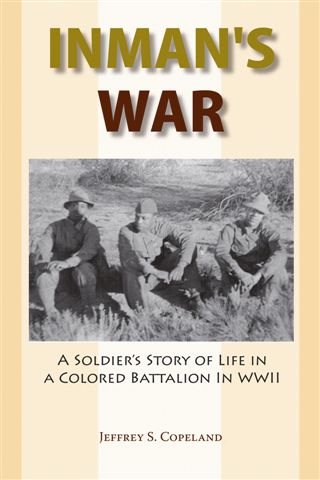
Jeffrey S. Copeland is Head of the Department of English Language and Literature at the University of Northern Iowa. A veteran of writing Language Arts textbooks, Inman's War: A Soldier’s Story of Life in a Colored Battalion in World War II (Paragon House) is his first journey into the other side of the publishing world. Inman's War has recently been nominated for the Orbis Pictus Award (for nonfiction books) and has been nominated for the American Library Association’s “Notable Books for 2007.” See below for a link to an audio interview with Jeffrey S. Copeland and a summary of Inman’s War. |
|
|
|
Read Work by Past Featured Readers
Now Available from Final Thursday Press
Poetry by Pierre-Damien Mvuyekure
Poetry by Jonathan Stull
Poetry by Vince Gotera ***Winner of the 2004 Global Filipino Literary Award for Poetry***
Poetry by Ahkos
Microfiction by Jim O'Loughlin |
Click here to listen to a radio interview with Jeffrey S. Copeland on Inman's War (.mp3 format)
A Summary of Inman’s War: A Soldier’s Story of Life in a Colored Battalion in WW II. by Jeffrey S. Copeland
Very briefly, the book is a nonfiction story of a soldier who served in what was called the “449th Colored Signal Construction Battalion” of the Army Air Corps during World War II. The soldier, Master Sergeant Inman Perkins, was an incredible man. At the time of being drafted, he held the M.A. degree in Chemistry from the University of Iowa. Shortly after receiving that degree, he moved to St. Louis to teach at Sumner High School, the first high school built west of the Mississippi River for African-Americans. There he fell in love with Olivia Merriwether, another teacher at Sumner, and the two were married. However, because of a St. Louis Board of Education ruling still in effect in 1942, their marriage had to be kept a secret or Olivia could have been asked to give up her job; quite simply, women were not allowed to keep teaching once they married. When Inman was drafted, he was assigned to the newly formed 449th and given the rank of Master Sergeant, which was as high as he could be placed, even with his high level of schooling, because of issues of race at the time. Without getting too long-winded here, the story then provides an account of his time in the service and the growth not only of his own spirit, but the accomplishments of the 449th as well. The 449th’s work was instrumental during the battle of Anzio, a battle designed by Winston Churchill that opened the door to Rome and also served as a trial run for the D-Day invasion that came just a few months later. The story of Inman and the 449th is an important slice of military history and African American history, one that has never been told before. In addition, Inman’s battalion was involved in one of the most dramatic instances of racial discrimination in military service of that era. In the history books, this incident at Fort Bliss is merely mentioned as one of the worst, but specific details of the event are never given. However, this incident also comes into the light for the very first time in this book.
In addition, his wife, Olivia Merriwether Perkins, continued to teach at Sumner High School in a career that spanned forty years. She vowed to put a little of Inman’s spirit into every student who walked into her classroom. Some of those students at Sumner included Tina Turner, Arthur Ashe, Chuck Berry, and Dick Gregory. Through the thousands of students she taught at Sumner, his spirit and his legacy have been kept alive.
In addition, the chapters detailing Inman’s Basic Training experiences (and the formation of the 449th) are based upon detailed comments he made in letters he sent back home to Olivia during that time period. From Olivia’s estate I acquired over a hundred and fifty letters Inman wrote to her, and they were a wonderful source of information as I wrote the story, especially as it appears no individual, personal accounts exist of the experiences of soldiers who served in the “Colored Battalions” that were formed during World War II (There are stories about groups like the Buffalo Soldiers, Tuskegee Airmen, and the Red Ball Express, but these tend to deal with the group effort rather than the individual, personal side of the story.). I believe this to be fresh territory -- and a story that has not been told before.
I would also like to mention that Dick Gregory has written the Introduction for the book, and I am very pleased with it. It says, basically, that this book should be in every home and library in America. Dick Gregory was Olivia’s favorite student, and he often stayed with her through the years when his travels took him back through St. Louis. Mr. Gregory loved the manuscript, and I was honored when he said he wanted to write the Introduction.
In summary, the book is partly the story of Inman Perkins and partly an important slice of the African American involvement in World War II. There are precious few African American heroes in the accounts of the events of that era, and Inman Perkins was, in so many ways, a hero to so many.
|
| updated January 3, 2007 by Jim O'Loughlin |
 Vibe
is located at 909 W. 23rd St. in Cedar Falls on the second floor of
Bought again Books.
Vibe
is located at 909 W. 23rd St. in Cedar Falls on the second floor of
Bought again Books.