Wednesday,
October
28,
2006
Vibe Coffee House, Cedar Falls
Book Release Reading by
Patrick Irelan
Upcoming: Grant Tracey on Thurs., Nov. 30
|
FINAL THURSDAY READING SERIES **ONE DAY EARLY THIS MONTH** |
|
Wednesday,
October
28,
2006
Book Release Reading by Upcoming: Grant Tracey on Thurs., Nov. 30 |
|
|
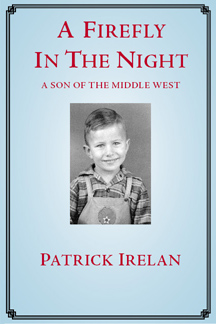
Signup for the open mic begins @ 7 p.m. on a first come, first served basis. Limited slots are available, so readers are encouraged to sign up early and read your best five minutes of poetry, fiction, or creative non-fiction. Singer-songwriters are also welcome. The open mic begins at 7:30 p.m. The featured reader takes the stage between 8:00 and 8:30 (depending on how many open mic readers there are). After the reading, there will be a brief question and answer session. Patrick Irelan is the author of the just-released personal memoir, A Firefly in the Night (Ice Cube Press), a sequel to Irelan’s family memoir, Central Standard (University of Iowa Press). Mary Swander writes of A Firefly in the Night, “This warm, reflective memoir is a must read for anyone interested in the search for self.” Irelan is known for his ability to capture the nuances of Midwestern life. You can read an excerpt from A Firefly in the Night below: |
|
|
|
Read Work by Past Featured Readers
Now Available from Final Thursday Press
Poetry by Pierre-Damien Mvuyekure
Poetry by Jonathan Stull
Poetry by Vince Gotera ***Winner of the 2004 Global Filipino Literary Award for Poetry***
Poetry by Ahkos
Microfiction by Jim O'Loughlin
|
Solidarity Forever by Patrick Irelan
This passage is taken from the essay "Solidarity Forever," which appears in the memoir A Firefly in the Night by Patrick Irelan (Ice Cube Press, 2006). This essay is set in the John Morrell and Company meatpacking plant in Ottumwa, Iowa, in the early 1960's. Copyright © 2006 by Patrick Irelan.
I never worked in any department more than two or three days. The noise level usually prevented conversation. Finally I arrived in the canned-ham department, which stood on the top floor of one of the many interconnected buildings that formed the plant. During my brief career as a packinghouse worker, this huge room was the only place I recall that admitted natural light. Every other department could have instantly become as dark as Tom Sawyer and Becky Thatcher’s cave simply by turning off the lights. The foreman was an agitated little man of about my own height and weight, but twenty years older. He led me to many stacks of cans on many pallets, located at the head of the five-pound-ham line. While speaking faster than I thought humanly possible, he said, “Keep the conveyer belt full of cans. Never drop one on the floor. If you drop it, throw it away. Sanitation laws. They’re expensive. Don’t drop them. Don’t stack. Keep the belt full. Got it?” I started to say I got it, but the man had already turned and walked away. I began my task. The belt started and stopped for reasons I never learned. I kept it full. Didn’t stack. Didn’t drop. Didn’t throw away. Noticed sharpness at top edges of unsealed cans. Noticed cuts on hands. Foreman returned. “Faster,” he said. I looked at the belt. “It’s full,” I said. “No, no! Like this.” He picked up three cans in each hand and shoved them onto the end of the conveyer belt. A few feet down the line, two or three cans fell off the belt. I’d worked at the packinghouse over a week by then and had begun to doubt the judgment of the foremen. “You told me not to drop them on the floor,” I said. “They’re expensive.” I picked up the cans and started to throw them into a trash hopper. “Stop!” “They were on the floor.” He ignored my concern for the clean food and drug laws. “You can’t throw that many away.” I took this opportunity to raise another issue. “I’m getting these cuts,” I said, showing him my hands. “Can I wear gloves?” I took a pair of jersey gloves out of the back pocket of my jeans. Since I never knew what job I’d have when I got to the plant, I always brought a pair of gloves. “No cloth gloves. Rubber gloves.” “Where can I get them?” “Company store. Down front. Look! More cans!” I looked at the belt. A tiny beachhead had opened. I filled it and turned back toward the foreman. Vanished. I’d have to find the store on my own. The line stopped for lunch at about eleven o’clock every day. In addition, each worker got a number of short breaks each day. You knew your turn had arrived when a man appeared at your side and said, “Piss break.” The women in the bacon department didn’t use that vulgar term, but there were no women in the canned-ham department. The union and the company had negotiated all these arrangements for the functioning of the human bladder, and the contract spelled everything out. I don’t know how the contract spelled the part about the pee breaks. When the line stopped for lunch, I gulped down the food my mother had prepared, then ran downstairs and found the company store. An old guy with thin gray hair commiserated with me about the cuts and fixed me up with a pair of black rubber gloves. I don’t remember how much they cost. I returned to the canned-ham department, after which my blood no longer added its flavor to the hams.
|
| updated Oct. 18, 2006 by Jim O'Loughlin |
 Vibe
is located at 909 W. 23rd St. in Cedar Falls on the second floor of
Bought again Books.
Vibe
is located at 909 W. 23rd St. in Cedar Falls on the second floor of
Bought again Books.