WHY THE FLASH
WORKS
A
flash system has three major
parts: - a small battery (the power supply)
- a gas discharge tube (actually produces the flash)
- a circuit that connects the power supply to the discharge tube
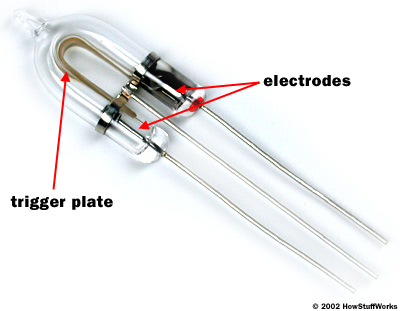 The discharge tube is similar to a neon
light. The tube is filled with xenon
gas with electrodes in either end
and a metal trigger plate at the middle
of the tube. The main idea is to conduct electrical current (from
the battery) through the gas tube from one electrode to the
other. As the electrons in the electrical current move, they
energize the xenon atoms, causing them to emit light.
The discharge tube is similar to a neon
light. The tube is filled with xenon
gas with electrodes in either end
and a metal trigger plate at the middle
of the tube. The main idea is to conduct electrical current (from
the battery) through the gas tube from one electrode to the
other. As the electrons in the electrical current move, they
energize the xenon atoms, causing them to emit light.
Gas in its normal state is not conductive, so the trigger plate introduces free electrons into the gas. When a brief, highly positive voltage is applied to the plate, it attracts the negatively charged electrons in the atoms so strongly that will actually pull them free of the atoms. This is called ionization. Since the electrons are negative, they move toward the positively charged terminal, colliding with other atoms along the way. the atoms that the electrons collide with are forced to lose their electrons as well. The speeding electrons collide with the xenon atoms which become energized and generate light.
The flash trigger is wired to the shutter mechanism. When a picture is taken, the trigger briefly closes, causing the electrical current to pass onto the metal trigger plate next to the flash tube. This is enough energy to ionize the xenon gas, making it conductive. The flash then lights up in synch with the shutter opening.
- a gas discharge tube (actually produces the flash)
- a circuit that connects the power supply to the discharge tube
The discharge tube is similar to a neon
light. The tube is filled with xenon
gas with electrodes in either end
and a metal trigger plate at the middle
of the tube. The main idea is to conduct electrical current (from
the battery) through the gas tube from one electrode to the
other. As the electrons in the electrical current move, they
energize the xenon atoms, causing them to emit light. Gas in its normal state is not conductive, so the trigger plate introduces free electrons into the gas. When a brief, highly positive voltage is applied to the plate, it attracts the negatively charged electrons in the atoms so strongly that will actually pull them free of the atoms. This is called ionization. Since the electrons are negative, they move toward the positively charged terminal, colliding with other atoms along the way. the atoms that the electrons collide with are forced to lose their electrons as well. The speeding electrons collide with the xenon atoms which become energized and generate light.
The flash trigger is wired to the shutter mechanism. When a picture is taken, the trigger briefly closes, causing the electrical current to pass onto the metal trigger plate next to the flash tube. This is enough energy to ionize the xenon gas, making it conductive. The flash then lights up in synch with the shutter opening.
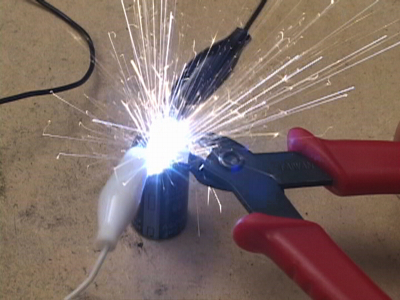
A flash discharging when the two terminals are brought together.