TERMINOLOGY
Backlighting
- light coming from behind the subject, towward the camera lens, so that
the subject stands out vividly against the  background.
Sometimes
produces a silhouette effect. Always use something (a hand, a lens
shade to avoid the light falls onto the lens - to avoid lens
flares). (An example of backlighting is to the right.)
background.
Sometimes
produces a silhouette effect. Always use something (a hand, a lens
shade to avoid the light falls onto the lens - to avoid lens
flares). (An example of backlighting is to the right.)
Bayonet
Mount - specifically implemented and devised for the attachment
of a lens to a camera. The bayonet mount does not require screws or
cumbersome, time consuming operations. It is structured so that a lens
can simply be pressed into place and turned. The `bayonets' or catches
on the camera have complementary recesses on the lens.
photo from http://www.leerentz.com/Fieldnot/tetbison.jpg
Cell Voltage - the cell voltage depends on the electrochemical system of the element;The measured voltage or cell potential of an electrochemical cell or galvanic cell. Example: the cell voltage of a lithium battery is 3 V.
Chemical Potential Energy - energy produced or absorbed in the process of a chemical reaction
Conducting Wire - a metal conductor that carries electricity over a distance
Developing
Agent - actually converts the silver halide grains in the
emulsion to metallic silver;will only work properly in an Alkaline
solution, reacts with the exposed photographic emulsion of the film,
Electric Circuit - unbroken path along which an electric current exists or is intended or able to flow.
Electrode - the path by which electricity is conveyedd into or from a solution or other conducting medium; especially the ends of wires or conductors, leading from the source of electricity and terminating in the meium transversed by the current.
Electrolyte - an elctrically conductive medium, in whicch current flow is due to the movement of ions; in a lithium battery the electrolyte uses no
water. A non-aqueous electrolyte is used instead, which is composed of
organic liquids and salts of lithium to provide ionic conductivity. This system has much higher cell voltages than the aqueous electrolyte systems.
Electron - a sub-atomic particle with a negative quaantised charge. A flow of electrical current consists of the unidirectional (on average) movement of many electrons. The more mobile electrons are in a given material, the greater it electrical conductance (or equivalently, the lower its resistance).
Exposure - the quantity of light allowed to act on aa photographic material; a product of the intensity (controlled by the lens opening) and the duration (controlled by the shutter speed or enlarging time) of light striking the film or paper. The act of allowing light to reach the light-sensitive emulsion of the photographic material. Also refers to the amount (duration and intensity) of light which reaches the film.
Fixing Bath - darkroom material. A solution that removes any light-sensitive silver-halide crystals not acted upon by light or developer, leaving a black-and-white negative or print unalterable by further action of light. Also referred to as hypo.
Focal Length - the distance between the film and the optical center of the lens when the lens is focused on infinity. The focal length of the lens on most adjustable cameras is marked in millimetres on the lens mount. The distance from the principal point to the focal point. In 35mm-format cameras, lenses with a focal length of approx. 50mm are called normal or standard lenses. Lenses with a focal length less than approx. 35mm are called wide angle lenses, and lenses with a focal length more than approx. 85mm are called telephoto lenses. Lenses which allow the user to continuously vary the focal length without changing focus are called zoom lenses .
Free
Electron - an electron that is not attatched to an atom or ion
or molecule but is free to move under the influence of an electric field
Imaging layers - imaging layers contain tiny grains of silver halide crystals, which act as light detectors. When exposed to light, they undergo a photochemical reaction. The silver halide grains are chemically modified to increase their light sensitivity.
Ionization - the formations of ions by separating atomms or molecules or by adding or subtracting electrons from atoms by strong electric fields
Latent Image - the invisible image left by the action of light on photographic film or paper. The light changes the photosensitive salts to varying degrees depending on the amount of light striking them. When processed, this latent image will become a visible image either in reversed tones (as in a negative) or in positive tones (as in a color slide).
Metal Trigger Plate - plates that are normally held a small distance apart by an insulator. The two plates are connected with wires to the PC cord of a flash unit. When the plates are forced together by, say, a colliding object, the flash unit will discharge.
Net Torque - torque is the application of Force to a rigid body such that it tends to produce a rotation. A net torque will cause a change in rotation:
Photographic Speed - the light sensitivity of the grain
Photon Detector - portions of light energy interact with electrons in the detector material and generate free electrons. To produce free electrons, the portions must have sufficient energy to free an electron from its atomic binding forces.
Pixel - "pixel" is short for picture elements, whhich make up an image, similar to grains in a photograph or dots in a half-tone. Each pixel can represent a number of different shades or colors, depending on how much storage space is allocated for it.
Power - the rate at which energy is transferred. Electrical energy is usually measured in watts
Real Image - an image formed by the convergence of light
Silver-Halide crystals - a substance that is sensitive to light; a single one-inch squaresection of an average piece of film may contain as many as 40 billion silver-halide crystals; Silver-halide crystals change their structure when exposed to light. Where more light falls on an area of the emulsion, more crystals change and clump together. Where less light falls, fewer crystals change and clump. Where no light falls, no crystals are changes or clump together
Stop Bath - darkroom material. An acid rinse, usually a weak solution of acetic acid, used as a second step when developing black-and-white film or paper. It stops development and makes the hypo (fixing bath) last longer.
Terminal - a contact on an electrical device (such aas a battery) at which electric current enters or leaves
Visible Light - the human eye is tuned to respond only to the energy within the limits of the visible spectrum, a narrow band of wavelengths between 380 and 760 nanometers = LIGHT
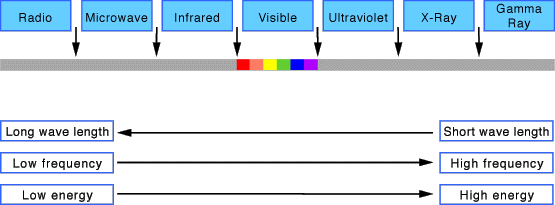
photo from www.howstuffworks.com
Voltage
- the energy potential from a source that ccan produce a flow of
electricity in a circuit; expressed in volts.
Xenon Gas - during discharge of a flash, the xenon gas emits broad spectrum white light, which is at nearly the same color temperature of daylight. For this reason, xenon flash tubes are now the universal choice for photographic flashes, since there is very little colour change when using normal daylight film.
Zoom - a camera technique with a special lens too adjust the depth of a shot, accomplished without moving the camera
background.
Sometimes
produces a silhouette effect. Always use something (a hand, a lens
shade to avoid the light falls onto the lens - to avoid lens
flares). (An example of backlighting is to the right.)photo from http://www.leerentz.com/Fieldnot/tetbison.jpg
Cell Voltage - the cell voltage depends on the electrochemical system of the element;The measured voltage or cell potential of an electrochemical cell or galvanic cell. Example: the cell voltage of a lithium battery is 3 V.
Chemical Potential Energy - energy produced or absorbed in the process of a chemical reaction
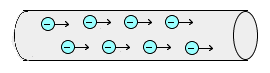
Conducting Wire - a metal conductor that carries electricity over a distance
 Conducting
Wire
Photo from
http://www.uvi.edu/Physics/SCI3xxWeb/Electrical/current.gif |
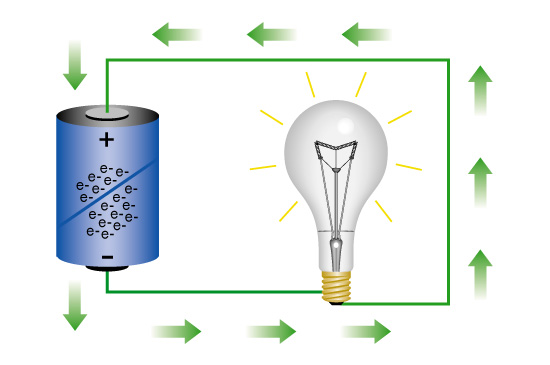
Electric Circuit - unbroken path along which an electric current exists or is intended or able to flow.
 Electric
circuit
Photo from http://www.garyferster.com/images/large/tec/Instruction2.jpg |
Electrode - the path by which electricity is conveyedd into or from a solution or other conducting medium; especially the ends of wires or conductors, leading from the source of electricity and terminating in the meium transversed by the current.
Electrolyte - an elctrically conductive medium, in whicch current flow is due to the movement of ions; in a lithium battery the electrolyte uses no
water. A non-aqueous electrolyte is used instead, which is composed of
organic liquids and salts of lithium to provide ionic conductivity. This system has much higher cell voltages than the aqueous electrolyte systems.
Electron - a sub-atomic particle with a negative quaantised charge. A flow of electrical current consists of the unidirectional (on average) movement of many electrons. The more mobile electrons are in a given material, the greater it electrical conductance (or equivalently, the lower its resistance).
Exposure - the quantity of light allowed to act on aa photographic material; a product of the intensity (controlled by the lens opening) and the duration (controlled by the shutter speed or enlarging time) of light striking the film or paper. The act of allowing light to reach the light-sensitive emulsion of the photographic material. Also refers to the amount (duration and intensity) of light which reaches the film.
Fixing Bath - darkroom material. A solution that removes any light-sensitive silver-halide crystals not acted upon by light or developer, leaving a black-and-white negative or print unalterable by further action of light. Also referred to as hypo.
Focal Length - the distance between the film and the optical center of the lens when the lens is focused on infinity. The focal length of the lens on most adjustable cameras is marked in millimetres on the lens mount. The distance from the principal point to the focal point. In 35mm-format cameras, lenses with a focal length of approx. 50mm are called normal or standard lenses. Lenses with a focal length less than approx. 35mm are called wide angle lenses, and lenses with a focal length more than approx. 85mm are called telephoto lenses. Lenses which allow the user to continuously vary the focal length without changing focus are called zoom lenses .
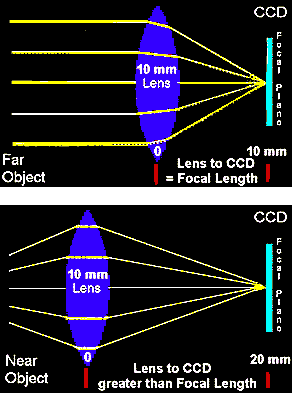
Photo from
http://www.cybercollege.com/tvp010.htm |
Imaging layers - imaging layers contain tiny grains of silver halide crystals, which act as light detectors. When exposed to light, they undergo a photochemical reaction. The silver halide grains are chemically modified to increase their light sensitivity.
Ionization - the formations of ions by separating atomms or molecules or by adding or subtracting electrons from atoms by strong electric fields
Latent Image - the invisible image left by the action of light on photographic film or paper. The light changes the photosensitive salts to varying degrees depending on the amount of light striking them. When processed, this latent image will become a visible image either in reversed tones (as in a negative) or in positive tones (as in a color slide).
Metal Trigger Plate - plates that are normally held a small distance apart by an insulator. The two plates are connected with wires to the PC cord of a flash unit. When the plates are forced together by, say, a colliding object, the flash unit will discharge.
Net Torque - torque is the application of Force to a rigid body such that it tends to produce a rotation. A net torque will cause a change in rotation:
Photographic Speed - the light sensitivity of the grain
Photon Detector - portions of light energy interact with electrons in the detector material and generate free electrons. To produce free electrons, the portions must have sufficient energy to free an electron from its atomic binding forces.
Pixel - "pixel" is short for picture elements, whhich make up an image, similar to grains in a photograph or dots in a half-tone. Each pixel can represent a number of different shades or colors, depending on how much storage space is allocated for it.
Power - the rate at which energy is transferred. Electrical energy is usually measured in watts
Real Image - an image formed by the convergence of light
Silver-Halide crystals - a substance that is sensitive to light; a single one-inch squaresection of an average piece of film may contain as many as 40 billion silver-halide crystals; Silver-halide crystals change their structure when exposed to light. Where more light falls on an area of the emulsion, more crystals change and clump together. Where less light falls, fewer crystals change and clump. Where no light falls, no crystals are changes or clump together
Stop Bath - darkroom material. An acid rinse, usually a weak solution of acetic acid, used as a second step when developing black-and-white film or paper. It stops development and makes the hypo (fixing bath) last longer.
Terminal - a contact on an electrical device (such aas a battery) at which electric current enters or leaves
Visible Light - the human eye is tuned to respond only to the energy within the limits of the visible spectrum, a narrow band of wavelengths between 380 and 760 nanometers = LIGHT
photo from www.howstuffworks.com
Xenon Gas - during discharge of a flash, the xenon gas emits broad spectrum white light, which is at nearly the same color temperature of daylight. For this reason, xenon flash tubes are now the universal choice for photographic flashes, since there is very little colour change when using normal daylight film.
Zoom - a camera technique with a special lens too adjust the depth of a shot, accomplished without moving the camera