WHY THE
BATTERIES WORK
Batteries have two terminals. The kind of batteries
that the Nikon N55 require are the CR2-type 3V lithium batteries.
On these batteries, the two terminals are marked (-), or negative, and
(+), or positive. Electrons
collect on the negative terminal of the battery. They must travel
from the negative terminal to the positive terminal for a chemical
reaction to take place.
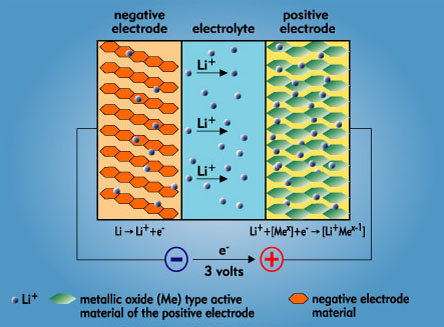
photo from:http://www.cea.fr/gb/publications/Clefs44/an-clefs44/clefs4469a.html
In lithium batteries, the lithium is released by the negative electrode in ionic form (Li+) and travels through the electrolyte. Lithium batteries, unlike most other batteries, do not use water in the electrolyte. Because they do not use water, the cells can operate with a much wider potential and has much higher cell voltages. The lithium then inserts itself into the crystal network of positive electrodes. Each Li+ ion that passes into the battery's internal circuitry is compensated by the passing of an electron into the external current. To maintain the flow of electrons, a conducting wire is connected between the positive and negative terminals of the battery. The battery then acts as a kind of pump, pulling electrons from one end of the wire and then pushing them to the other end. This allows the electric current to continue. This is why batteries can sit on a shelf and still remain good. It is only when the terminals are connected that the chemical reactions begin.
Each time a battery transfers an electron, it uses up a small portion
of its chemical potential energy.
Once the battery runs out of chemical potential energy, it is "dead"
and must be replaced.
Lithium batteries are used in most cameras because they provide a fairly constant voltage and power. They also work well in hot or cold temperatures, much unlike other types of batteries (some of which do not function in extreme temperatures). This makes them ideal for things like outdoor photography.
photo from:http://www.cea.fr/gb/publications/Clefs44/an-clefs44/clefs4469a.html
In lithium batteries, the lithium is released by the negative electrode in ionic form (Li+) and travels through the electrolyte. Lithium batteries, unlike most other batteries, do not use water in the electrolyte. Because they do not use water, the cells can operate with a much wider potential and has much higher cell voltages. The lithium then inserts itself into the crystal network of positive electrodes. Each Li+ ion that passes into the battery's internal circuitry is compensated by the passing of an electron into the external current. To maintain the flow of electrons, a conducting wire is connected between the positive and negative terminals of the battery. The battery then acts as a kind of pump, pulling electrons from one end of the wire and then pushing them to the other end. This allows the electric current to continue. This is why batteries can sit on a shelf and still remain good. It is only when the terminals are connected that the chemical reactions begin.
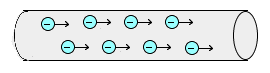 A conducting wire showing how the electrons flow along it. http://www.uvi.edu/Physics/SCI3xxWeb/Electrical/current.gif
|
Lithium batteries are used in most cameras because they provide a fairly constant voltage and power. They also work well in hot or cold temperatures, much unlike other types of batteries (some of which do not function in extreme temperatures). This makes them ideal for things like outdoor photography.