| Contents |
History Of Flight | The Jet Engine |
Control In The Air |
Light Aircraft |
Vertical Take-off |
Helicopters |
|
| Frank Whittle British aero engineer and pilot designed the world's first jet engine even with
inadequate support and money. In 1937 he started the world's first jet engine on his test bench. Hans von Ohain borrowed ideas from Whittle
and in 1939 created the first jet engine aircraft. Modern jet engines work on the same principles as Whittle's early designs but are more
powerful and economic. Air is sucked into the front of the engine and squeezed under great pressure by spinning blades of a compressor.
This is then spayed with fuel and set on fire causing hot gasses blasting backwards pushing the engine forwards. |
|
 |
|
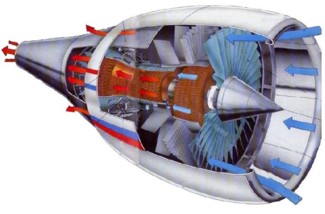
| 1. The Air Inlet: Every second more than one tonne of air is sucked into the inlet however only a small portion passes into the central engine. The rest flows around it to cool the engine and give extra thrust.
|
|
2. The Intake Fan: The huge turbine has over 50 carefully designed blades. The blade tips move 100,000 kph therefore are made of strengthened titanium-metal alloy. |
| 3. The Drive Shaft: The main shaft runs the length of the engine. It is turned by the turbines at the rear, and it carries this spinning motion to the front intake fan and compressor blade.
|
|
4. The Compressor Blades: The drive shaft turns the blades, which are designed to compress the incoming air. The air then flows into the combustion chamber.
|
| 5. The Combustion Chamber: Jet fuel (kerosene) is sprayed into the compressed air in heat-resistant chamber. The fuel and air burn in a continuous and controlled �slow explosion�.
|
|
6. The Turbines: As the burning gasses rush out of the combustion chamber, they make the turbines spin with great force. The turbines are made of heat-resistant materials, which are fixed up to the main drive shaft, making it turn too.
|
|
| Contents |
History Of Flight | The Jet Engine |
Control In The Air |
Light Aircraft |
Vertical Take-off |
Helicopters |
|