|
|
|
| Contents |
History Of Flight |
The Jet Engine | Control In The Air |
Light Aircraft |
Vertical Take-off |
Helicopters |
|
| Control In The Air: |
|
Most aircraft are controlled in the air by three main controls, a rudder on the fin, two elevators on the tail plane, and two ailerons on the wings. They all work on the basic principle action and reaction. An aircraft flying level allows air to run smoothly past it. With the movement of one control disrupts the air stream causing the air to push the control surface. The control surface reacts by moving away and in turn moving the plane with it. The throttle controls the speed of the aircraft by adjusting the amount of fuel and air taken by the engines.
|
 |
|
| Turning: |
|
| In order to turn the aircraft to the right the rudder control surface on the fin to the right, which pushes the planes back end to the left causing the front to swing to the right.
|
|
| Banking: |
|
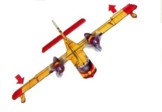
| To turn the aircraft in a smooth and stable method the plane banks preventing it from flipping over. The plane tilts it wings by using the aileron. When turning right the left aileron tilts downward and the right aileron tilts upwards. |
|
|
|