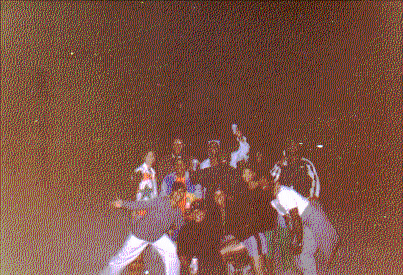
Junkanoo is the national festival of The Bahamas. This festival showcases song, dance and costumes. It has similarities to Rio de Janeiro's Carnival, Trinidad & Tobago's Carnival, Barbados' Crop Over and New Orleans's Mardi Gras. The Junkanoo festival, however, is synonymous to the Bahamas. The celebration is a physical parade (or 'Rush-Out') that is characterized by its music and costumes.
Brief History
Junkanoo, a West African ritual, began as a Bahamian slave celebration to honor the three days they were granted at Christmas time. The slaves, throughout their respective islands, wore masks and played homemade instruments (drums and bells) as they paraded throughout the streets. Even after the abolishment of slavery, the African descent Bahamians still practiced this ritual.
Celebration Dates and Location
The festival is celebrated twice a year. Once on Boxing Day (December 26th) and again on New Year's Day. Both parades begin in the wee hours of the morning (usually around 1a.m.) and end shortly after sunrise. The night-light adds to the mystic of the parade as the music hypnotizes the spectators whilst the costumes mesmerises them. The major parade occurs in the heart of downtown Nassau. Over thousands of Bahamian gather to watch their native festivity.
Junkanoo Groups, Costumes and Music
The first Junkanoo parades in Nassau were not as organized as they are today. These parades would literally be 'rush-outs' as Bahamians would rush from their neighborhoods as a group. The individuals would be dressed in shirts and pants decorated in multi-colored crepe paper.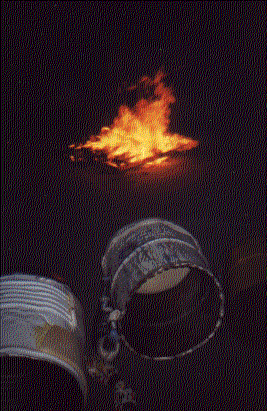 The music would be provided through the beating of goat skin drums, blowing of whistles an horns, and the shaking of cowbells. The first costumes were pieces of cardboard designed and decorated with crepe paper.
Although the parades of the 21st century have grown they still follow the established guidelines of the original 'rush-outs'. The groups are no longer just community oriented but are well organized institutions that plan for the December/January celebrations from as early as June. Both the young and the young-at-heart spend hours decorating (also know as 'pasting up') their costumes, which now a days take on a life of their own. The major groups are huge; some having over 1,000 members whom participate in the parades. Even the music has grown. Major groups now use brass instruments to perform over the rhythmic beats of the drums. The drums are constructed of not just goat's skin but sheep, cow and deerskins have also become common drums. The costumes have also grown as beads, sequences, feathers and glitter are added to enhance the beauty of the crepe paper designs.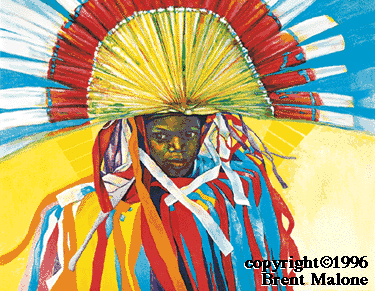
The Poor Righteous Teachers
The 'Poor Righteous Teachers' Junkanoo group was founded in 1992, on the beliefs and values of the original Junkanoo rush-out. The group's first parade was the Quincentenial parade in October 1992 (commemorating Columbus' first landfall). The group's number one philosophy is to HAVE FUN. 'PRT' is an institution: it is one of the strongest 'Scrap Gangs' in Junkanoo (a 'scrap gang' is a group who does the bare minimum required to perform in the parade, just to participate). The group's members span from the United States, United Kingdom, and Europe as well as those 'down-home' Bahamians. PRT is not a Junkanoo group; it is a Junkanoo icon, symbolized by the grocery cart, or 'trolley', that bares its banner.