GEOGRAPHY
The official name of The Bahamas is the 'Commonwealth of the Bahamas.' Firstly, let's dispel a common misconception: The Bahamas is not a single island but instead comprises of a 100,000sq mile 'archipelago' (chain of islands) that extends over 500 miles between southeast Florida and northern Hispaniola (Cuba). The country lies between longitudes 72o35'W and 80o30'W and latitudes 20o50'N and 27o30'N.
'The Bahamas' is named from the Spanish word 'bajamar', meaning 'shallow water'. The country is located along the Tropic of Cancer. However, some of the deepest waters in the world are located in The Bahamas (Specifically 'The Tongue of the Ocean'). The world's third largest barrier reef is also found here.
The Bahamas consists of 700 islands and cays. Out of these, only forty of these are populated. These islands are made of limestone and surrounded by coral reefs. The capital city, Nassau, is located on the island of New Providence. Other inhabited islands include Grand Bahama (home of the second city Freeport), Abaco, Bimini and the Berry Islands, Eleuthera, Andros (the biggest island), Cat Island, San Salvador (first landfall of Columbus), Great Exuma, Rum Cay, Long Island, Crooked Island, Ragged Island, Acklins, Mayaguana and Great Inagua.
CLIMATE
The Bahamas, due to its location, is washed by warm waters from the Gulf Stream and cooled by southerly trade winds. The country is described as having a tropical maritime climate.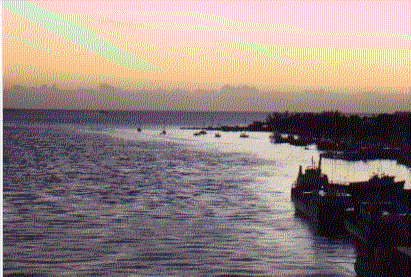 The Bahamas does not fall victim to snow, hail, frost or sleet as its temperatures are quite moderate in the inter; rarely falling beneath 60oF. The summer temperatures seldom rise above 90oF. The humidity is fairly high, especially in summer months. Winds throughout the year are predominantly easterly. The rainy season occurs usually from May - October. The Hurricane Season starts in June and ends in November, with the greasiest risk months being August, September and October.
Below are the monthly average temperatures for The Bahamas:
| Month | Average Temperature(oF) |
| January | 70 |
| February | 70 | March | 72 |
| April | 75 |
| May | 77 |
| June | 80 |
| July | 81 |
| August | 82 |
| September | 81 |
| October | 78 |
| November | 74 |
| December | 71 |