Organisers
Background
Objectives
Methodology
Program
Accomodation
Travel
Steam Tours
Accompanying
| |
Methodology
-
Holistic
Approach: There are
several preconditions to developing potentially successful models in sustainable
development. One of these includes
relevant local approaches: in the context of DHR, non-western models will be
critical to ensure that the local values are embedded in the developmental
processes. Another will be a
holistic approach to natural and cultural environments and to movable and
immovable heritage resources, including tangible and intangible elements. These
are diagrammatically represented below.
Holistic
Representation of Cultural and Heritage Resources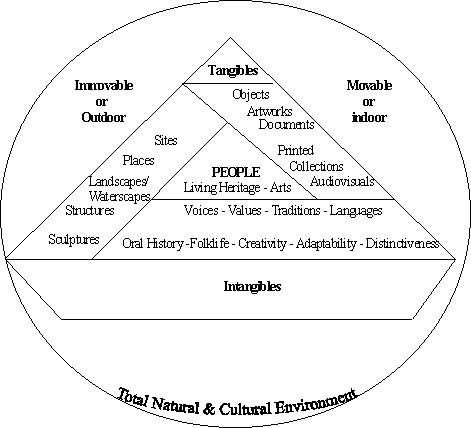
Reproduced
from Amareswar
Galla,
‘Authenticity: rethinking heritage diversity in a pluralistic framework’,
Nara
Convention on Authenticity in Relation to the World Heritage Convention.
World Heritage Bureau, UNESCO, Paris, 1995, pp. 315–322.
-
Preparing an appropriate model: Collection of Information of earlier studies and
practices in preserved heritage Railway operation from the
Festiniog Railway in Wales, UK, Puffing Billy in Victoria, Australia and
Semmering Railway in Austria.
-
Benefit from an association: Bring together the people, employees, stakeholders,
professionals, institutions, agencies, industry & government to undertake
capacity building for sustainable development.
-
Interpretation: Assess, appraise and evaluate heritage and resources for development
and presentation.
-
Stakeholders Workshop: Interaction with CEO’s, Stakeholders, Management
& Employees in all resource areas. Also, sensitise all concerned to the
current and potential threats and to the possible opportunities.
-
Stakeholders Workshop: Interaction with CEO’s, Stakeholders, Management
& Employees in all resource areas. Also, sensitise all concerned to the
current and potential threats and to the possible opportunities.
Principal
Technical Advisor, Chairman, Convenor & Resource Persons
Resource
Information: -
-
Layout of
the Section, bridges, level crossings, waterways/drains, landslide prone area,
Pagla Jhora area & buffer zones
-
Stations
– Darjeeling, Ghum, Sonada, Kurseong, Tindharia, Sukna, Siliguri
-
Locomotives
& other Artifacts (Including Archives)
-
Tindharia
Workshops
-
Offices,
other maintenance facilities
-
Hillsides,
valleys. Topography, plantations, settlements
-
Cultural
& Community Links, Stakeholders/Heritage bodies for Sustainable development
Form
Categories: -
-
CEO’s
– Government, Public, Private, Donors
-
Stakeholders
& Stakeholder
Community Leaders–In the World Heritage Area and beyond.
-
Management
– Railways & Civil Services
-
Staff –
Employees and other workers
Form
Groups in Architecture, Material, Natural & Intangible: -
-
Architectural
– Stations, Buildings, Offices, Houses & Misc Constructions
-
Artifacts
– Locomotives, Other Artifacts, Archives
-
Natural
– Layout, Buffer Zones, Track, Bridges, Land Management, Afforestation, Water
Course
-
Management & Hill side strengthening, Encroachments, Signage,
Hoardings
-
Intangibles
– Arts, Crafts, Folklore
Interactive
sessions & field visits of participants to associate people of the World
Heritage area, Group Presentations
-
Reports: The workshop will possible be followed up with
the formation of a suitable project team of professionals & Employees in
order to develop appropriate themes and organize a donors conference in late
2002.

|
 Stakeholder
Workshop on Darjeeling Himalayan Railway (DHR)
Stakeholder
Workshop on Darjeeling Himalayan Railway (DHR)