 Stakeholder
Workshop on Darjeeling Himalayan Railway (DHR)
Stakeholder
Workshop on Darjeeling Himalayan Railway (DHR)


|
|
|
Darjeeling
is a popular hill resort in India. It is situated in the North of West Bengal.
“Darjeeling” means the place of the “DORJE”, the mystic thunderbolt of
Lama region. This place is flocked by Tribes from the neighboring areas of West
Bengal, Nepal, Sikkim, Tibet and Bhutan.
While Darjeeling was growing, Rawland Macdonald Stephenson was crusading his
battle for Railway extension in India. He
promoted 'East India Railway Company' [EIR].
On August 15, 1854 the first train steamed off from Howrah to Raniganj
and extended upto Silliguri in the middle of 1878. The option of reaching Darjeeling from Silliguri was by 'PALKI'
and 'Bullock-Cart' etc. Franklin Prestage, the agent of
'THE GUARANTEED EASTERN BENGAL RAILWAY' took up the agent-ship. At that
time E.B.R. had no plan to take Rails to the Hills, because the hills were
considered a formidable sphere where E.B.R./N.B.R. failed as corporate
organisations, Prestage however, succeeded as an individual entrepreneur. His
confidence was based on the belief that a line substantially reduces the cost of
Bullock-Cart transport between plains & Darjeeling: Rice was Rs.98/- a ton
at Siliguri and Rs.238/- Darjeeling. A
Railway could cut down the cartage rate by as much as a half and still earn a
good profit.
The genesis of the Darjeeling Himalayan Railway (DHR) is significant both
economically and in engineering terms. The railway broke new ground in India in
both domains. It was the first
railway in India built exclusively with Indian capital. The immense reduction in
transport costs to and from Darjeeling guaranteed plenty of traffic and hence a
reasonable return on the investment, thus facilitating its financing, which ran
to Rs.2.8 million. The journey time from Calcutta to Darjeeling was reduced from
5-6 days to less than 24 hours, thus enabling Darjeeling's development as a hill
station and holiday destination.
In 1878, Prestage submitted a detailed scheme to the Government of Bengal. The
Lt. Governor Sir Ashely Eden sanctioned this. Accordingly, a contract was made
dated 8/4/1879 between Secretary of State & Franklin Prestage. The
government land and right to use the existing Cart Road was granted free of
cost. Prestage settled for a 2 ft Rail Gauge and formed "The Darjeeling
Steam Tramway Co" with capital fully subscribed in India. By 1887, Rupees
28,00,000/- had been spent which was almost Rs.60,000/- per mile. Motive Power
and Rolling Stock cost a mere Rs. 10,000/-. On Sept. 15, 1881 the title of
Company was changed to 'Darjeeling Himalayan Railways' {DHR} Co'.
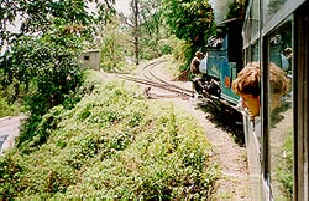
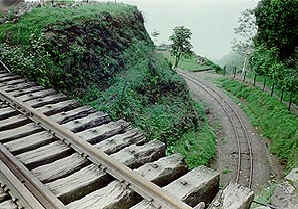
From an engineering viewpoint, surveying the route was a daunting task,
however, great ingenuity was shown in overcoming natural obstacles and
maintaining the nevertheless steep gradient at a level which could be run by
adhesion only, i.e. as an ordinary railway without the use of rack mechanism or
cable. This was achieved in three ways: - 1.
Zig-Zagging and Criss-Crossing across the Hill Cart Road - entailing over
150 crossings en route; 2.
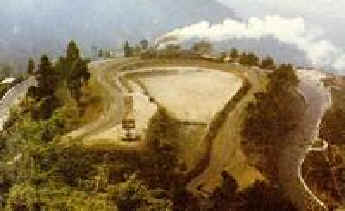
Running a loop where the train describes a full circle to finish at a
similar spot some 20 feet higher; 3.
Reversing on a Z-shaped layout where the train runs forward, reverses
backwards up the slope, then proceeds forwards again parallel to the approach
line but at higher altitude. These
solutions led to low Engineering investments by maintaining the alignment of
hill cart road, obviate the need for tunnels, need only small bridges very close
to the side of the road and yielded an average gradient of 1 in 30, rising to 1
in 20 in places. Gillander Arbuthnot & Co. constructed this engineering
masterpiece from 1879 to 1881. The progress of construction & opening the
sections by DHR was as follows: -
i.
Siliguri
to Kurseong
31¾ miles
on 23/8/1880,
ii.
Kurseong
to Sonada
10 miles
on 2/2/1881,
iii.
Sonada to
Darjeeling
9 miles
on 4/7/1881
iv.
Darjeeling
to Bazar
¼ miles
in 1886.
The DHR line rises a total of 6850 ft over its 87.48 kms length passing through
tunnels, 'Loops' and 'Z' reversing stations. The gradient is steady around 1:28
and maximum gradient achieved is 1:22.5 which is almost the limit of a pure
adhesion Railway. From New Jalpaiguri to Siliguri it runs along the plains at
speeds upto 28 kmph. At Sukna the climb begins and speed reduces to below 15
kmph, continuing uninterruptedly to the 7407 ft summit at Ghum, then descending
the final 5 miles into Darjeeling. Ghum has the distinction of being the second
highest conventional summit railway station in the world (after Cuzco in the
Andes which operated tourist trains in season time around once a month).
However, for regular passenger operation, Ghum is the highest Railway station in
the world.
After independence in 1948, the Government of India acquisitioned DHR and
amalgamated them into Assam Railways. Presently,
DHR/Assam Railways is known as N.F.R. (NORTHEAST FRONTIER RAILWAY). The narrow
gauge Railway to Darjeeling now
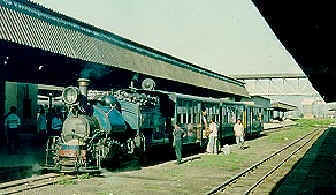
starts from New Jalpaiguri, 3 miles from Siliguri. There are many trains from
Howrah, New Delhi, Trivandrumand Mumbai and other major stations all over the
country bringing tourists to Darjeeling, the Eastern Hill - Queen. There
is a renewed interest in rehabilitation, revival and preservation of DHR in its
primeval form. This is also attributable to the movement for preservation of
Steam traction.. There has always been an interest in this train all these years
in the Indian Railways. This has ensured that the DHR continues to operate
notwithstanding losses over the years. Restorations whenever necessary have been
carried out keep the system working. Without modernization and major inputs the
DHR has continued to perform. It is also to the credit of Tindharia workshops to
keep the locomotives surviving, some of which are over 100 years old and the
youngest is about 70 years old. The construction of the Railway is one of the
greatest engineering feats of the 19th century. The Darjeeling
Himalayan Railway Heritage Foundation (DHRHF) was set up at the initiative of Mr
Tenduf in India in 1994. It led to the formation of the Darjeeling Himalayan
Railway Society (DHRS) in United Kingdom (UK) and a Darjeeling Himalayan Railway
Society in Australia. Landslides
have caused severe disruptions right from the beginning. However, the Railways
have always gone ahead and done the restorations. During the monsoons of 1998,
an unprecedented landslide took place disrupting the track mainly at two points.
Both the track and road were washed out and fallen down the hills. As the road
runs together with the rail, some of the road restoration took the track
alignment. Many imagined that the track would possibly never be restored again.
However, the Railway rose to the occasion and the work has been completed. A new
alignment was necessary over as many as 7 short new bridges, new track, grading
and curves. The line is operational all through once again. During 1999 even
while the DHR was closed due to landslides; Station buildings were given a
face-lift, the roof of the Ghoom station building which was blown away was
replaced to restore the original form, a garden was made to adorn Ghum station,
improvements in Rolling stock were made, water supply was improved and many
other works were carried out.
For the long term, the Railway Board is considering many initiatives. Planning
is on in key areas affecting viability, modernization, track inputs &
tourist interests. For passenger operation diesel engines have been introduced.
These have reduced the journey time. For tourist operation, appropriate steam
services are being considered with new coaches. A new tourist train has been
started between Darjeeling & Ghoom. Necessary track and building inputs are
being provided. Back to Top
|
|
Convenor Rajesh Agrawal Director, National Rail Museum Chanakyapuri, New Delhi 110021 India. Tel: 91-11-6880804, 3304137 Fax: 91-11-6880804 Web: http://www.railmuseum.org Email: [email protected] Last Updated: Sunday, October 07, 2001 10:38 AM |
