| Super Twin21 Baja |
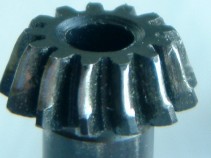
| I am sure that the hardened steel, helical cut ring and pinion gears that come on the Hyper-7 buggy are strong enough to withstand the abuse from 2 engines. I think the root of my stripped gear problems before was flexure of the plastic transmission housing under heavy loads, causing the gears to separate and de-mesh. If the housings are all aluminium as they will be in the new car, I won't have any problems. I can even upgrade the diff casings themselves to aluminium, as they are available for the Ofna Dominator truck. Being so large (bigger than a 1:6 FG Marder buggy), I will need longer driveshafts on all 4 wheels and for the central transmission. My current plan is to cut and extend my current shafts using home made steel collars. I have looked into industrial drive shafts with sliding splines, but they are really expensive and usually limited to 1000 RPM. I do not have the equipment to make my own driveshafts from scratch, also they need to be hardened where there is sliding contact (dogbones). The bearing housings for the rear gearbox will be accurately machined using a faceplate on my lathe - on the Proto speed car I achieved a press-fit using this method. For seats made slightly bigger than press fit, bearing adhesive can be used. My current plan for the front gearbox is to use the stock plastic from the Hyper-7, as there is far less stress on the front and it should not suffer from breakage. Stress can be reduced greatly on both front and rear by fitting a centre diff, but at the moment I intend to use the spool I made for the Twin21 truck. |
| TRANSMISSION SYSTEM |
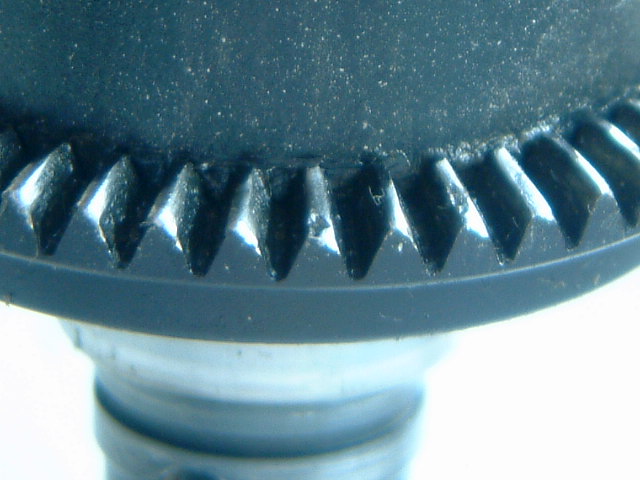 |
| What I am trying to prevent :( The result of the previous Twin21 truck |
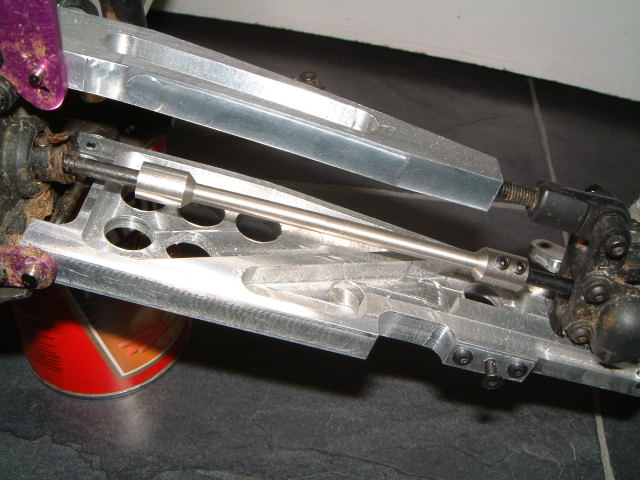 |
| Stainless steel drive shaft extension. These allow me to keep the standard shafts from the Hyper-7 so I don't need to make new, complex CV joints. They attach to the stock shafts with 2 grub screws at each end, which lock on to a flat ground on to the shaft. |
 |
| I am sure that the hardened steel, helical cut ring and pinion gears that come on the Hyper-7 buggy are strong enough to withstand the abuse from 2 engines. I think the root of my stripped gear problems before was flexure of the plastic transmission housing under heavy loads, causing the gears to separate and de-mesh. If the housings are all aluminium as they will be in the new car, I won't have any problems. I can even upgrade the diff casings themselves to aluminium, as they are available for the Ofna Dominator truck. Being so large (bigger than a 1:6 FG Marder buggy), I will need longer driveshafts on all 4 wheels and for the central transmission. My current plan is to cut and extend my current shafts using home made steel collars. I have looked into industrial drive shafts with sliding splines, but they are really expensive and usually limited to 1000 RPM. I do not have the equipment to make my own driveshafts from scratch, also they need to be hardened where there is sliding contact (dogbones). The bearing housings for the rear gearbox will be accurately machined using a faceplate on my lathe - on the Proto speed car I achieved a press-fit using this method. For seats made slightly bigger than press fit, bearing adhesive can be used. My current plan for the front gearbox is to use the stock plastic from the Hyper-7, as there is far less stress on the front and it should not suffer from breakage. Stress can be reduced greatly on both front and rear by fitting a centre diff, but at the moment I intend to use the spool I made for the Twin21 truck. |
| UPDATE - 28/11/04 I've made a lot of progress on the car now. The main chassis is getting close to being finished. On the transmission side, I have the rear gearbox complete! Its taken a good month to get this part right, but I am very happy with the result as it is. This has to be the toughest gearbox in RC! |
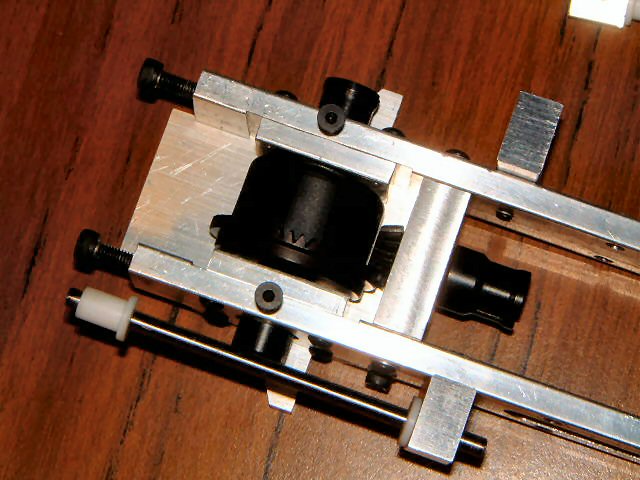 |
| Rear gearbox with lower plate removed. The insert plates either side of the diff hold the bearings that the diff spins on. The diff, pinion and bearings are lifted straight from the Hyper-7 - all the rest is custom. That rod is one of the rear hinge pins on its solid teflon bushes. Rear hinge pin brace not shown. |