| I Home I Artwork I Current Projects I Blog I Email I |
| Favorite Links: |
 |
 |
| Practical Infrastructure
Infrastructure is the material expression of the ideas, values, and motives. It is the means to achieving the human objective. As a collection of tools, it composes things like buildings, transports, factories, and communication networks. Its greatest expression in the late twentieth century rested in the city. These great gardens of man were intended to facilitate the achievement of the human goal. Infrastructure rests essential to all forms of human society. To address any potential utopian lifestyle, one must consider it. Infrastructure should be conservative. Its capacity to destabilize the surrounding biosystem can be minimized in this way. This can be achieved by sticking to design that is essential to its purpose. Form follows function. This defines the beauty in the design. A conservative disposition can also be maintained through the use of recyclable materials for construction. Aluminum, plastic, and glass components can be reused to serve a multitude of purposes through time. Energy used to run the machine should also be renewable. Wind and solar energy as well as agricultural derivation predominate. In addition to the smallness, there is a quest for social equity that should also prevail in design. Infrastructure should be composed of simplistic technique and components so that anyone can accomplish its construction. To do this, a basic language of form must be established. This allows the machine to be composed of a small number of interchangeable parts. It is possible to construct an example of such a system. In it, there are a limited number of system components necessary to make design successful. These components are steel conduit, reinforced concrete or masonry, plastic sheet, wire, cut lumber, pipe, aggregates, and organisms. Conduit is used to construct geodesic domes and struts for shelters and bridge supports. Reinforced concrete a stone masonry is used to build foundations and retaining walls. Plastic sheeting is use to build inflatable walls for geodesic domes and NFT troughs. Wire is used for tensional support of hangers, plants, and towers. Cut lumber is used to produce flooring and furnishings for shelter. Pipe is used to transport water and waste. Aggregates include soil, recipes, fertilizer and other chemical mixtures, and mulch. Organisms are the plants and animals that serve as sources of food and medicine. There are also a number of specialized �gizmos� that also make the system work these include things like water pumps, active and passive solar panels, fuel cells, blowers, electrical wiring, generators, light bulbs, plastic film tracking, bolts and screws, and control systems. With these ingredients the designer secures basic human needs like shelter, food, heat, waste treatment, and energy for the inhabitants of the system. With a few more industrial devices, communication, transportation, and information storage and retrieval can also be achieved. The Vocabulary of Forms Frank Lloyd Wright insisted form should follow function when one designs a building. But to be an effective executioner of construction, one must have an understanding of valuable forms and their potential uses. If one has no understanding of the essential nature of the system, how can they apply it in practical ways? To begin the construction of infrastructure one must first commit to analysis the potential variations of form that hold possible its resolution and character. There are different ways to begin the examination. One way is the construct the form in a material exposition. Models make excellent tools when one wishes a visual on an object. Glue, tape, and construction board used with tools like rulers, pencil, and cutters make in miniature the creator�s imagination. Models may also be graphic. Drawings can also expose the essential character of form. If the form is Euclidean, it�s also possible to expose it to mathematical analysis. Relationships between elemental dimensions and surface area, mass, center of gravity, and volume can be found. These can instill the essential usefulness and determine the model�s value. With this analysis in mind, coupled with graphic exposition, the character of various systems can be examined. A vocabulary can be developed that will instill the means to becoming an exceptional designer of practical infrastructure. For example: an analysis can be made of various geometric systems relating surface area to volume. |
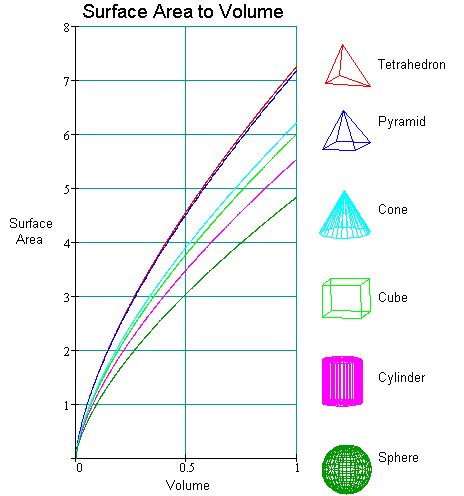 |
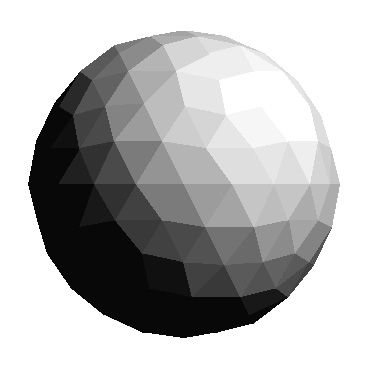
| What one discovers is that a sphere uses less surface area than tetrahedrons, pyramids, cubes, cylinders or cones for the same amount of volume. This suggests a sphere is the most efficient means to contain space, requiring less material to do the same job. The geodesic imitates the value of the sphere in containing space. |
 |
| At the same time a physical analysis of stability will find the tetrahedron more stable than all other geometric systems. In fact, it is with structural stability that the tetrahedron finds its greatest praise. The following struts make use of the tetrahedrons strength. |
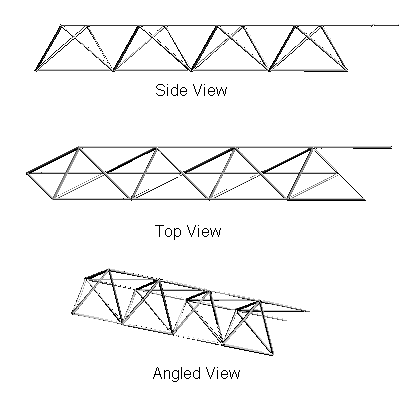 |
| Fasteners lay at the ends of each rod holding firm each one�s position to the other. This assures a system wholly unalterable beyond the destruction of the bars or the fasteners themselves. These struts can be used to span distances or provide vertical support. Such are the advantages of the popular space frame.
So with just these two examples a vocabulary of forms has begun to emerge: � Spheres or geodesic domes do the most efficient job of containing space. � Tetrahedrons are structurally the most stable of the systems and should serve as support units. These two ideas combined offer a generic means by which to build bioshelters. The geodesic dome built out of space frame tetrahedrons can span great distances. In this, the system affords its inhabitants protection from the elements while they lead lives unencumbered by unpredictable climate changes and extremes. Once one builds the dome anything can be constructed within. The Measurement of the Form A design that must be measured is not worth building. If construction requires skills beyond that of the common man then it�s likely grounded in doctrines of exclusivity rather than inclusive. The requirement for inclusively is to find materials that entail simplistic integration. For example, cylindrical pipe and rods whose ends are round are superior to rectangular beams. Wood studs 2x2, 4x4, or 6x6 whose ends are square are superior to 2x4 or 2x6 that have ends rectangular. Razor thin polymer or metal sheets are superior to wood panels that have thickness when it comes to dividers or walls. What this means is that when I build something, whether a solar panel, greenhouse, a flower bed, or a piece of furniture, I do it without ruler, yard stick, or tape measure. When people ask me,� How high is that wind mill?� I reply, �About that high.� �How large is your greenhouse?� I pace out in front of them its approximate breadth. Then, I point to a distant object to show its length. I go the way of the Greeks armed with no more than a compass, level, and common sense to rendition my design. The length of a geodesic dome�s strut isn�t what�s important. What�s important is how that strut�s length is with respect to all the others. Space frames work the same way. The units by which these components are measured are irrelevant. What is important is that they are measured relative to one another. In this, I am free to appeal to the essence of the designs mandate rather than the material�s oddity. The key is to bring the materials close to geometry�s ideal rendition. Geometric lines and planes often lack material practicality. They lack the thickness matter needs for strength. A strut needs substance if it�s to withstand forces of tension and compression but this substance must remain symmetrical about support systems and non-existent when it�s absolutely not required. In doing this, the builder is allowed freeform construction with little regard for material limitations. |
 |
| Pyramids
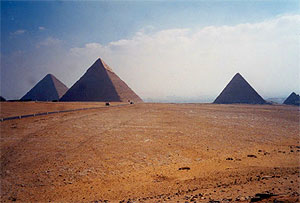
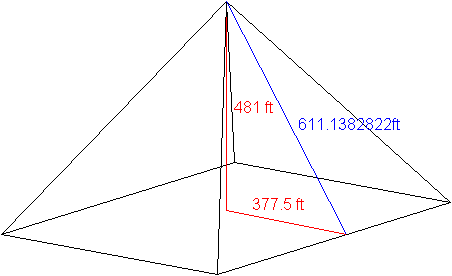
For those artists that need something to measure, why not instill a representation of geometric abstraction into the construct? For example: the Egyptians built the great pyramid of Giza with an almost sacred reverence to geometry and astronomy. It�s almost as though they were trying to tell us, �Hey we knew all about this stuff long before you guys figured it out!� Consider the following: The base of each side of the great pyramid is 755 feet. The structure�s original height was 481 feet. The sloping angle of the pyramid�s side is approximately 51 degrees. Take the total length of all four sides at its base and divide it by its height multiplied by 2 and one gets a number that approaches Pi. |
 |
| In this, the length about the base represents the circumference of a circle while the height represents the circle�s radius.
If one takes the length from the midpoint of one of the bases edge to the center of the pyramid�s base (half the base edge length), square this value then add that to the squared value of the height one can use the Pythagorean theorem to find the length from the base of the pyramid�s edge to its tip. |
 |
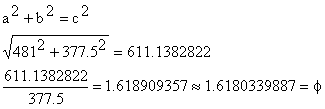 |
| By taking the length from the pyramids base to its tip and dividing this by half the base edge length, one approaches the value of Phi. This value is the famous golden ratio we see throughout human artistry. It is believed that Phi is an inherent balance people gravitate toward aesthetically. This would explain why it reappears over and over again in architectural and artistic form throughout antiquity.
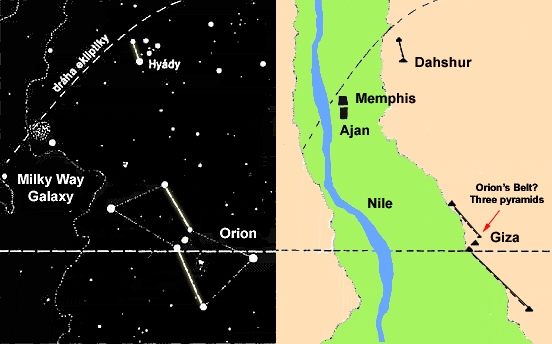
Each side of the pyramid is carefully aligned with each of the cardinal points of the compass, north, south, east, and west. The essence of such precision is impractical by the standards of the age. Furthermore, the entire Giza plateau may serve as a star chart for the constellation Orion, the three pyramids representing the three stars on Orion�s belt and the Nile representing the Milky Way Galaxy. |
 |
| Abstractions in mathematics, astronomical and seasonal observations, even a map or representation of stellar or even terrestrial configurations are worthy of measurement in an artists expression of design. Like the Egyptians and their pyramids, these give the human infrastructure its power and it suggests to any future archeologists that we too had a basic understanding of nature and mathematics. In this we can communicate with the future and they, in turn can hear from the past. While most things humans construct should be impermanent and transient you can be sure that representations of or world, its continents, rivers, and seas, mathematical constants and proofs, every chemical and physical equation, a Rosetta stone of the language for which we speak, the times for which we date ourselves should be etched in stone if not bronze. Better this is done by all the souls that inhabit our planet in every quarter and in every home. We need to avoid the failures of the library at Alexandria. Maybe in this no information will be lost should our civilization be visited by another dark age.
My Material Utopia There are as many utopias as there are dreamers willing to weave them. The following elements constitute the material aspects of my version of the ideal. In these the basic necessities people require are provided. These needs are shelter, energy, food production, transportation, and communication. I welcome any suggestions, additions, and alternative renditions you might have to offer. First and foremost, the iconic and tell tale signs of my material ideal are the geodesic dome, space frames, and solar collectors. These have the advantage in that they are portable, light weight, and are easy to assemble and dismantle. |
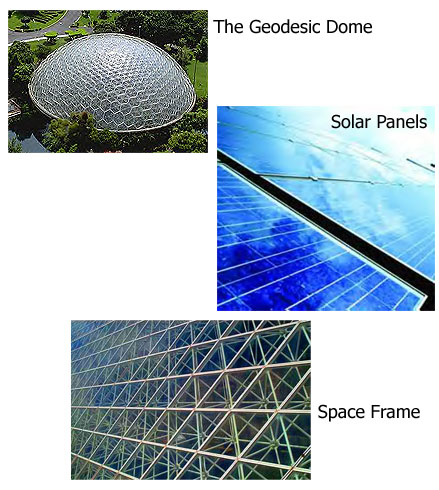 |
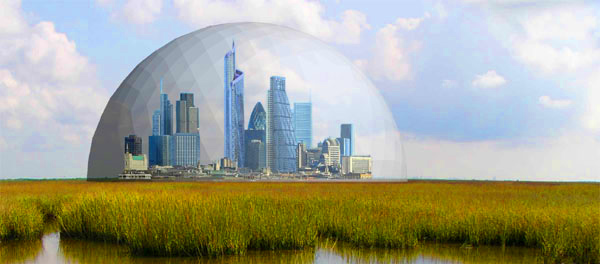
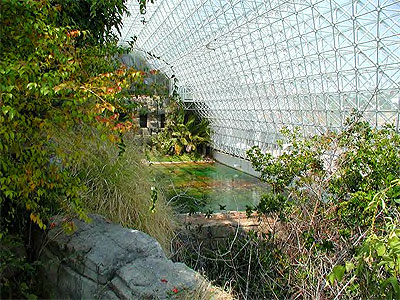
| The geodesic serves as the primary structural element serving as the bioshelter. Within this people can work, grow food, exercise and play protected from the outdoor extremes and adversity. The dome can be as small as a house or as large as a city. |
 |
| Space frames have the advantage of not having to rely on gravity to maintain their integrity. They take advantage of the stability of a tetrahedral support system. They have proven to be very durable and reliable while being light weight and cheap to manufacture.
Photovoltaic solar panels coupled with voltage regulators, fuel cells, and inverters would power everyday activities. Active solar collectors will be used to heat water and supplement temperature regulation within the bioshelters. |
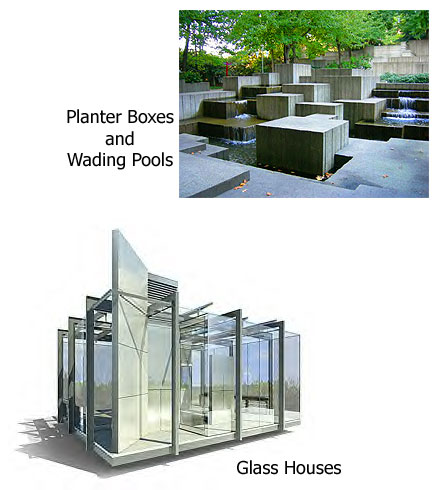 |
| Other elements might include concrete wading pools and glass construction. Pools and waterfalls serve as baths for people while surrounded by hanging epiphytes and flowering herbs. Glass walls reveal a society transparent unto itself holding no secrets or covert ambitions. Shelter and nature merge. The human spirit is allowed to return to its source and finds home to all the world�all the Universe. These are the things such transparencies reveal. |
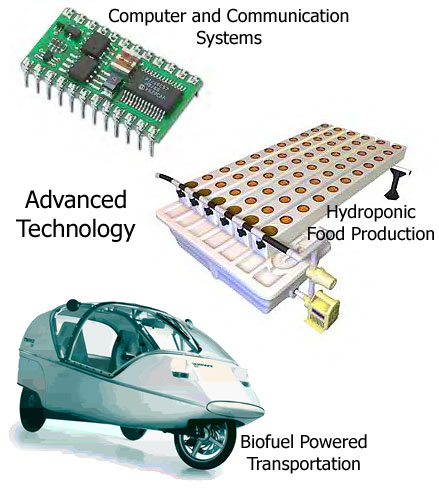 |
| The ideal should also embrace some new technology. Computers and communications systems should be used to govern climate, energy, and material distribution. Robots will replace people with respect to menial chores. Hydroponics will supply fresh, clean produce. People may elect to collect their meals from the hanging gardens about their patios and open spaces around their living quarters and baths. Transportation vehicles will run off of renewable biofuel and solar generated electricity. |
 |
| Intangible Beauty
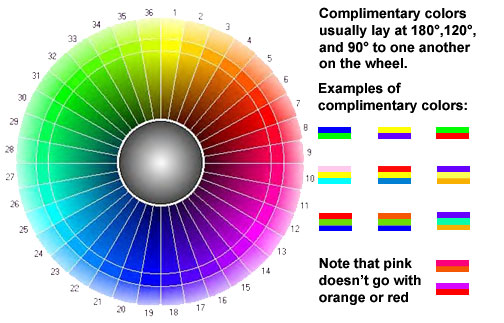
There are methods we deem the artist�s forte that I don�t plan to dwell upon too much here. I do want to mention that color is very important. When choosing color schemes, choose colors that compliment each other. These are colors that appear at 180�, 120�, and 90� to one another on the color wheel. Adjacent colors like pink and purple compliment one another and are complimented by single or adjacent colors opposite them. These colors can be intense and bright or light and pastel. |
 |
| Furthermore I can�t imagine a world without music. My favorite instrument is the acoustic guitar but I also enjoy playing and listening to the harp. Also, nothing beats a woman�s voice singing. I�m not talking opera here, just plain simple singing. I also like the sound of young women laughing, distant crashing waves, birds chirping and twittering in the early morning, and chimes. There are also elements like the feel of a gentle breeze on an open grassy plain, the sight and smell of flowers in the garden. I�m not sure why but the most serine times in my life had these elements in them. They complete an ideal�they complete my version of paradise on earth...my Utopia. |
 |
 |
 |
 |
 |
 |
 |
 |
 |
 |
 |
 |
 |
 |
 |
 |
 |
 |
 |
 |
 |
 |
 |
 |