| I Home I Artwork I Current Projects I Blog I Email I |
| Energy for the Future |
 |
 |
| Non-Renewable Energy Sources
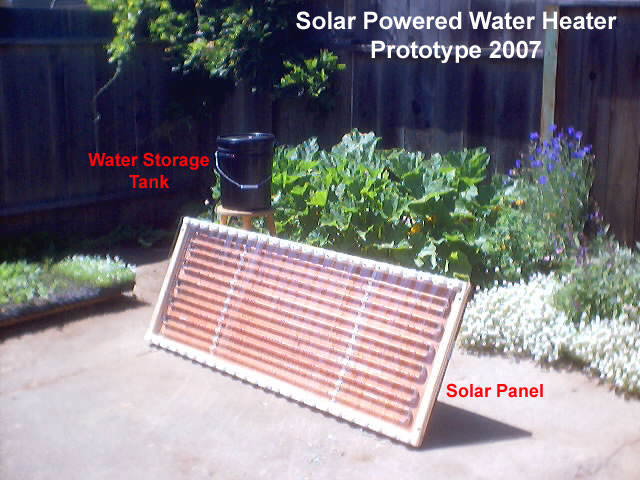
Natural gas Coal Petroleum The greatest disadvantage in the use of these energy sources is that they are non-renewable. They will eventually run out. There are also environmental consequences through their use. Global warming has been partially attributed to their widespread consumption. As carbon is reintroduced into their biosystem, global temperatures will rise. This will cause abberative weather patterns causing unforeseen deficits in the biological foundation of human society. Nuclear Energy The issue of safety falls into question with the use of nuclear power. The radioactive hazard of this energy source makes the nuclear option dubious to say the least. There is always the possibility of accidents with the operation of these plants. A nuclear meltdown could cause radioactive poisoning of huge areas of human as well as animal habitat. There is also the question of dealing with the spent fuel which remains dangerous for as much as a thousand years. Renewable Energy Renewable energy exists in unlimited supply. But some forms seem more advantageous than others. Geothermal - The biggest disadvantage of geothermal generation of energy is that it�s not available widespread. Most homeowners don�t have their own geothermal spring in their backyards. Hydroelectric - Dams are known to interfere with migrating habits of fish. They also lead to short term environmental changes above and below stream. see grand canyon Wind energy is cheap, easy, and readily available to individuals. But wind generators can block beautiful scenery. The blades of the vanes have also been known to kill large numbers of birds. Solar: The Best Alternative Solar energy holds the greatest appeal of all the energy sources. Solar panels can readily be incorporated into architectural design. Passive solar uses placement of windows to make the greatest advantage of solar gain during the cold season. Active solar forces air or weather through panels, usually mounted on the rooftops. This air or water is subsequently used to heat the building or provide warm water for bathing or cooking. Here�s a simple hot water heater I built one Saturday afternoon while living on the California coast. |
| These types of devices were really popular after the oil crunch of the seventies. Government subsidies were going out to homeowners who went solar and everyone was trying to get on the band wagon.
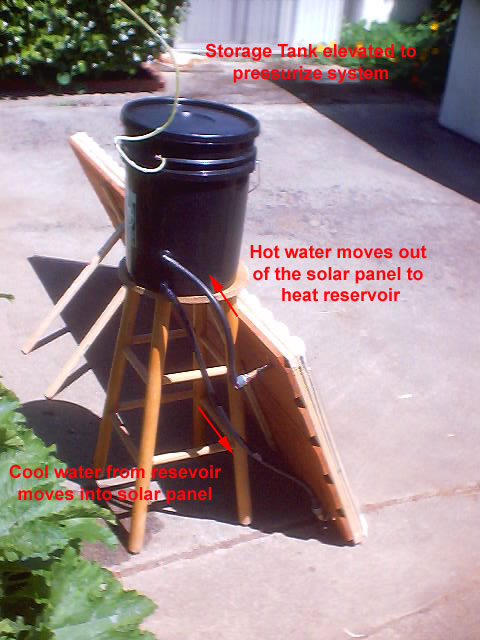
This one makes use of a reservoir to provide an ample supply of steamy tea kettle hot water. An air hose fed by an air pump is planted in the upper black hose to bubble hot water from the panel to the reservoir. |
| The same principles that operate this water heater can also be used to actively heat air. Replace water hoses with air ducts and bubbler with a blower. Warm air moves out of solar panel to any place the blower can push.
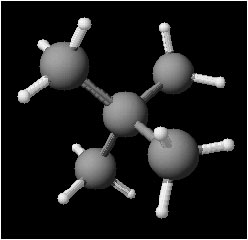
Photovoltaic Photovoltaic has the disadvantage of initial manufacturing cost. But this may be off set by the longevity of these panels. Photovoltaic cells are made of special materials called semiconductors. Silicon is the most commonly used. This is because of silicon�s special chemical properties. Silicon has fourteen electrons. These electrons are arranged in three different kinds of shells. The first two shells are entirely full but the outer shell is only half full with four remaining electrons. This allows the element to form a crystalline structure where one atom form a bond with four other neighbors. |
 |
| Pure silicon crystals conduct electricity poorly for they have no free electrons to serve conduction. The electrons are locked up in the crystalline structure. Solar cells are composed of silicon with impurities. Consider silicon with an atom of phosphorus. Phosphorus has five electrons in its outer shell, not four. Phosphorus still bonds with four other silicon atoms but has one extra electron.
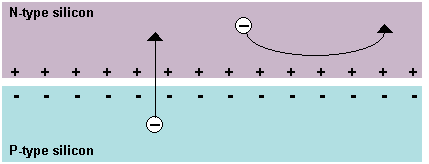
When energy, like heat, is applied to pure silicon it can cause a few atoms to break free of their bonds, leaving their atoms. A hole is left behind when this happens. These electrons will travel about the crystal lattice looking for another hole to fall into. They are called free carriers and carry electrical current. There are so few free carriers in pure silicon that it is of little use. But impure silicon doped with phosphorus works differently. It takes a lot less energy to knock loose one of those extra phosphorus electrons. In fact, most of these electrons do break free. Silicon doped with phosphorus is called N-type silicon. Actually, only part of the solar cell is N-type. The other part is doped with the element boron. Boron has but three electrons in its outer shell instead of four, yet, it bonds with silicon as phosphorus. Silicon doped with boron is called P-type silicon. Solar cells are composed of both N-type and P-type silicon. When these are placed in contact with one another, the free carriers on the n-type side make a mad dash to fill the free holes on the P-type side. This results in an electromagnetic field, that over time makes it harder and harder for free electrons to cross the barrier to the P-type side. Equilibrium is reached preventing all the free holes from being filled by free carriers. Once this occurs the electromagnetic field, doped with silicon, serves as a diode allowing electrons to travel only from the P-type side to the N-type side of the cell. |
 |
 |
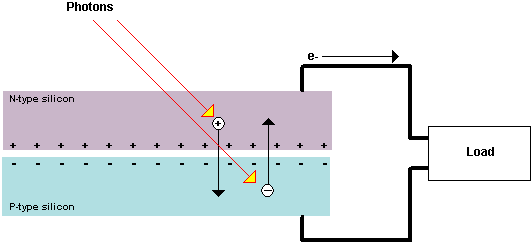
| When light hit�s the cell, a photon can displace an electron attached to a phosphorus atom. If this happens close enough to the electromagnetic field, or if the free carrier or free hole happens to wander close enough to the region of its influence, the field will send the electron to the N-type side and the hole to the P-type side. This causes disruption to the cells neutrality. If one connects an external current path, the transfer of electrons from the N-type side to the P-type side can be made to do work. |
 |
| Silicon is a very shiny material so an antireflective coating is used on cells. A glass cover plate is also used to protect the cell from the elements. |
 |
| The Basic Photovoltaic Set-up |
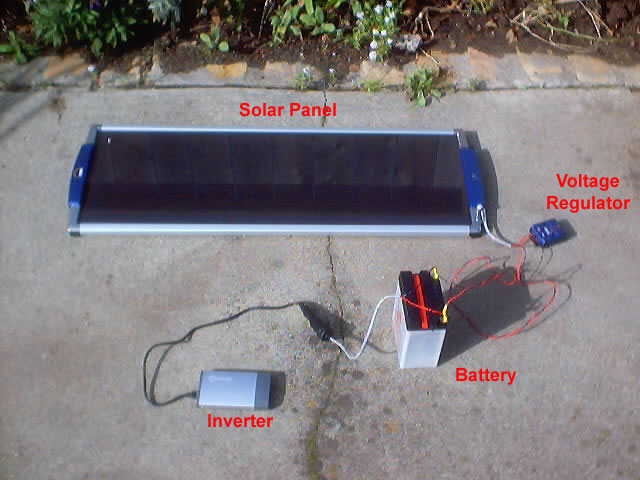 |
| The basic photovoltaic system is made of four parts. First, the solar panel collects the sun's light and converts it to electricity. This electricity is stored in batteries or fuel cells. Attached between the batteries and the solar panel is the voltage regulator. |
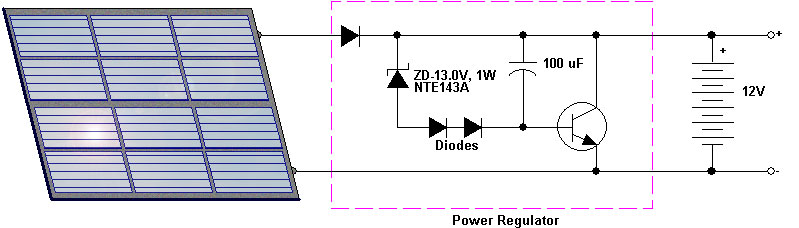 |
| The voltage regulator or power regulator keeps the solar panel from overcharging the battery reducing it longevity. Also attached to the battery is the inverter. |
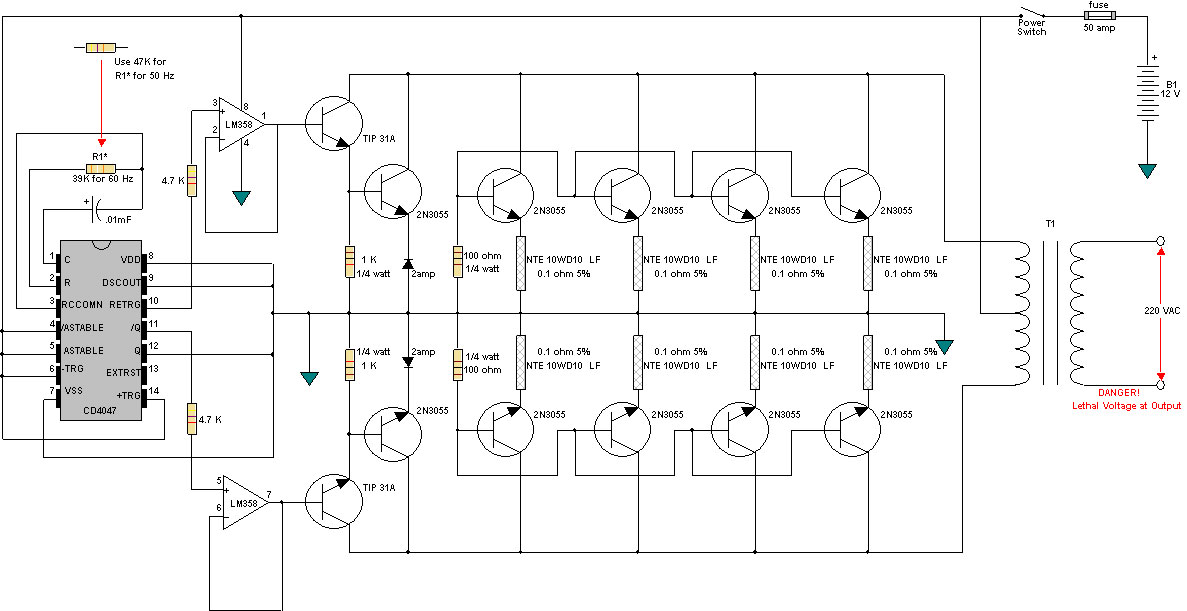
| The inverter converts low voltage battery power into practical 120 volt AC current.
Energy Storage A hydrogen fuel cell system seems the best way to store energy chemically. Much like a battery, a fuel cell is very efficient at converting chemical energy into usable electricity when needed. When energy is being stored, electrolysis converts water into free hydrogen and oxygen. The hydrogen is stored for later use. When electric power is needed, the fuel cell or electrochemical conversion device combines the hydrogen with oxygen to yield water and usable electric current. The current is strong enough to drive even an electric motor. This process produces very little pollution. |
 |
 |
| Favorite Links: |
 |
 |
 |
 |
 |
 |
 |
 |
 |
 |
 |
 |
 |
 |
 |
 |
| Related Links: |
 |
 |
 |