 |
|
|
|
|
|
|
|
|
|
|
|
|
|
|
|
|
|
|
|
|
|
|
|
|
|
|
|
|
|
|
|
|
|
|
|
|
|
|
|
|
|
|
| Home | Artwork | Current Projects | Blog | Email | |
|
|
|
Robot Visions
Electronic governance, artificial intelligence, hydroponics, automated manufacturing
|
|
|
|
 |
|
|
|
Ralph McQuarrie
|
|
|
|
|
|
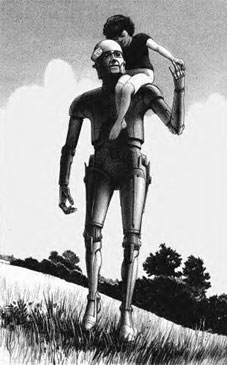
Since I was a child I have held an utter fascination with robots. For a kid that seemed to move around a lot and made only temporary friends, robots seemed the solution to acquiring more permanent friendships. Oh, how splendid it would be, if I could only figure out how to build a mechanical friend that would never go away! It was from this solitary youth that I gained the first incentive to build intelligent machines.
Today, I see these devices as a way of getting repetitive and boring work done. I�ve never believed in sending these occupations abroad. That we exploit the cheap labor in Asia and South America seems so inequitable. I also don�t believe we should enslave creative youths to the task at home. I believe the best alternative lies with our robots. These can get mass production accomplished void of any dehumanization.
Robots and computer systems can facilitate governorship of infrastructure, general communication, manufacturing of basic necessities, and provide entertainment for the population. Electronic systems can control climate within bioshelters, transportation systems, and regulate energy production. Robots can engage in manufacturing and maintenance, freeing people of all this monotonous labor.
|
|
|
|
A Simple Control Circuit |
|
|
|
 |
|
|
|
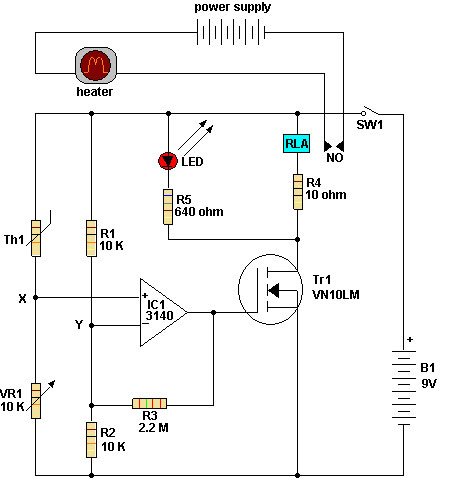
This simple circuit uses a Wheatstone bridge, an operational amplifier, and a field-effect transistor. The thermister allows it to serve as a thermostat. The thermister could easily be replaced by a photocell to allow the circuit to serve as a light sensor. Other components could afford measurements of humidity, pH, tension, moisture, or proximity. To what degree these conditions are sensed determines the response of the circuit. In the case of a thermostat, low temperatures allow an electric relay to moderate a heater. Once temperatures rise, the thermostat deactivates the heater until temperatures fall again. This is the essence of hard-wired control systems.
Hard-wired electronic control systems can be used to negotiate active air and water flow in solar-powered heat collectors. They can also be used to regulate electric power generated by photovoltaic panels or wind generators, insuring longevity of fuel cells and practicality of electric supply. Hydroponic growers use, collections of the thermometer�s basic circuit design attached to sensors, fans, lights, and pumps to control temperature, humidity, light, and irrigation in their gardens. The same basic concept could be used to regulate climate, water, and light in homes.
|
|
|
|
Control Modules
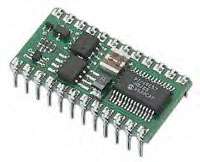
Another more advanced and versatile option for the robot designer is the microcontroller.
|
|
|
|
 |
|
|
|
Microcontrollers or control modules are processors that can allow everything from appliances to robots the ability to operate. They can interface with computer systems affording an assortment of program alternatives. Designing systems with control modules requires one to learn the language by which the modules are programmed. These commands must be typed into a PC and downloaded into the microcontroller. Once programmed, control modules can work autonomously. They can be used with sensors and servos to facilitate more options than any hard-wired electronic system.
A huge problem with present day robotic systems deals with their lack of concurrency. In current microprocessors, multiple sensory inputs run through a single loop. This takes time. Information from one sensor in the design must wait for others to be processed before its data can be assimilated. What if the pending sensor has data saying the robot was about to drive off a cliff. By the time the loop comes around, allowing this information to be assimilated, it might be too late; the robot has already gone over the edge. In the near future, more advanced processors will afford sensory input to be assimilated simultaneously. This will negate this current deficiency.
|
|
|
|
"Dawn of the Age of Robots" |
|
|
|
In the January edition of �Scientific American,� Bill Gates predicts that every home will soon have smart mobile devices or robots engaged in basic household chores. The fledgling industry of robots today has profound similarities to the computer industry of the 1970s. The robotics industry that is soon to arise will change life as we know it all over the planet. Those who get in it now will likely do well. Oh, if only I could be that poor lonely child again, instead of the old fart I�ve become. What money I could make!
|
|
|
|
Favorite Links: |
|
|
|
 |
|
 |
|
 |
|
 |
|
|
|
 |
|
 |
|
 |
|
 |
|
|
|
 |
|
 |
|
 |
|
 |
|
|
|
 |
|
|
 |
|
 |
|
|
|
 |
|
|
|
|
|
|
|
|
|
|
|
|
 |
|
|
|
 |
|
 |
|
|
|
|
|
 |
|
|
|
|
|
|
|
|
|
 |
|
|
|
 |
|
 |
|
 |
|
|
|
|
|