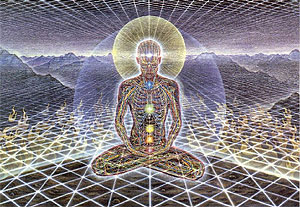
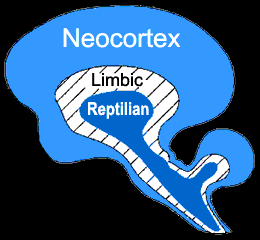
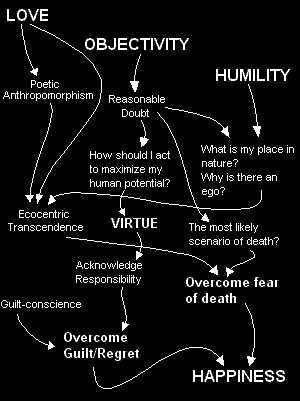
| The brain has evolved and grown like a city, where, as the city expands, the inner city remains intact and continues to operate within the confines of the elder intent. The new city or suburbs lie outside the inner city and employ a more neoteric plan. Six hundred million years ago, our ancestors had brains that were limited to controlling automatic systems like heartbeat and breathing. The name of this inner brain is the neural chassis. The neural chassis still operates in the human brain today. It still controls essentially the same activities it has always directed. But much more exists in the human brain than merely this system. About the age of the reptiles a new part of the brain evolved outside the neural chassis. This part is called the reptilian complex or R-complex. The behavior and function of this brain region is much more advanced than the neural chassis. It is from this part of the brain that selfish motivation arises. Selfishness, before the R-complex evolved, had presence only in the mimicry of the �selfish� gene. It is suggested, that the selfish gene�s agenda reaches extra genetic potential in the reptilian brain. The extra genetic potential for selfishness is suggested to be reflected in the lives of dinosaurs. But selfish motivation wasn�t enough. A new creature appeared on the circuit. Nature found out that sometimes it was advantageous for �selfish� genes to cooperate. To raise young required an organism to be sensitive to the needs of others. To live and hunt in packs required collaboration. With this, a new layer of the brain evolved over the other two. Mammals came into being. The layer outside the R-complex is called the limbic system. This is the home of higher brain functions like altruism. Birds and mammals have well developed limbic systems.
It�s important to note that genes don�t think. They haven�t rationalized that altruism will contribute to their conservation. �Selfish� genes don�t allow altruism to be cooperative. That would imply reason. It is simply by happenstance that altruism serves the gene. While altruism exists because of the gene, it does not exist by the gene�s dictate beyond the automatic biochemistry of the design. Altruism, like selfishness, is a program. It�s a child program when compared to the older selfish program. In this child program lays the feel good associated with being altruistic. This program was not rationalized. It simply came into being. It exists only in the context that it is unselfish. Pure altruism is the nature of the program. The program knows of no selfish gene. Selfish motivation played itself out. A new program was needed for the gene to continue. Altruism was born. While we can rationalize this evolution as selfishly motivated, neither the program nor the gene can. Only reason and the R-complex see the selfishness. That�s like asking an agrarian if they think city life is backward. Reason can justify altruism only in terms of self preservation. The merits, importance, and even reality of altruism is often debated. Some go so far as to assert that everything is selfishly motivated. This is a religion of selfishness. For a gene to be selfish, it would have to have an R-complex. It does not. In fact, it is just as easy to imagine a gene altruistic as it is to imagine it selfish. Perhaps a gene is acting selfishly in order to be altruistic. It would be like denying a street bum a handout so he is forced to get a job and better his as well as everyone else�s lives. But, to believe the gene altruistic is just as unrealistic as to call it selfish. Altruism and selfishness are simply not the stuff genes are made of. To assert life as fundamentally selfish or altruistic is an irrational religious assertion. Evolutionary history serves as proof to the merits of altruism. In the age of dinosaurs, the reptile had an R-complex and a primitive limbic system. At the same time, there were smaller, weak, rodent like creatures who had a more developed limbic system as well as the R-complex. Sixty-five million years ago, an adversity occurred that caused mass extinction. Most of the reptiles went extinct. The child rearing rodents took over the world. The case can be put to rest. Altruism not only exists, it is essential to humanity�s survival. People should engage it and should never deny it. Selfish Altruism Altruistic behavior is never truly altruistic when selfishly motivated. Like other virtues, altruism is best engaged for the sake of itself rather than for the sake of the end it serves. To concentrate on the end would concede selfish cooperation. To allow oneself to go with the flow of the altruistic program, for the sake of the engagement, allows one to come closer to experiencing true altruism. Even the feel good associated with the program can be interpreted as self motivated. Pure altruism is only realized when it becomes habit and is not employed for the sake of its technique, the feel good it provides, or the end it serves. It is just done. As with all virtues, reason comes into play. It defines what constitutes the virtuous act. It sets the means by which the act is accomplished. It also sets limits upon the act. Reason defines an altruistic act by perceiving a part of the self in another. A person is compassionate to a bum because they know how they would like to be treated if placed in that position. Reason does this because relating others to the self is the best way to interpret others. After all, it knows the self better than anyone. Reason dictates do unto others as you would have done unto yourself. This would apply whether cooperative or altruistic. Many of the benevolent feelings in friendship develop the same way. Friendship arises out of mutual interests and aims. This makes it much easier to see the self in a friend. Altruism develops very strongly in friendships, oftentimes, overriding family. Reason sometimes sets limits on altruism by assessing the ability of the actualizer to do the job. If the altruistic act should endanger the life of the actualizer, the practice of future altruistic acts or altruism higher in priority, reason will try to discontinue the activity. Meditations In addition to sound ethics, exceptional behavior also composes a healthy spirituality. Altruism, objectivity, and humility compose the foundation of a good spiritual life. Their practice, through a process that is reasonable as well as poetic, yields a degree of egocentric transcendence. This in turn, leads to a state of spiritual revelation. Altruism is the first component of availing spirituality. Altruism is the practice of putting another ahead of oneself. Its credentials rest in acts of compassion and friendship. As a behavior that people seem naturally predisposed to exhibit, it�s not a difficult behavior to master. The ways in which it is played out are limitless. Its practice can serve as the objective in action. This is to be benevolent for the sake of benevolence. Collectively, good will can spread throughout a community. In a positive environment, one good deed, however small, can send civic-minded ripples throughout a community. It is like a seedling that is nourished and grows with each act of love by the community members. Eventually, the tiny sapling becomes a big tree! Altruism can be promoted by a series of activities that become actualized out of a love of one�s community. One way to achieve an altruistic disposition is to practice virtue. To promote an unselfish society is to practice the precepts. An ethical standard tends to summarize virtue and precepts and all other capacities for altruistic affirmation. The standard is called �the golden rule.� The Golden Rule: Do unto others as you would have done unto yourself. Another way to promote altruism in a community is to relieve social barriers. Racism and sexism are an affront to compassion. Altruism may also be aspired by the practice of offering. There are many ways to provide or to offer something to another. There is the physical offering which is to provide service by one�s labor. The highest form of this would be the self sacrifice of one�s life. A spiritual offering is to provide compassion and tenderness to others. The offering of eyes is to transport a warm glance bestowing comfort or tranquility. This is difficult in a typically large city. Often, eye contact can be interpreted as an invitation to a more intense charitable dialog. Be prepared to be asked for more. There is also the countenance offering. One can provide countenance with a smile. Oral offering is to provide kind warm words to others. Seat offering is to secure another a chair or place. Finally, there is the offering of shelter to another. This is especially important if a warm bath is included in the deal. � Physical offering - provide service by one�s labor, the highest form being the self sacrifice of one�s life � Spiritual offering - offer a compassionate heart to others (compassion, tenderness) � Offering of eyes - offer a warm glance � Countenance offering �- provide a sense of approval and support with a smile � Oral offering - provide kind, warm words to others � Seat offering � Shelter offering What one offers another is largely determined by one�s accurate interpretation of their needs. It�s much easier to realize the needs of others by appealing to their state in life. This can be done through fasting. Fasting reminds one of human frailty. It can put one in another�s shoes. To know homelessness, go without a home. To find the starving, go without food. Another step in realizing a healthy spiritual being is to find objectivity. Objectivity is an open mindedness about everything. In it, one realizes absolution is impossible in interpreting anything. Ideas other than those true by definition are subject to reasonable doubt. Human perception and interpretation are imperfect. All beliefs must be held tentative. The good and evil in life are also subject to this. One�s interpretation of evil is oftentimes essential to the perpetuation of a greater good. The polarity of yin and yang, good and evil, active and passive, positive and negative, light and dark, summer and winter, male and female are each dependent on the other. Each lead to the other and are defined by the other. Both and their interaction serve a higher calling. The third ingredient to the recipe of a healthy spiritual life is humility. This involves seeing oneself as a part of a greater whole. It is supported by three practices. The first is the practice of objectivity. This is to realize that truth can be interpreted in many ways. A poet sees a sunset differently than a meteorologist. It ultimately suggests that personal preconceptions of reality may be false. One must become open to the possibilities. Another practice is visualization. This is the process of becoming familiar with the imaginings that come when one shuts off the external world. This process exercises subconscious emergence and improves visualization skills. It may also improve a person�s creative and problem solving ability. Visualization can be enhanced through the third practice called mind expansion. Mind expansion is a way to develop the minds imaginative vocabulary. It is said to intensify the depth of everyday experience in that it creates a dialog between the sensual and the soul without the intermediary of the ego self. The process goes as follows. Process: 1. Relax and empty your mind 2. Pick up an everyday object and look at it (key, coin, ect.) 3. Notice surface texture, ridges, bumps, things that normally aren�t noticed in everyday use. 4. Don�t analyze the object. Just take in the experience. 5. Discontinue after thirty seconds. Go back to daily routine. 6. Repeat the exercise with another object later. This activity is repeated throughout the day at various time intervals. The practice of altruism, objectivity, and humility lead to a dynamic yielding spiritual enlightenment. This �cooking� of the recipe is both poetic and reasonable and produce a degree of egocentric transcendence. The first aspect of this dynamic is poetic anthropomorphism. This is seeing a part of oneself in another. To see a part of oneself in another person can lead to friendship and compassion. It is easy to see some of oneself in another person. But to see it in an animal, plant, rock, or even planet is agreeable. This poetic capacity allows one to feel benevolence toward these things as one would for a friend. Reasonable doubt also has its role to play in the dynamic. This is the process of asking the big questions about living. It assures the importance of science and history suggesting the relevance of the natural world. The questions it often raises include those like: How should I act to maximize human potential? This inquiry leads to a social philosophy and the establishment of a system of ethics. What is my place in nature? This leads to natural philosophy. The causality principle usually prevails. Why is there an ego? What purpose does it serve? This is a big issue in today�s New Age groups. Ego is the reptilian self awareness. It is exercised in selfishness. One might argue selfishness the essential upon which everything progresses in the fairest way possible. Competition yields growth. Apportionment of production�s benefits is assured through the selfish interests of each member of the group. To guarantee their own allotment, individuals will keep others from taking more than their warranted share. In truth, self-preserving checks and balances are only needed when foresight is lacking. Discipline can be asserted in a system guided by environmental consciousness and purposeful intent. Selfishness would not be needed for entities to regulate one another. What is the most likely scenario of death? Trepidation and fear permeate one�s character when one imagines falling away from life. First, there is pain in sickness. Then, there is nothing for the rest of eternity. There is little to suspect more of dying than this. Yet, there are those who reject this conclusion. It is agreed that, when left to objective meditation, there is a portion of oneself that is aware of all the rest of the parts. Self awareness knows the body, emotions, and thoughts. Surely, this part composes the human soul. Furthermore, the substantiality for which it is felt suggests it immortal. It is likely that the soul is causation without substance itself. Reincarnation suggests that it is like the flame of a candle. They believe that when the body runs down from old age and dies, the flame is transferred to a new candle. It is also possible that it dies with the physical self without another body to light itself to. The soul surviving death is likely an illusion. There is little that supports the notion of life after death, of a heaven, or of gods. The soul dies with the body. There is little proof otherwise. Mystics refer to extinction as Nirvana. This state is the dissolution of the finite self and is considered the highest destiny of the human spirit. Like the wind, Nirvana can not be shown. Perhaps it is the bliss and peace of Raja Yoga. While everyone good and bad, spiritual or not may eventually concede to it, how one approaches it may be relevant. One may become more comfortable with self extinction when the ego becomes disarmed in everyday affairs. Mortality becomes less an issue when one approaches it in a state of egocentric transcendence. This is the third person meditation. It is the denial of self interest as a primary source of motivation to feelings of love for the greater whole. It uses visualization developed through mind expansion. It involves visualizing the material self within its environment. This gives a person a more holistic perspective to the workings of reality. The person becomes environmentally conscious and less egocentric. Self-centered values become trivial and give way to awareness of community and love. The underlying goodness and justice towards the greater good takes hold and finds power. The third person meditation has been called �self remembering.� Its attainment is achieved through a methodology. The way through knowledge involves the study of conventional religious thought. One learns through sages and scripture of essential being. An intensive reflection occurs where the hypothesis of a third self (soul) is confirmed. This is done by: � Language usage: If I say, �I�m walking through the woods,� who�s talking?! � Physics: pretty chancy because scientific thought is never absolute � Metaphor: In this confirmation, one imagines being an actor on the stage of life. The eastern metaphor of the chariot driver applies verily here. Once one recognizes the third person, one has only to shift one�s self identification to that abiding part. One is no longer only arms, torso, head, and legs but, in essence, is soul. Thinking from the soul�s perspective is achieved. The way through love: One moves on to acknowledge love of the greater whole through love itself. First, one poetically anthropomorphically sees the greater whole. Human qualities are attributed to the whole. Environmental idealists refer to the biosphere as �Gaia.� Native Americans regard the entire earth as �Mother Earth.� Like a friend one loves it for the sake of love alone. Mystics suggest, in meditation, one chant and repeat the name one calls the whole. Egocentric Transcendence Once one acknowledges love of the greater whole, the next step to the third person methodology occurs. This is the denial of ego. This denial can be accomplished by two means. The first way is through work. This method is intended to starve the finite ego by denying it the consequences of work�s action. By denying reward through one�s industriousness, the ego goes hungry and becomes weaker. If one does this, other incentives for hard work can be realized. Individuals can work out of love and no longer need to employ it for its personal rewards. The work is done for the sake of the greater whole. Another way the ego can be denied is through psychophysical exercises. Raja yoga, which suggests a hierarchy of systems (body consciousness, individual consciousness, and infinite eternal being), can reduce the ego. This form of meditation goes as follows: Raja yoga: 1. Practice five abstentions: from injury, lying, stealing, sensuality, and greed 2. Practice five observances: cleanliness, contentment, self control, studiousness, and contemplation of the divine 3. Find a posture that lies between discomfort and the opposite pole of relaxation - the lotus position: yogi sits with legs crossed so that each foot rests sole up on its opposing thigh. The spine is erect with allowance for its natural curvature. Hands are placed palms up on lap one on top of the other with thumbs touching lightly. Eyes are closed or allowed to gaze unfocused-focused on the ground. 4. Control breathing 5. Close the doors of perception and concentrate on the terrain within at the expense of the sensual. Attention is placed squarely on the mind to the exclusion of the material. 6. Let the mind wonder to pick one object to which concentrate on to the exclusion of all other mental forms. 7. Bring the conscious into unity with the separate object. The two are merged to the extent that self awareness disappears. 8. Make the object formless leaving nothing. By acknowledging love for the greater world coupled with a shift to the abiding part, the ego finds its accurate and appropriate place. The ego�s world is not abrogated entirely. It still retains its role in the scheme of the primary and secondary selves. But it finds itself often taking a back seat when transcendence finds precedence. While the ego continues to serve its important role, its relevance is understood within the context of the greater good. Product - the enlightened person This liberation from the egocentric produces some wonderful traits in the enlightened person. � The enlightened person tends to feel love and compassion for all living things. � Fear of death is gone for this person. Death becomes an essential need of the greater whole and is even regarded as one of the highest acts of love. One dies to make room for the next generation. Feelings of love for the greater good overpower fear of death. � The liberated tends to be happier. Old worries no longer apply and become out obsolete. � The individual reappraise values from the egocentric perspective. � The enlightened seem to exhibit greater intellect. They become aware of a larger theme in life�s play. � The transcendent also acquire a capacity to overcome guilt. To overcome guilt - steps to resolve guilt: 1. Acknowledge the mistake 2. Take responsibility for it 3. Commit to never repeat it in the name of love or perhaps goodness � Because the liberated has greater vision, they tend to be communally equalitarian. Equality makes sense. By egocentric transcendence, spiritual needs are served in an enlightened combination of altruism, objectivity, and humility. Through these ingredients, a dynamic acknowledges soul and the greater world to which it belongs. It shifts self identity to the soul and finds love for the greater whole. In turn, the owner of that soul finds peace, happiness, and understanding that put a leash on the insatiate the untamed ego�s world assures. |
| Virtue
Once one decides what makes a society good, it comes time to consider the individual. There is responsibilities society and its institutions should satisfy. There are also obligations that individuals should engage as members of the community. They are actions and conduct that allow the system to serve its purpose and maximize people�s potential to live. The enlightened strive to live by this higher conduct due to a devotion that rests in mind and spirit. People want to be good because their reason dictates they should. Their spirit dictates decency by affinitarian dictate. It simply feels good. For whichever dominates in the drive toward uprightness, without it, society would be incapable of functioning well. The first components of this higher conduct are the virtues. These virtues are self discipline, responsibility, courage, perseverance, honesty, loyalty, faith, work, friendship, and compassion. To be self disciplined is to let reason govern one�s actions. How it works is by using reason to set one�s priorities. It can be a decision to stop eating sweets in order to prevent cavities. The priority is healthy teeth over sweets. Once one establishes the priority, then, comes the hard part. The person must start controlling passions and impulses through practice. The desire for candy and cakes must be overcome. Responsibility is to own one�s own actions and to be held accountable for them. Many try to blame others for mistakes they make. When this is not possible, they oftentimes deter attention from themselves by pointing out the faults in others. They seek these faults in an attempt to pull themselves up at the expense of other�s integrity. To be responsible is not to succumb to these reductions. It is to face one�s own mistakes and weaknesses. Plato suggested that courage, like most virtues; work because we have the capacity to reason. He believed that valiancy is knowing what to fear as dictated by reason. Many times, when approached by an unreasonable fear, it is through self determination that we find the courage to confront it. Yet, there may be more to the courageous than mere intelligence. True bravery is to overcome justifiable fear by a stronger more compassionate will. Exposing oneself to risk, absent of self interest, one endeavors to be of service to others. This is the courage of heroes in legend. Perseverance, like Plato�s courage, only works when used in conjunction with reason. It is the capacity to continue trying to succeed at an endeavor until it is completed. But, if reason dictates the quest irrelevant, the perseverance may not yield fulfillment. The deed becomes foolish. Honesty is to adhere to the truth. It is to express oneself accurately to oneself as well as others. When living in a society where the means of exchange is an aesthetic and altruistic dynamic, honesty is very important. It is important to define truthfully one�s own faults, weaknesses, goals, feelings, and beliefs. This way, people can do a better job of helping one achieve their dreams. Loyalty is caring for other persons, groups, beliefs, or institutions regardless of the inconvenience. It generates trust as its product. Faith is a firm belief in goodness and its inevitable capacity to overcome evil. It is a commitment to goodness that prevents people from going morally adrift. Decency is practiced and supported even at the risk to one�s own life. It is an acceptance that there is an underlying �goodness� to the universe. This notion is supported by a consistency of forms and systems that exist within people as well as the rest of nature. As products of nature, people reflect its character in their interests. It is not that the world is good. It is considered good only by human attribution. Nature simply is. Work is an activity one engages to achieve an end. Some types of work can serve as an expression of one�s own character or integrity. A volunteer, who works to save lives, does so for an end that serves as an expression of their character. But the product work serves doesn�t have to be the only end. The means by which the end is accomplished can be an end in itself. This is achieved through the choice of technique one employs to accomplish the work. The worker can design their own course of action. To find solutions to each obstacle in the means becomes an expression of integrity and strength. In this, both the activity and the products of work can serve as expressions of character. But work can move beyond the expression of ego. It has the capacity to become an end in itself on a truer level. By this, productivity is assured due to an inherent need to be productive. The means become ends in and of themselves where the love and challenge of technique is practiced and an inherent need to accomplish something relevant prevail. Compassion is to come to the aid of others in distress perhaps because one sees a bit of the self in the other. But it even rests inherent when given no regard by reason. Friendship is the acquaintance and affection for others. It yields levels of benevolence that serve as the best pattern for all relationships. It usually arises out of mutual interests. Friends may see a bit of themselves in the other. The relationship requires honesty, especially about oneself, the ability to hold enough respect and affection for the other to take their criticism with their praise, loyalty, and love. It is clear that if all members of a community wish to be friends, they should aspire to practice these virtues. If individuals practice these virtues so shall the community as a whole. The community shall then find alliance with other communities of the same noble standing. The Precepts The golden rule asserts individuals do unto others as they would have done unto themselves. This suggests a person who practices virtue would want to live in a community where its members also practice virtue. The rule might also be restated that one must not do unto others as one wishes not done unto themselves. One is dealing with precepts rather than virtues in this sense. While virtues are activities one should engage, precepts are conduct one should not. The precepts are: not to kill, not to steal, not to lie, not to be unchaste, and not to take intoxicants. One should never commit murder. Cherish and nurture life instead. Support and protect the lives of others in the community. Include the interests of children, the sick, and the elderly. Do not steal. Respect the private space and property of others for this is their dream space. Its aggregate leads to the meditations and reflections that can augment the community as a whole. Do not lie. Be honest with yourself and those in your community. It is important to determine an accurate account of one�s ambitions, beliefs, gifts, and overall condition. This is very important if trade is engaged on an altruistic level. If people wish to give one a gift, they have no idea what that person truly wants if that person has not been honest about their appetites. Truthful expression insures that resources are not wasted on developments that never matter. Do not commit adultery. There are obvious biological motives to restrict ones sexual habits. The spread of sexually transmitted diseases can be increased without a conservative predilection. There is also the prospect of reduced genetic variability in small communities when some members are not allowed to contribute to the future gene pool. There is also the risk of paternal disenfranchisement. Fathers are essential in developing psychologically healthy children. Finally, the last precept insists one should not take recreational drugs. These impair good judgment, lead to poverty, and even psychological and physical malice. A racial memory of a mythical golden age suggests a past when people were more extraordinary beings. Eden, Camelot, and Atlantis suggest an enlightened prehistory which was lost to human weakness. They remind us of what can be destroyed when we turn on goodness and virtuosity. These legends also promise what could come to pass if we return to correctness. It is important not to under estimate one�s affect on the environment. One�s environment is often a reflection of one�s character. A community is an expression of its people. This implies that the world is what one makes of it. Individual philosophy can make the difference between whether heaven or hell should prevail on Earth. An obvious dependence on personal behavior should be considered when wishing to bring back myth�s golden age. The practice of virtue by individuals can lead to its conveyance to the entire community. Reason, Foresight, and Altruism In people there is selfishness, competition, fear, jealousy, and propensities toward violence which can drive people to act viciously in their world. These characteristics are sometimes justified in the name of technological progress. After all, we owe World War II for advances in radar technology, rocket science, and nuclear physics. But this rational may serve humanities undoing in a world where small groups wield atomic and biological weapons of genocidal proportions. People are also capable of reason, foresight, a capacity for love, and a passion for beauty that are undeniably the tools and motives to their survival. It is clear that the former inherent dispositions should be displaced by these. To do this, one must understand what these noble characteristics are and secure the promise they allow one to aspire to. Reason is the mental practice of interpreting the nature of reality. To know it is to know science, mathematics, history, and philosophy. It begins by generating concepts true by definition. It finishes by producing the most likely theories on the nature of the human predicament. Time tests their credibility. But even with the greatest tests of time, theories are tentative and soi-disant. Reason never proves anything. It only disproves. Foresight is another human capability that can contribute to humanities survival. This is the ability to make a reasonable guess as to the outcome of events by placing reality�s interpretation into account. By developing an understanding of the most likely truths, one can determine one�s best course of action in life. Reason combined with foresight allows one to make choices that should secure desirable objectives. While reason and foresight serve as the means behind the wise person�s actions, beauty and love serve as their motive. The splendor of love and all other things comparable in beauty feed the soul. In this, people move beyond existence to live. Reason and foresight can decide the way things will be. But the soul insists that one must not ask what the essence of nature is but of what it ought to be. Should it be a world driven by greed, hatred, and fear or should it be based on reason, foresight, beauty, and love? The affinity of soul would choose the loveliness of the later as primary. The darker motives would find audience only in the poet�s sense of aesthetic. In a roundabout way, they too would find their course to the soul but only in the context of intangible beauty. Beginning and maintaining this suggests the brighter constitutions make up the foundation of good life. They lie essential to humanity�s future success. Love, the Reptilian Brain, and Selfish Genes If altruism does exist, where did it come from? How was it evolved to? To answer this, one has to go back to a time when love may not have existed, a time when reptiles, rather than mammals, ruled the earth. Life arose on earth three and a half billion years ago. For the first three billion years, the conservation of replicating molecules would reign supreme over the activities of life. Some scientists dub these replicating molecules as �selfish genes� because of their self conserving predisposition. These primitive molecules started interacting with others to compose cellular structure. Multi-cellular organisms arose no less than seven-hundred million years ago. An explosion of life occurred shortly thereafter. By five-hundred billion years ago, life had managed to colonize land. The development of complex nervous systems and brains were soon to follow. |
| | Home | Artwork | Current Projects | Blog | Email | |
 |
 |
| Related Links: |
 |
 |
 |
 |
 |
 |
 |
 |
 |
 |
 |
 |
 |