


Internal Parasites
The basic relationship between parasitic worms and horses is that the adult worm lives in the horse's bowel, surrounded by the food that passes through the horse's digestive tract. Often, the worm attaches itself to the bowel wall to stop itself from being carried right through the horse with food and water. It is not in the parasite's interests to kill the horse, because if it does, the worms in that horse will die, too. In the wild, where horses roam over a wide area, they rarely develop a worm burden severe enough to be fatal. When they are restricted continuously, as are domestic horses in a field, the number of worms they take in can be enormous and possibly lethal.
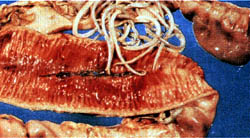 Roundworms
Worming Programs
There are three anthelmintics, or worming drugs, that are active against a reasonably wide range of worms: ivermectin, pyrantel, and the benzimidazoles (all of whose chemical names end in "-ndazole"). It is not possible to control all worms with just one wormer; you must target and then have one drug for routine use throughout the year. Change the type of wormer every one or two years. You should not change it every time you dose, as this will make it easier for the worms to become resistant to the wormers. There are no resistance problems with ivermectin and pyrantel, but in some parts of the world there is resistance to the benzimidazole wormers. To prevent a significant number of worm eggs from being released on your pasture, you should worm every four weeks with a benzimidazole wormer, every six weeks with pyrantel, or every eight weeks with ivermectin.
CLICK
HERE FOR A GREAT ON-LINE RESOURCE ABOUT THIS TOPIC.