

Gaits andMovement of the Horse
The evolution of the horse did not include prolonged periods of movement. A wild horse spends most of its day grazing, and usually only when it has to move to new pastures does it travel any distance. Only rarely would it walk or trot for more than five to 10 minutes without stopping. By trotting for 10 minutes a horse can cover quite a distance, certainly far enough for it to reach a new grazing area. Fear will stimulate a horse to gallop away from danger, but it cannot keep galloping for long, and it is not necessary for it to do so. After a few minutes, either it will have escaped from the danger, such as a predator, or it will have succumbed.
The following are the four gaits of the horse:
Walking-Four-beat gait

At the walk, the horse has three feet on the ground and only one in the air at any time. It places each foot on the ground in trun; first a hind leg, followed by the foreleg on the same side, then the other hind leg and finally the remaining foreleg.
Trotting-Two-beat gait
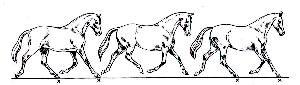
At the trot, opposite fore-and hind feet hit the ground together in turn to give a two-beat gait. The fact that only one forefoot or hind foot is bearing weight at any one time makes this the best gait to use to detect lameness.
Cantering-Three-beat gait

At the canter, two diagonal feet hit the ground together. The other two feet hit the ground separately, making a three-beat gait. One forefoot is followed by the opposite hind foot, then the other two feet together. There is a time when no feet are on the ground.
Galloping-Four-beat gait
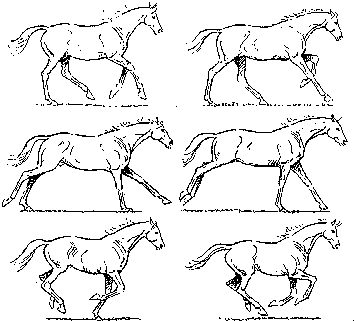
This follows the same pattern as the canter, but the paired limbs do not hit the ground together. The hind limb lands slightly before the paired forelimb, making a four-beat gait. In the gallop and the canter, a horse can change which foreleg is leading.
Artificial Gaits
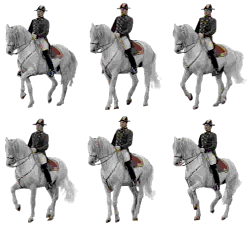
Just as humans have interfered with the look of horses, they have also developed artificial gaits to enhance riding comfort and give a showy appearance. The paso is a four beat, lateral gait of the Peruvian Paso breed, which results in a very mooth ride. An example of this type of gait is displayed in the animated graphic at the top of this page.
Jumping
This simple animation shows a horse jumping properly and is based on sketches.
To stop the animation just hit the stop button on your browser tool bar.
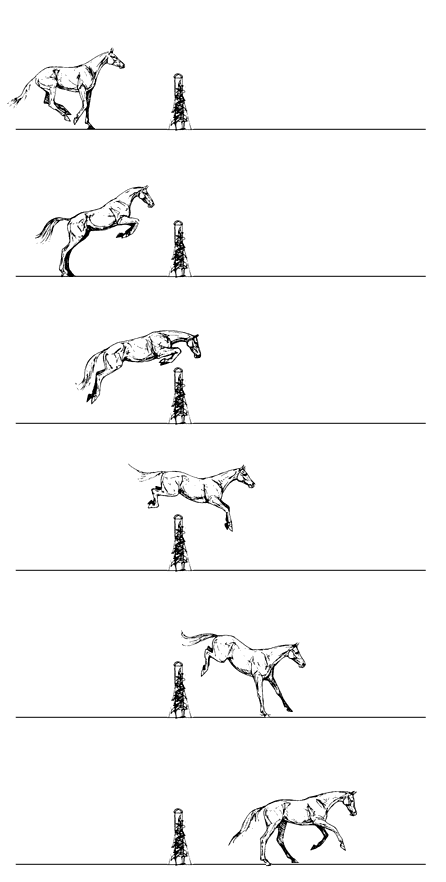
The following describes the sequence of movements a horse makes when jumping :
- Takeoff - Forelegs fold, hind legs thrust
- Flight - Hind legs leave the ground
- Flight - Bascule
- Flight - Forelegs unfold, hind legs folding
- Landing - Hind legs folded, over fence
- Landing - Hind legs clear of fence, forelegs extending
- Landing - One foreleg lands first
- Recovery - Second foreleg grounded, first foreleg picked up
- Recovery - First hind leg grounded, both forelegs picked up
- Recovery - Second hind leg grounded, first stride of canter begins