
Horses Teeth
 The horse relies a
great deal on its teeth. Its digestive juices cannot break down the cellulose
in grass, so this is done by bacteria in its colon. If the teeth do not
break down the herbage to a thick "soup," then the bacteria will not be
able to work on it, the horse will get no nutrition from it, and the fibrous
material may become wedged in the intestines. The lack of good, functional
teeth is probably one of the major reasons why a horse may not live to
an old age in the wild.
The horse relies a
great deal on its teeth. Its digestive juices cannot break down the cellulose
in grass, so this is done by bacteria in its colon. If the teeth do not
break down the herbage to a thick "soup," then the bacteria will not be
able to work on it, the horse will get no nutrition from it, and the fibrous
material may become wedged in the intestines. The lack of good, functional
teeth is probably one of the major reasons why a horse may not live to
an old age in the wild.
Different Teeth
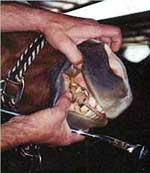
The horse's upper and lower jaw are basically a mirror image of each other in terms of teeth. Each has six incisor teeth (three on each side). These are the teeth that cut food. In the adult horse there are six premolar and six molar teeth (three of each on each side). These are the teeth that chew food. Int the young horse, the back three molars are not present. In male horse, there may be one canine tooth on each side. These have no function.
Teeth and Skull
 In
order to reduce the weight of its large skull, the horse has three air-filled
sinuses on each side. These lie in front of the eyes. The roots of most
of the molar teeth extend up into these sinuses.
In
order to reduce the weight of its large skull, the horse has three air-filled
sinuses on each side. These lie in front of the eyes. The roots of most
of the molar teeth extend up into these sinuses.
Click on the picture to view a larger version
Teeth as an Indicator of Age
A horse's teeth can be used as a means of estimating its age, although the estimate can be only approximate. The cutting surface of the incisor teeth becomes worn down with age, revealing a different cross section as it does so. This can help in estimating age up to the age of eight. From then on, the horse will be officially referred to as "aged". The older a horse is , the more angled its front teeth will be. At about the age of 10, a mark known as Galvayne's groove appears at the top of the upper corner incisors. It gradually grows to the bottom, then starts to disappear from the top.