


Colours and Markings
The coat of early horses was probably a certain color to give camouflage in the wild and allow the horse to blend into its background and hide from predators. A sand coloured coat still provides Przewalski's horse with good camouflage in its desert home. Most of the colours we see today have been developed by humans through selective breeding. Some colors are dominant to others; a foal will be the dominant colour if only one of its parents is that colour. Other colours are recessive; only if both parents are that colour is the foal likely to be, too. The order of dominance of the main colours to each other is gray, bay, brown, then black. Chestnut is recessive.
 Dun-
A dun varies from mouse coloured to sand coloured with a dark skin.
It usually has a black mane, tail, and legs.
Dun-
A dun varies from mouse coloured to sand coloured with a dark skin.
It usually has a black mane, tail, and legs.
 Bay-
A bay has a black mane and tail and black lower legs, and is reddish-brown
over the rest of its body.
Bay-
A bay has a black mane and tail and black lower legs, and is reddish-brown
over the rest of its body.
 Chestnut-
This is a reddish brown horse with a similar-coloured mane and tail.
Chestnut-
This is a reddish brown horse with a similar-coloured mane and tail.
 Brown-
A horse with a black mane, tail, and legs, and a mixture over the rest
of its body.
Brown-
A horse with a black mane, tail, and legs, and a mixture over the rest
of its body.
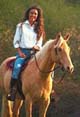 Palomino-
A gold coloured horse with a much paler, sometimes almost white, mane
and tail.
Palomino-
A gold coloured horse with a much paler, sometimes almost white, mane
and tail.
 Roan-
Roans have white hairs mixed with black (blue roan), bay (red roan), or
chestnut (strawberry roan).
Roan-
Roans have white hairs mixed with black (blue roan), bay (red roan), or
chestnut (strawberry roan).
 Spotted-
Brown or black spots, confined to a "blanket" on the rump or spread over
the whole body.
Spotted-
Brown or black spots, confined to a "blanket" on the rump or spread over
the whole body.
 Pinto
The coat has large areas of brown or black and white. A horse of this
colouring is also known as a paint.
Pinto
The coat has large areas of brown or black and white. A horse of this
colouring is also known as a paint.
Leg Markings
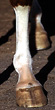
Extents of white: When describing the white markings on a horse's leg, it is best to refer to the top timit of the white. White areas are susceptible to infections because the skin, which has no pigment, is delicate.
- White extending up to the felock joint- sometimes called a sock
- White extending up the cannon- sometimes called a stocking
- Markings on a white coronet- sometimes called ermine, especially if black
 |
 |
 |
| Sock | Stocking | Coronet |
Face Markings
Names: White markings on the face can be a star (any white marking between or above the eyes) a snip (a white mark between the nostrils), a stripe (a narrow vertical white mark), a blaze (a wide mark down the nose), or a freckled stripe. These markings are often the inspiration for horses' names.
 |
 |
 |
 |
| Star | Snip | Stripe | Blaze |