| The first prerequisite to breeding crested geckos is to obtain an adult sexual pair. Crested geckos will readily breed without special arrangements. A male will mount a female from behind while biting the neck or head area of the female. Copulation will last for 5 to 15 minutes and repeated for several days. Copulation usually occurs at night. You can observe crested geckos at night by using 25 to 40 watt red bulb for illumination. The gestation period is 30 to 45 days. A plastic container (e.g. shoe box) measuring 30L x 15W x 10H cm (12L x 6W x 4H inches) with moss are ideal for an egg laying site. A 15.2 diameter x 7.6H cm (6 diameter x 3H inches) deli-cup with a hole on the side can be used as well. The moss should be moist, but not wet. Mist one section of the nest box everyday to provide moist and dry areas at all times. |
 |
| BREEDING |
 |
 |
 |
 |
 |
 |
 |
 |
 |
 |
 |
 |
| The CGI website is designed and maintained by: |
| All Rights Reserved. Copyrighted � 2001 by Emerson Sy. |
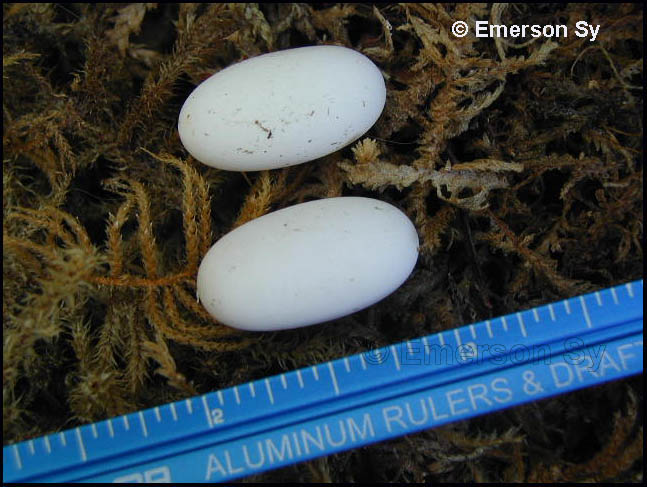 |
| Female crested geckos usually lay two eggs per clutch. Young adults and old females may only lay one egg per clutch and with less frequency. Viable eggs are hard shelled and white in coloration. The average size of an egg is 2.4L x 1.3W cm (9/16L x 8/16W inches). Under-calcified eggs are semi-transparent with scattered granular calcification. Most, if not all, under-calcified eggs are not viable. Females usually lay two eggs at a time under the moss. If soil is provided as substrate, the eggs are slightly buried, but are noticeable. You should check the egg laying site everyday during the beginning of breeding seasons and collect the eggs accordingly for incubation. Start checking the egg laying site daily again 20 to 25 days after the first clutch. Eggs that are left under dry condition will desiccate. Eggs might also be damaged by feeder insects if left in site. When a female lays under-calcified eggs, separate the male for 3 to 6 months to prevent them from breeding much further. Provide extra calcium supplements for the female during this time of separation. Heavily coat feeder insects and mix additional calcium carbonate with mashed fruits at every feeding. A small dish with calcium powder can be placed in the enclosure of the female as well. |
| INCUBATION After collecting the eggs, prepare a plastic container or a deli-cup. The most practical incubation media to use are vermiculite and perlite. These two materials are generally available in garden section of home improvement stores and national chain stores. Some keepers prefer to mix vermiculite and perlite at 1:1 ratio; other use either perlite or vermiculite exclusively. My preference is to use coarse-vermiculite exclusively or 3:1 ratio of vermiculite to perlite. Place approximately 5.0 to 6.5 cm (2.0 to 2.5 inches) of vermiculite in a plastic container or a deli-cup. Add a few drops of water at a time to the vermiculite and mix thorougly until it feels moist, but no water should drip when pinched between your fingers. Bury the eggs horizontally 3/4 or all the way in the incubation medium. The eggs are spaced 1 inch apart. Eggs that are incubated between 20.0�-24.4�C (68�-76�F) will hatch approximately 70 days later using a Hovabator incubator (Thermal Air Model 1602R). If your room temperature is within this range, you can also successfully hatch CG's without using an incubator. Unfertilized eggs usually will mold within two weeks. Moldy eggs should be removed immediately to avoid affecting viable eggs in the same plastic container or deli-cup. Henkel suggested that crested geckos are temperature sex dependent, but further studies are required to verify if this phenomena really occur with R. ciliatus. Preliminary studies suggest that eggs incubated between 26.0�-27.0�C (78.8�-80.6�F) are mostly females while eggs incubated above 28.0�C (82.6�F) are mostly males. |
| A clutch is normally compose of two eggs. |