| Housing is one of the most important factors to be considered in keeping crested geckos. Depending on your goals, an enclosure can be an elaborate vivarium or a simple setup with appropriate furniture. Crested geckos are arboreal species and thus, the height of an enclosure is more important. A single adult specimen can be housed in an enclosure measuring 12L x 12W x 18H inches. A screen enclosure measuring 18L x 18W x 24H inches or a screen tubular cage or "tube" cage measuring 24H x 18 diameter inches can house a pair or 1.2 (one male and two females) comfortably. Provide several hiding spots to minimize stress. Females have high social tolerance, but this cannot be said about males. Housing two or more males in one enclosure should be avoided. Males are known to severely injure each other during a fight. Males that are raised together in one enclosure establish social hierarchy early on and fighting rarely occurs. Individuals should be closely observed to make sure each one is eating properly. Glass aquariums with screen tops have been used successfully. A 20-gallon tall glass terrarium can comfortably house 1.2 specimens. The bottom should be lined with moss substrate to avoid snout injury when catching preys. Dry branches and live plants should be added. The only drawback of glass terrariums is poor ventilation. Plastic containers can be utilized as well. Half gallon or one gallon plastic jars are indispensible when raising hatchlings and juveniles individually. The top should be covered with 1/16 inch screen to prevent escape. Various sizes of plastic containers by Sterilite can comfortably house hatchlings and adult crested geckos. Use soldering iron to punch holes for proper air circulation. |
 |
| HOUSING |
 |
 |
 |
 |
 |
 |
 |
 |
 |
 |
 |
 |
| The CGI website is designed and maintained by: |
| All Rights Reserved. Copyrighted � 2001 by Emerson Sy. |
 |
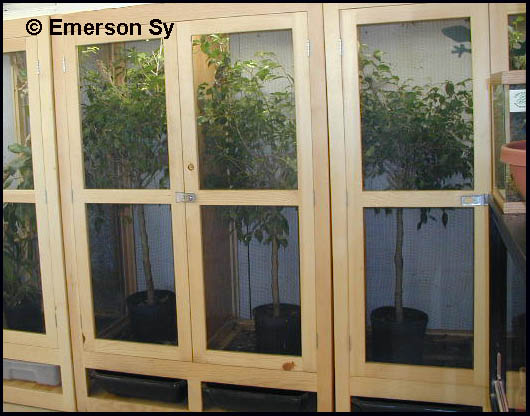 |
| For keepers with carpentry skills, building your own enclosures is as satisfying as keeping crested geckos. Enclosures constructed with wooden frames and 1/16 to 1/4 inch galvanized screens work very well and are aesthetically pleasing to the eyes. Crested gecko enclosures should be furnished with different sizes of dry branches at varying heights and orientations. Crested geckos actively climb horizontal and vertical branches through out the night. Mixing different gecko species in one enclosure should be avoided whenever possible. Pathogens are known to be transmitted due to this practice. Adding live plants such as ficus, pothos or schefflera is highly recommended. This will provide more hiding places for the inhabitants and help maintain humidity in the enclosure. |
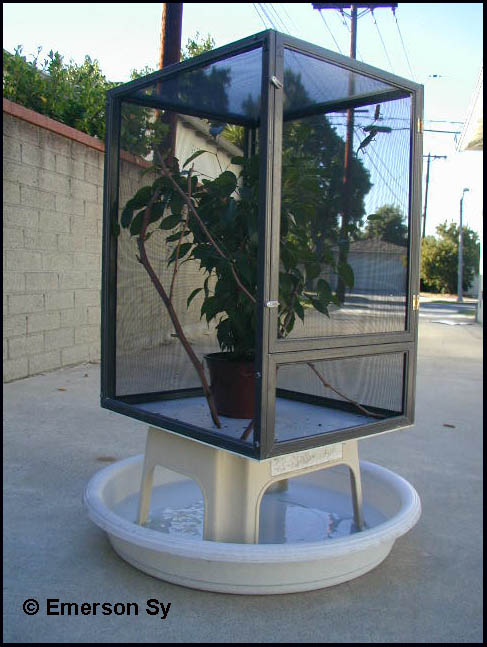
| A screen cage elevated under a water basin to prevent ants from attacking CGs. |
| <<< Enclosures similar to the one pictured can be customed built to fit your specific needs. |
| Photo opportunity : Lawrence Martin |
| TEMPERATURE New Caledonia and its off-shore islands have moderate temperature throughout the year, but extreme temperatures as low as 10�C (50�F) and as high as 36.7�C (98�F) occur as well. Ideally, temperatures should range from 22.2� to 25.6�C (72�-78�F) during the day and 20.6� to 23.3�C (69�-74�F) at night. During colder months, a basking lamp with 40 watt red bulb can be used, but ensure that the proximity of heat-producing lamps will not cause thermal burns. Crested gecko seems to thrive and reproduce without the benefit of ultraviolet radiation, but exposure to unfiltered sunlight whenever weather permits is highly recommended. Make sure that the cage has shaded part at all times when outdoors to avoid overheating, which can be fatal. When indoors, a ReptiSun 5.0 fluorescent bulb (Zoo Med Laboratories, San Luis Obispo, CA) placed approximately 13 cm (5 inches)away from the top of enclosures can be used for UVB irradiation. |
| HUMIDITY In the wild, R. ciliatus experiences relatively high humidities averaging from 73% to 83% throughout the year. To replicate this in captivity, mist the enclosure once or twice a day. Ideally, heavily mist at night, which will also be a source of drinking water for geckos. It is imperative to provide a hide box or nest box with moist moss. Crested geckos will retreat into the cooler hide box when temperature gets warmer than the optimal temperature range. A moist hide box will also help prevent difficulty in skin shedding (dysecdysis). Enclosures should have good air ventilation to avoid stagnant air and wet conditions at all times. This can have a detrimental and sometimes fatal effect to crested geckos especially hatchlings and juveniles. A digital thermometer-hygrometer (e.g. Radio Shack catalog number 63-1013) that can record minimum and maximum temperature and humidity is indispensible for monitoring purposes. |
| Another important factor is enclosure cleanliness. An enclosure should be thoroughly cleaned with running water once every week or two weeks. Dead crickets, uneaten food and fecal matters should be removed immediately to avoid attracting ants. This will also address unwanted smell that occurs when enclosures are not properly cleaned on a regular basis. Substrate should be washed with tap water when soiled. Replace or add more substrate as required. |
|
||||||||||||||||||||||||||||||||||||||||||||||||||||||||
|
||||||||||||||||||||||||||||||||||||||||||||||||||||||||
|
||||||||||||||||||||||||||||||||||||||||||||||||||||||||
|
||||||||||||||||||||||||||||||||||||||||||||||||||||||||
| Average is based on 18 years of historial weather data Source: ISMC Summary, Version 4.0 |
| Average is based on 18 years of historial weather data Source: ISMC Summary, Version 4.0 |
| Average is based on 19 years of historial weather data Source: ISMC Summary, Version 4.0 |
| Average is based on 117 years of historial weather data Source: ISMC Summary, Version 4.0 |