| Crested geckos readily eat mashed fruits and insects. The mandibles of a crested gecko are fairly weak so it is important to offer appropriate sized feeder insects that are soft bodied such as crickets (Acheta domestica),silk moths or silk moth larvae (Bombyz mori), small land snails (Helix aspersa) and wax moths and wax moth larvae (Galleria mellonella). Crested geckos also do not masticate insect preys. As a general rule, feeder insects should not be bigger than the width of a crested gecko�s mouth. Crickets should be power-fed 48 to 72 hours before offering to crested geckos. Offer different kind of grains such as oat, crushed rice, crushed corn, soybeans, barley, wheat bran and germinate to compose the dry part of the gutload ingredients. Most grocery stores sell powdered cereal or baby cereal made with various grains. The wet part of the cricket diet should be chosen based on high calcium contents. This is also the feeders' source of water. Deep green leafy vegetables such as collard green, mustard green, texas green and turnip green are good choices. Yellow and orange vegetables such as carrots and yellow squash should be offer as well. Different fruits such as sliced apples, peaches, oranges, lime and cantaloupe can be offered interminglingly. |
 |
| FEEDING |
 |
 |
 |
 |
 |
 |
 |
 |
 |
 |
 |
 |
| All Rights Reserved. Copyrighted � 2001 by Emerson Sy. |
| The CGI website is designed and maintained by: |
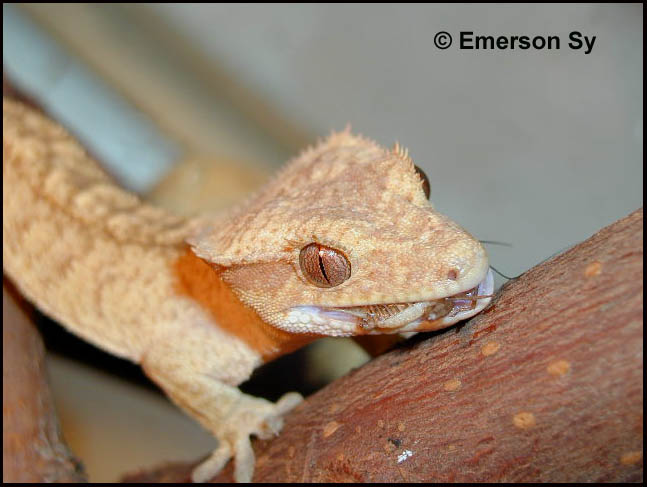 |
| A feeder insect should easily fit in a CG's mouth |
| Only offer 3 to 5 appropriate sized insects per feeding for each CG at night. Excessive insects can stress crested geckos and they will ignore the insects. |
| Aside from live prey items, crested geckos readily eat mashed fruits such as peaches, apples, bananas, pears, apricots and various berries. Calcium and vitamin supplements can be mixed into the mashed fruits before offering to crested geckos. Commercial baby food brands such as Gerber � and Beech-Nut � are readily available in baby food section of a local supermarket. Use a small inverted plastic lid to place half to one teaspoon of mashed fruit per gecko. Uneaten portions should be removed the following morning to avoid attracting ants, which can kill crested geckos. Mashed fruits can compose 50-75% of the diet and live insects can compose the other 25-50%. Based on fecal analysis, crested geckos in the wild mostly consume fruits (Henkel, 2000). Adult crested geckos should be fed 3 to 4 times a week. Hatchlings and juveniles should be fed 4 to 5 times a week for optimal growth. |
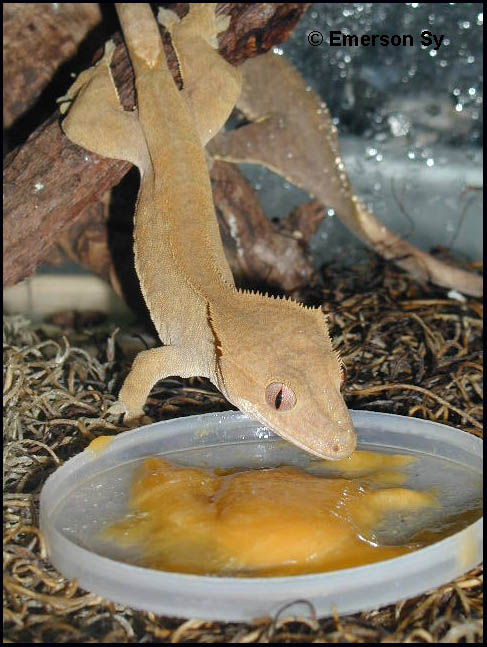 |
| Although crested geckos accept various fruits, peaches are more readily eaten >>> |
| VITAMIN AND CALCIUM SUPPLEMENTS Feeder insects lack all the required nutrients for a crested gecko to thrive. It is therefore important to supplement with vitamins and calcium carbonate. Calcium supplement should be offered at every other feeding for adult crested geckos and more often for juveniles and gravid females. This can be done by "dusting" feeder insects prior to being offered to your crested geckos. Calcium and vitamin supplements can also be mixed with mashed fruits. Multi-vitamin supplements should be offered once every week or every two weeks depending on how well you "power-feed" your feeder insects. Popular brands such as Herptivite and Reptivite are commonly available in reptile stores. Over-supplementation does occur with detrimental results. It is best to use moderation when using vitamin and calcium supplements. |
| WATERING Mist the sides and plants of enclosures atleast once a day to provide drinking water for crested geckos. Mist more often during warmer months to help cool down the ambient temperature. A small water dish can be ulitized as well, but make sure to change the water every day. Stagnant water can be a breeding ground for bacteria and other pathogens. |