| Vibrational frequencies of a Wurtzite crystal structure Cadmium Sulfide sphere are calculated based on the five bulk linear elastic constants. Comparison with polarized Raman scattering experimental data shows good agreement. |
| Table I.
Force constants for lattice simulation of hexagonal Cadmium Sulfide (Using C++ program hex2.cpp.) | ||
| constant | units | value |
| a | (metres) | 1 |
| c | (metres) | 0.93 |
| ρ | (g/cc) | 4.825 |
| C11 | (GPa) | 90.7 |
| C12 | (GPa) | 58.1 |
| C13 | (GPa) | 51.0 |
| C33 | (GPa) | 93.8 |
| C44 | (GPa) | 15.04 |
| C66 | (GPa) | 16.3 |
| k6pt | (N/m3) | 5.581e9 |
| ksp1 | (N/m) | 2.567e10 |
| k3pt | (N/m3) | 1.134e10 |
| ksp3 | (N/m) | 1.968e10 |
| ksp4 | (N/m) | 8.706e9 |
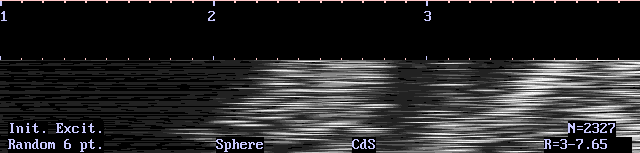
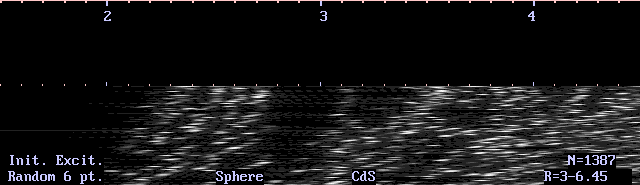
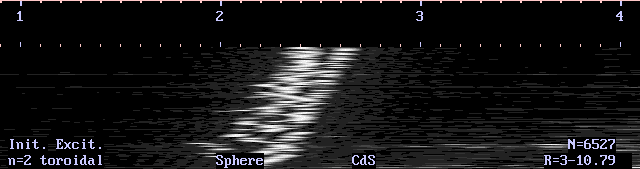
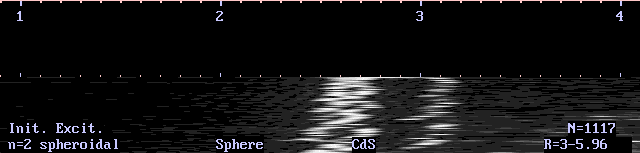
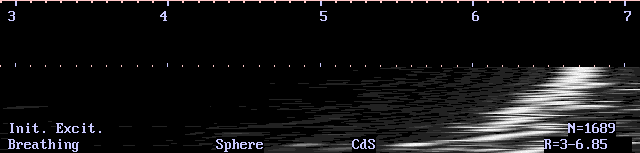
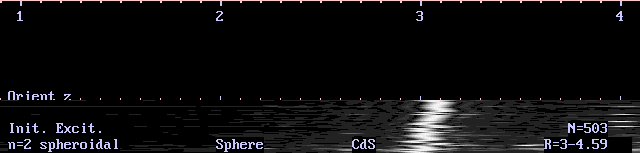
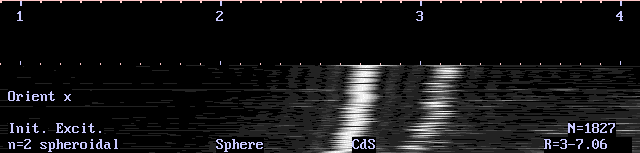
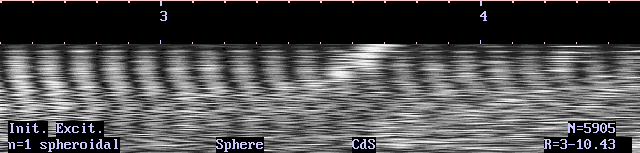
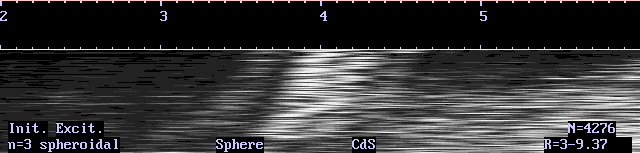
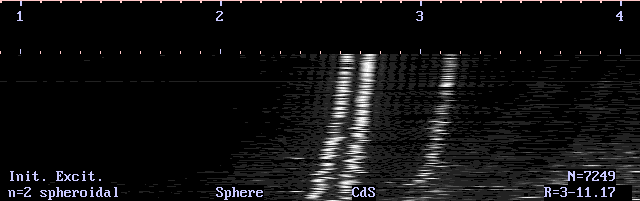
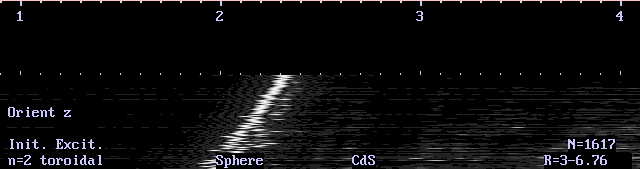
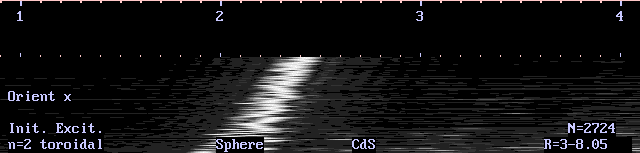
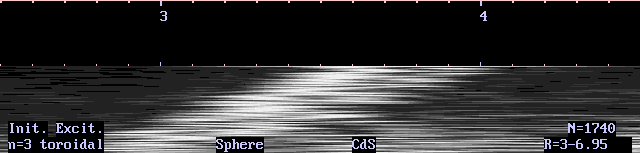
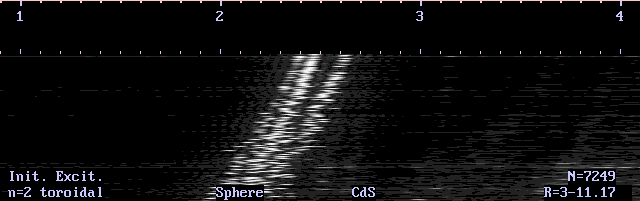
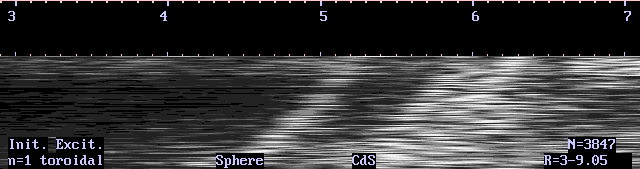
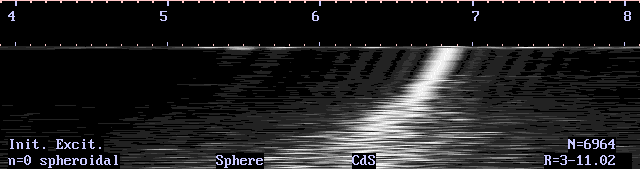
| Figure 1. Fourier transforms of lattice simulations of CdS spheres are shown. The initial disturbance of the lattice is as shown at lower left. For each plot, the horizontal axis is η = ω R/(1765 m/s). The vertical axis is 1/R, with infinite R at the top. R at the bottom is 3. The maximum radius and number of atoms, N, used is shown at the lower right. (hc2mod.cpp cdssph0a.gif...) |
|
|
|
|
|
|
|
|
|
|
|
|
|
|
|
|
| Table II.
Vibrational frequencies (ω in rad/s) of a CdS (Wurtzite form) nanosphere of radius R | ||||
| mode type |
angular momentum quantum number l |
η | ω R | frequency, ν, for 10 nm diam. sphere (cm-1) |
| sph | 0 | 6.98 | 12320 | 11.09 |
| sph | 1 | 3.85 | 6795 | 6.11 |
| sph | 2 | 2.66 | 4695 | 4.22 |
| sph | 2 | 2.77 | 4889 | 4.40 |
| sph | 2 | 3.18 | 5613 | 5.05 |
| sph | 2 | 5.20 | 9178 | 8.26 |
| sph | 2 | 5.40 | 9531 | 8.58 |
| sph | 2 | 5.60 | 9884 | 8.89 |
| sph | 2 | 6.00 | 10590 | 9.53 |
| sph | 3 | 3.75 | 6619 | 5.96 |
| sph | 3 | 4.05 | 7148 | 6.43 |
| sph | 3 | 4.32 | 7625 | 6.86 |
| sph | 3 | 6.80 | 12002 | 10.80 |
| sph | 4 | 5.40 | 9531 | 8.58 |
| sph | 5 | 6.40 | 11296 | 10.16 |
| tor | 1 | 5.55 | 9796 | 8.81 |
| tor | 1 | 6.20 | 10943 | 9.85 |
| tor | 1 | 6.50 | 11472 | 10.32 |
| tor | 2 | 2.55 | 4501 | 4.05 |
| tor | 2 | 2.60 | 4589 | 4.13 |
| tor | 2 | 2.75 | 4854 | 4.37 |
| tor | 3 | 3.90 | 6884 | 6.19 |
| tor | 3 | 4.20 | 7413 | 6.67 |
| tor | 4 | 5.30 | 9355 | 8.42 |
| tor | 4 | 5.60 | 9884 | 8.89 |
| tor | 5 | 6.50 | 11472 | 10.32 |
| tor | 5 | 7.00 | 12355 | 11.12 |
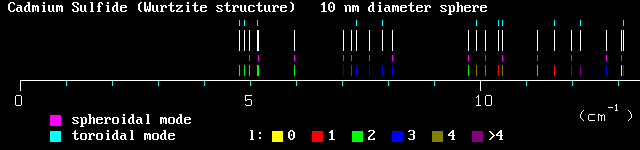
| Figure 2.Calculated vibrational spectrum for selected modes of a 10 nm diameter CdS
(Wurtzite crystal structure) nanoparticle
(hc2fmod.cpp cds.frq readfrq3.cpp cds.scr s2g.cpp cds.gif) |
 |
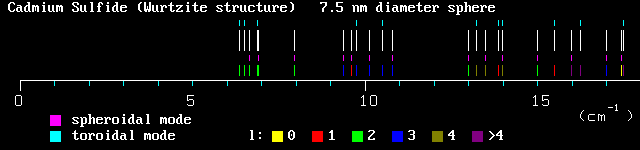
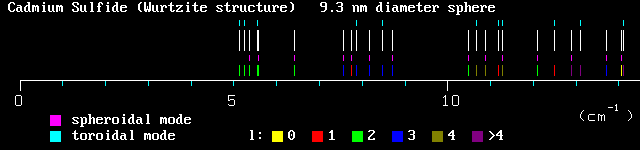
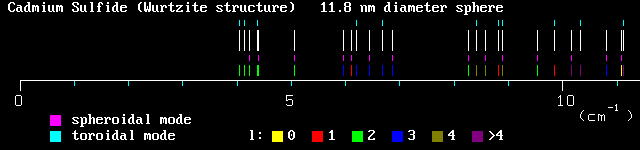
| Figure 3.Calculated vibrational spectrum for selected modes of CdS
(Wurtzite crystal structure) nanoparticles of various diameters as observed in the
experiment of Tanaka, Onari and Arai.
(hc2fmod.cpp cds.frq readfrq3.cpp cds.scr s2g.cpp cds.gif) |
 |
 |
 |
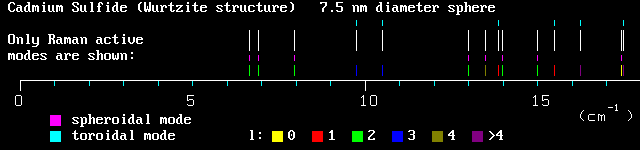
| Figure 4. Raman active spectrum for selected modes of CdS (Wurtzite crystal structure) nanoparticles of diameters 7.5 nm as observed in the 1993 experiment of Tanaka, Onari and Arai. (hc2fmod.cpp cds.frq readfrq3.cpp cds.scr s2g.cpp cds.gif) |
 |
|
W. Q. Chen, H. J. Ding, R. Q. Xu "Three-dimensional static analysis of multi-layered piezoelectric hollow spheres via the state space method" International Journal of Solids and Structures 38 (2001) 4921-4936 :: Chen, W. Q. and Ding, H. J. (2001) Free vibrations of multi-layered spherically isotropic hollow spheres. International Journal of Mechanical Science, Vol. 43(3), 667-680. :: H. Cohen, A. H. Shah and C. V. Ramakrishnan 1972 Acustica 26 329-333, "Free Vibrations of a Spherically Isotropic Hollow Sphere" P. R. Heyliger and A. Jilani 1992 International Journal of Solids and Structures 29 2689-2708 "The Free Vibrations of Inhomogeneous Elastic Cylinders and Spheres" Chen, W. Q., Cai, J. B., Ye, G. R. and Ding, H. J. (2000) "On eigenfrequencies of an anisotropic sphere". ASME Journal of Applied Mechanics, Vol. 67(2), 422-424. Chen, W. Q. "Effect of radial inhomogeneity on natural frequencies of an anisotropic hollow sphere" Journal of Sound and Vibration, Vol. 226(4), 787-794.(1999) :: Chen, W. Q. and Ding, H. J. (1997) "On free vibrations of an embedded anisotropic spherical shell" ASME Journal of Pressure Vessel Technology, Vol. 119(4), 481-487. Ding, H. J. and Chen, W. Q. (1996) "Natural frequencies of an elastic spherically isotropic hollow sphere submerged in a compressible fluid medium". Journal of Sound and Vibration, Vol. 192(1), 173-198. W. Q. Chen and L. Z. Wang, "Free Vibrations of Functionally Graded Piezoceramic Hollow Spheres with Radial Polarization" Journal of Sound and Vibration vol. 251, pages 103-114 (2002) :: W. Q. Chen, "Vibration Theory of Non-Homogeneous Spherically Isotropic Piezoelastic Bodies" Journal of Sound and Vibration" vol 236 pages 833-860 (2000) :: Palko JW, Kriven WM, Sinogeikin SV, Bass JD, Sayir A "Elastic constants of yttria (Y2O3) monocrystals to high temperatures" JOURNAL OF APPLIED PHYSICS 89 (12): 7791-7796 JUN 15 2001 http://hercules.geology.uiuc.edu/~stas/Abstracts/JAP01_89_7791.htm Room temp: C11=223.7(0.6) C12=112.4(1.1) C44=74.6(0.7) GPa K = 149.5(1.0) GS=66.3(0.8) [Voigt-Reuss-Hill average] Formula for Voigt and Reuss for cubic crystal (in french; has error in C' definition) http://www.ens-lyon.fr/LST/WEBHP/elasticite/node2.html GV = (2C'+3C44)/5 = Voigt Bound GR = 5C'C44/(2C44+3C') = Reuss Bound GS=(GV+GR)/2 = Voigt-Reuss-Hill average C'=(C11-C12)/2 Also, for a cubic crystal, the VRH bulk modulus is (C11+2C12)/3 "Gas-phase-condensed Y2O3:Eu3+ nanoparticles of < 10 nm contain multiple phases: monoclinic Y2O3:Eu3+, cubic Y2O3:Eu3+, monoclinic Eu2O3, and a disordered phase. Larger particle sizes predominantly form in the metastable monoclinic phase" "Annealing as-prepared 4-nm Y2O3:Eu3+ at 500-900 C produces cubic-phase Y2O3:Eu3+ and removes all other phases. " link Noninertial mechanism for electronic energy relaxation in nanocrystals Ho-Soon Yang,* Michael R. Geller, and W. M. Dennis Department of Physics and Astronomy, University of Georgia, Athens, Georgia 30602-2451 pdf :: H. S. Yang, M. R. Geller Dennis, "New Mechanism for Electronic Energy Relaxation in nanocrystals" Aug 15 2000 preprint H. S. Yang, M. R. Geller, W. M. Dennis, "Noninertial Mechanism for electronic energy relaxation in nanocrystals" Phys. Rev. B vol. 62 (2000) 9398. :: T. Takagahara, J. Lumin. 70, 129-143 (1996) "Electron-phonon interactions in semiconductor nanocrystals" List of recent publications by Takagahara group (in Japanese) http://www.hiei.kit.ac.jp/~takaghra/ http://www.chem.vt.edu/chem-dept/tissue/nano/ "While the elastic modes of spherical nanoparticles can be calculated analytically, this is not the case for nonspherical nanoparticles." "Visscher et al. ...mode structure for ellipsoidal nanoparticles..." :: W. M. Visscher, A. Migliori, T. M. Bell and R. A. Reinhart, "The normal modes of free vibration of inhomogenous and anisotropic elastic objects" J. Acoust. Soc. 90 (1991) 2154-2161. M. K�gl, L. Gaul A 3-D Boundary Element Method for Dynamic Analysis of Anisotropic Elastic Solids Computer Modeling in Engineering & Sciences, 1(4) (2000), pp. 27-43 abstract U. Banin, G. Cerullo, et al. "Quantum confinement and ultrafast dephasing dynamics in InP " Phys Rev. B vol 55, March 1997 :: Has general axis formula for Young's modulus! 1/E = (C11+C12) +... http://www.crystran.co.uk/optics.htm Sapphire Al2O3 C11=496 C12=164 C13=115 C33=498 C44=148 B = 240 GPa http://www.tydex.ru/materials/materials2/sapphire.html ??? CdSe density 5.67 g/cc. !!!??? http://ncsr.csci-va.com/materials/cdse.asp CdSe (Wurtzite) 5.81 g/cc Article on CdSe modelled using pair potential Table III gives calc and experi. elastic constants for wurtzite, zinc blende and rocksalt forms CdSe Experimental values (Wurtzite = hexagonal): C11 = 74.6 GPa C12 = 46.1 GPa C13 = 39.4 GPa C33 = 81.7 GPa C44 = 13.0 GPa C66 = 14.3 GPa B = 53.4 GPa from: Eran Rabani "An interatomic pair potential for cadmium selenide" Journal of Chemical Physics vol. 116, no. 1 (2002) pdf :: CdS colloidal quantum dots: S. A. Empedocles, D. J. Norris, M. G. Bawendi, Phys. Rev. Lett 77, 3873 (1996). Another experiment [Cerullo, De Silvestri & Banin 1999 pdf ::, see figure 6] used femtosecond pump-probe spectroscopy to look at a CdSe nanocrystal with diameter 3.6 nm in a polymer film. Excitation of the breathing (n=0 spheroidal) mode led to damped oscillations with frequency 21 cm-1 and damping time 1.5 ps. This frequency corresponds to ω = 3.96×10¹² and ω R = 7120. But this is for CdSe and not for CdS. http://www.spie.org/web/abstracts/2300/2362.html Paper #: 2362-33 Femtosecond pump-probe studies of CdSe microcrystals embedded in a germanium dioxide glass matrix, pp.304-311 Author(s): Toshihiro Arai, Univ. of Tsukuba, Tsukuba, Ibaraki, Japan; Akinori Tanaka, Univ. of Tsukuba, Sendai, Japan; Kiyoto Matsuishi, Univ. of Tsukuba, Tsukuba, Ibaraki, Japan; Seinosuke Onari, Univ. of Tsukuba, Tsukuba, Japan; Yoshihiro Maruyama, Hamamatsu Photonics KK, Tsukuba, Ibaraki, Japan; Mitsuru Ishikawa, Hamamatsu Photonics KK, Tsukuba, Ibaraki, Japan. Abstract: We report here results of experiments on the transient absorption spectra of CdSe microcrystals embedded in a germanium dioxide glass matrix. The transient absorption spectra were measured by means of femtosecond pump-probe method. In the sample with the smaller microcrystal size within the category of the strong confinement regime (the individual particles confinement regime), the absorption bleachings due to the carrier dynamics in the quasi-zero- dimensional quantum confined states were observed. In the sample with the larger microcrystal size within the category of the weak confinement regime (the exciton confinement regime), the absorption bleachings due to the hot carrier in the 3D electronic states were studied at various excitation intensities.!31 |