Updated: January 21, 2008
Breathing Mode Frequency of InAs Nanoparticles

The vibrational frequency of a sphere of the anisotropic cubic crystal InAs is calculated from its elastic constants and compared with experimental measurements of the breathing mode frequency of nanoparticles. The damping time of the oscillations is also calculated.

   Indium Arsenide (InAs) is a crystal with cubic symmetry and density 5.68 g/cc. Its elastic constants (on-line reference) at 293 K are C11 = 83.4 GPa, C12 = 45.4 GPa, C44 = 39.5 GPa. The Zener anisotropy factor of InAs is

A = 2 C44 / (C11 - C12) = 2.079

A C++ computer program cc3mod.cpp is available [Murray 2002] to accurately compute the vibrational frequencies of an elastic sphere to within the order of 1%. However, this program is limited to materials with Zener anistropy factor A less than or equal to 2. Even so, the elastic constants of InAs need to be altered by less than 2% in order to bring A back to 2. There is no reason to suppose that vibrational frequencies should change significantly for such a small change. Therefore, cc3mod.cpp has been used to calculate the frequency of the "breathing" mode of InAs. The result is that ω R is estimated to be 10600.
   For comparison, if InAs is assumed to be an isotropic elastic material with longitudinal sound speed sqrt(C11/ρ) = 3830 m/s and shear sound speed sqrt(C44/ρ) = 2640 m/s, the resulting frequency of the breathing mode has ω R = 8315.
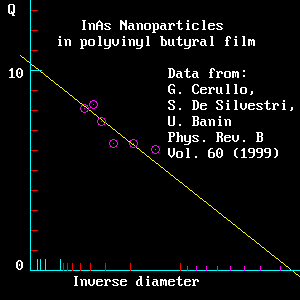
Figure 1.The vertical axis is ωR, where ω is angular frequency and R is particle radius. The left side of the figure corresponds to infinite particle size. (inas.cpp inas.gif)
   Figure 1 (at right) shows experimental data for the frequency of the breathing mode of InAs nanoparticles [Cerullo, De Silvestri and Banin 1999 pdf ::]. The yellow line is an informal straight line fit to the data. The extrapolation to infinite particle size (the left edge of the plot) is that ω R is 12000. So the experimentally observed vibration frequency is 13% higher than that expected from theory.

Effect of the Matrix
   In the experiment, the nanoparticles were implanted in polyvinyl butyral film. Such a surrounding medium has two effects. First, it provides a mechanism for the vibrational energy to be radiated away, leading to damping of the oscillations. Second, it shifts the center frequency of the vibrations.
   For an isotropic elastic sphere (a) surrounded by a fluid medium (b), the complex vibrational frequency of breathing modes is obtained by finding the complex roots, s, of the equation: [Murray 2002]

s2 tan(s) = [ 4(CTa/CLa)2 + i s (zb/(ρaCLa))] ( tan(s) - s )

where

s = ω R / CLa   (a dimensionless complex number)
ω = complex angular frequency (rad/s)
i = sqrt(-1)
CTa = sqrt(C44aa)
CLa = sqrt(C11aa)
ρa = density of sphere
C11a and C44a are the elastic constants of sphere (assumed isotropic)
zb = acoustic impedance of fluid surface = ρb Cb [ (kb R )2 - i kb R ] / (1 + (kb R )2)
ρb = density of surrounding fluid
Cb = speed of sound in surrounding fluid
za = ρa CLa
R = radius of the sphere
kb = s CLa / (Cb R) = wavevector in fluid

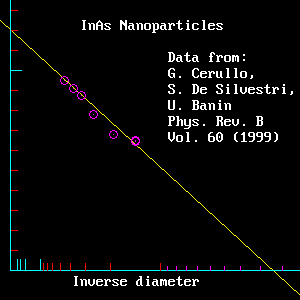
Figure 2.The vertical axis is Q, the product of decay time τD and angular frequency ω. The left side of the figure corresponds to infinite particle size. (inas2.cpp inas2.gif)
   A short C++ program finds.cpp is used to find the root s. We are forced to approximate the InAs sphere as isotropic. We also approximate the polyvinyl butyral as a fluid medium even though it is a solid. This is justifiable since the wavelength is small compared to the sphere radius. Numerical values are as follows:

CTa = 2640 m/s
CLa = 3830 m/s
ρa = 5680 kg/m3
Cb = 2350 m/s (on-line reference)
ρb = 1110 kg/m3 (on-line reference)
R = (55 Angstroms)/2

   I should mention that I am not too confident in the values for the mechanical properties of polyvinyl butyral (PVB, "Butacite", "Butvar"). If it has Y = 2.60 GPa and ν = 0.41 then it would have CL = 2350, and B = 4.8 GPa. However, I saw another reference claiming that PVB has bulk modulus 2.0 GPa. So these numbers should not be taken to be precise. Here are some references that quote values for the properties of polyvinyl butyral:
ν = 0.37 www.ultrasonic.com
B = 2.0 GPa www.internationalglassreview.com
Y = 1.93 to 2.34 GPa www.oup-usa.org

   The resulting value of s is 2.104 - 0.204 i. If the equation is solved with ρb=0, s is 2.167 (no imaginary part). The damping time τD = 3.5 ps. Defining the quality factor Q as

Q = τD ω

Q is 10.31, and this is independent of R. In Figure 2, Q from the experimental data for InAs is plotted versus inverse radius, allowing the limit as R is large to be extrapolated. The yellow line crosses the vertical axis at 10.3! So the agreement is excellent! This suggests that energy loss due to mechanical coupling to the surrounding medium is indeed the predominant damping mechanism.
   The vibration frequency is decreased by only 3% by the presence of the surrounding polyvinyl matrix.
   In the experimental paper they mention the alternative of suspending the nanoparticles in toluene. The density of toluene is ρb = 0.867 g/cc. I didn't find any reference for the speed of sound in toluene, but judging from other organic materials it should be in the range from 900 to 1300 m/s. If Cb = 1100 m/s in toluene, then Q will be increased to 28. If Cb = 900 m/s in toluene, then Q will be increased to 33. If Cb = 1300 m/s in toluene, then Q will be increased to 23.

Other Comments:
   The experimental paper also mentions CdSe nanoparticles. Since CdSe normally has the wurtzite structure, it has hexagonal symmetry. Therefore, its bulk elastic properties require more than three elastic constants to describe. The program cc3mod.cpp is only able to handle crystals with cubic symmetry.


References:
G. Cerullo, S. De Silvestri and U. Banin "Size-dependent dynamics of coherent acoustic phonons in nanocrystal quantum dots" Phys. Rev. B volume 60 (July 15, 1999) pdf ::

D. B. Murray "Eight Point Force Molecular Dynamical Estimates of Vibrational Frequencies of an Isotropic Elastic Sphere" 2002 link to article

D. B. Murray "Breathing Mode Vibrations of an Isotropic Elastic Sphere Surrounded by a Fluid Medium" 2002 link to article

Elastic constants of InAs may be found at:
http://www.ioffe.rssi.ru/SVA/NSM/Semicond/InAs/mechanic.html

Mechanical properties of polyvinyl butyral may be found at:
http://www.ultrasonic.com/tables/plastics_top.htm
http://www.ultrasonic.com/tables/plastics_bottom.htm

Daniel Murray
Associate Professor
Math, Stats & Physics Unit
University of British Columbia - Okanagan
Kelowna, BC, Canada
daniel "dot" murray "at" ubc "dot" ca

For a list of related articles click on the link.
Hosted by www.Geocities.ws

1