Last updated: Aug 9, 2002
Rebound of an Isotropic Elastic Cylinder
from a Hard Frictionless Floor

Rebound of a cylinder using molecular dynamics. There is no friction. The floor is infinitely hard.

   The coefficient of restitution of an object boucing either off the floor or off of another object has been studied extensively, both experimentally and theoretically. In particular, the problem of a rigid thin rod hitting a hard floor has been studied experimentally and theoretically [Hurmuzlu 1998 pdf ::].
   Consider a right circular cylinder of radius R and height h. The cylinder is made of isotropic elastic material of Young's modulus Y, density ρ and Poisson ratio ν. The mass of the cylinder is m, where m = ρ π R2 h. There is no viscous dissipation. The cylinder initially has no angular velocity, and its orientation with respect to the floor is selected randomly. The cylinder is then thrown towards the floor at speed vy0. The initial center of mass kinetic energy is KCMi = 0.5 * m * vy02 There is no gravity. After the collision, the cylinder has angular velocity (vector) ω. Its moment of inertia (tensor) is I. So its angular kinetic energy is Kangf = 0.5 ω I ω. The velocity of the center of mass of the cylinder after the collsion is vyf. (vxf=vzf=0 since there is no friction). The final center of mass kinetic energy is KCMf = 0.5 * m * vyf2. The energy ratio for the collision is defined as ER = (KCMf+Kangf)/ KCMi. The amount of energy lost is Elost = KCMi -(KCMf+Kangf). The lost energy is transformed into potential energy and kinetic energy of vibrational modes of the cylinder. This includes energy that goes into tearing or plastically deforming the cylinder in a violent collision.
   For a spherical object bouncing off the floor, the coefficient of restitution, e, is defined as the ratio of final to initial speed. For a non spherical object the definition of the coefficient of restitution is complicated by the mixture of rotational and rectilinear motion after the collision. To avoid these complications, we initially focus only on ER the energy ratio, and leave discussion of the coefficient of restitution to later.
   The approach taken here to determining the energy ratio is by using molecular dynamics applied to individual pointlike atoms that make up the cylinder. The atoms are assumed to interact through a model potential U(r).
Lenn Jones
Quad pot
   The atoms in the solid are arranged in a face centered cubic lattice. The number of atoms that makes up the cylinder is N. Memory limitations in the computer limit N to 13000. The material thus simulated has the following mechanical properties, as detailed in Table I:

 Table I. Linear Elastic Properties of Molecular Dynamics Solid:
 PropertySymbolAverage
value
UnitMin.
value
Max.
value
Relation:
 Mass of one atommatom1.0000000kg(exact)  
 Density ρ1.0000000kg/m3(exact)  
 Atomic force constantdF/dr1.0000000N/m(exact)  
 Atom center-center distancedcc1.1224621m(exact)  dcc=(sqrt(2)atom/ρ)1/3
 Bulk Modulus B0.8399473Pa(exact)  2ρ(dcc)2(dF/dr)/(3atom)
 Young's ModulusY1.215Pa1.1721.261(use md4ym.cpp)
 Poisson's ratioν0.2589- - -0.24980.2674ν=(3B-Y)/(6B)
 Shear Modulus G0.4826Pa0.46230.5045G=3BY/(9B-Y)
 1st Lamé constant λ0.5182Pa0.50360.5317λ = B - (2/3)G
 Shear wave speedCs0.6947m/s0.67990.7103Cs=sqrt(G/ρ)
 Longitudinal wave speedCl1.2179m/s1.20681.2299Cl=sqrt((λ+2G)/ρ)
 Cs / Cl0.5704- - -0.56340.5775
 Y / ( 1 - ν2 )1.3023- - -1.26231.3449

   In order to apply the results of the molecular dynamics simulation to an actual macrosopic cylinder, simulations for a range of values of N must be extrapolated to the limit of large N. The results are shown in figure 1.

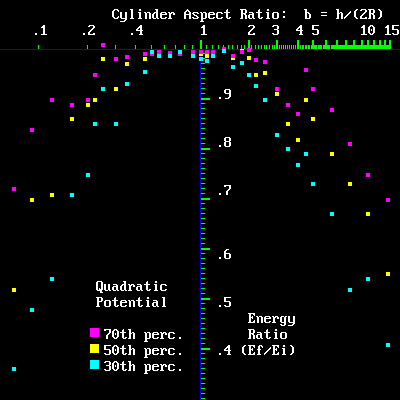
Figure 1. Energy ratio is plotted for cylinders with a range of h/(2R) impacting on a hard frictionless floor. The initial velocity is 0.02 m/s. The initial orientation of the cylinder is randomized. The vertical axis is the ratio of final to initial energy, including center of mass kinetic energy and rotational kinetic energy. The extrapolation to large object size (the limit of many atoms) is shown. The 30th, 50th and 70th percentiles of energy ratio are shown. (The energy ratio has a 40% chance of lying between the blue and purple points) The quadratic potential was used. dt=0.5. (md4c.cpp ploter.cpp figcyer.cpp figcyer.gif)

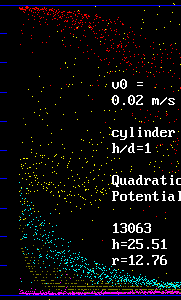
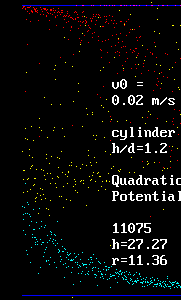
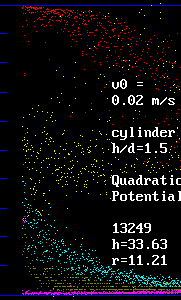
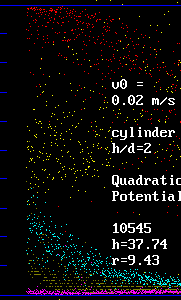
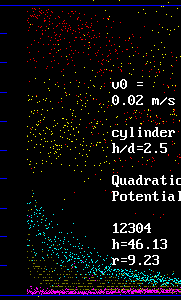
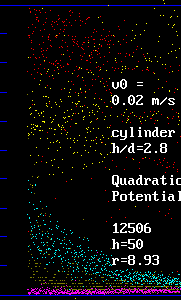
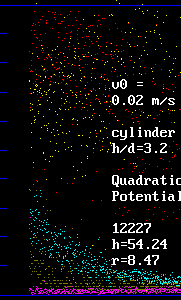
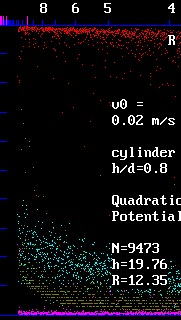
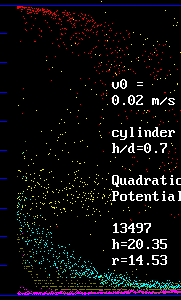
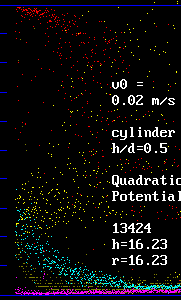
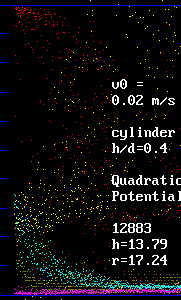
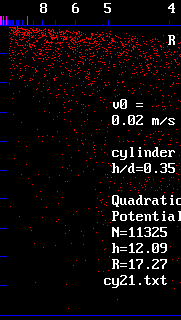
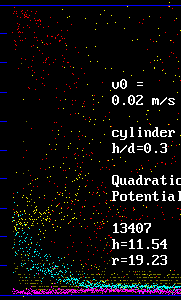
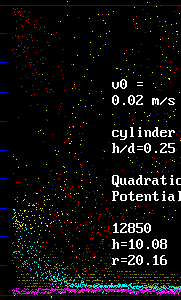
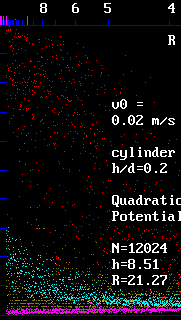
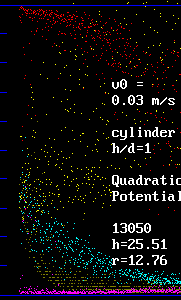
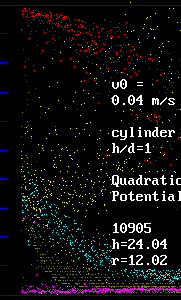
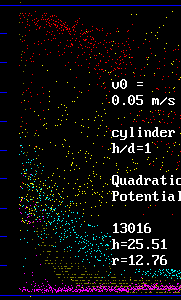
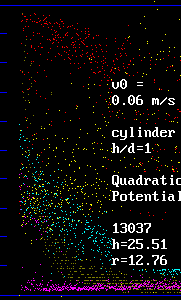
   Some examples of simulations that were used to obtain Figure 1 are shown in Figure 2 and Figure 3.

Figure 2. The horizontal scale is the reciprocal of object size. The left edge of each graph corresponds to infinite R. Red is energy ratio (0 to 1). Yellow is (tcoll/R) on a scale from 0 to 40. Blue is maximum strain during bounce (0 to 1). Brown is number of atoms in contact on a scale from 0 to 100. Purple is final maximum strain (0 to 1). (md4b.cpp dt=0.5)

Figure 3. The horizontal scale is the reciprocal of object size. (or else R-2). The left edge of each graph corresponds to infinite R. Red is energy ratio (0 to 1). Yellow is (tcoll/R) on a scale from 0 to 40. Blue is maximum strain during bounce (0 to 1). Brown is number of atoms in contact on a scale from 0 to 100. Purple is final maximum strain (0 to 1). (md4b.cpp dt=0.5)

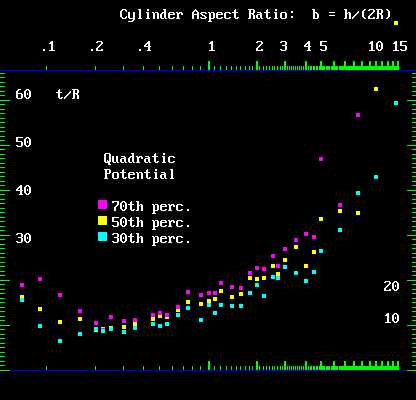
   From Figure 1, it is apparent that the energy ratio is always very close to 1 when h/(2R) is in the range from 0.5 to 1.8 . Thus, a cylinder which is coin-like in shape with h/(2R) < 0.5 (that is, with h < 1.0 R) will lose a significant amount of energy during the bounce. The amount of energy lost increases as the coin becomes thinner. Also, a thin rod with h/(2R)>1.8 (that is with R < 0.28 h) will lose a significant amount of energy during the bounce. The amount of energy increases as the rod becomes thinner. It is not surprising that a collision with a hard floor could excite vibrational modes of a cylinder which lead to some energy loss. The more interesting question is why this energy loss is so small for 0.5 < h/(2R) < 1.8.
   The results of Figure 1 can be scaled to a cylinder with given Young's modulus Y and density ρ. However, the Poisson ratio, ν, of the atomic lattice is approximately 0.2589, and this cannot be scaled to other values of the Poisson ratio. The Poisson ratio for most materials is in the vicinity of 0.3. The initial speed of 0.02 m/s is for a material for which the speed of shear waves is 0.6947 m/s and the speed of longitudinal waves is 1.2179 m/s. For a typical plastic, the speed of sound is on the order to 1000 m/s. Thus, Figure 1 corresponds to a plastic cylinder dropped at approximately 20 m/s. For a metal with speed of sound closer to 5000 m/s, Figure 1 corresponds to a drop speed of 100 m/s.

Figure ??. Collision time over radius R is plotted for cylinders with a range of h/(2R) impacting on a hard frictionless floor. The initial velocity is 0.02 m/s. The initial orientation of the cylinder is randomized. The vertical axis is the ratio of collision time to the radius of the cylinder. The extrapolation to large object size (the limit of many atoms) is shown. The 30th, 50th and 70th percentiles of t/R are shown. (t/R has a 40% chance of lying between the blue and purple points) The quadratic potential was used. dt=0.5. (md4c.cpp plottc.cpp figcytc.cpp figcytc.gif)
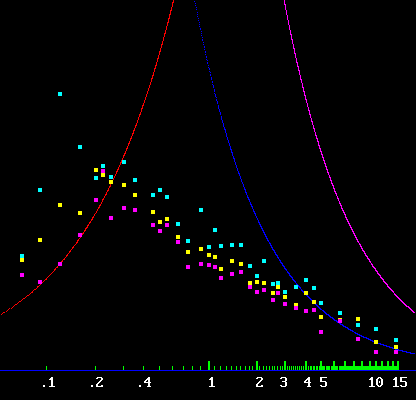
Figure ??. (f R) is plotted for cylinders with a range of h/(2R) impacting on a hard frictionless floor. The initial velocity is 0.02 m/s. The initial orientation of the cylinder is randomized. The vertical axis is f times R. The red line is the frequency of the coin saddle mode. The extrapolation to large object size (the limit of many atoms) is shown. The 30th, 50th and 70th percentiles of t/R are shown. (t/R has a 40% chance of lying between the blue and purple points) The quadratic potential was used. dt=0.5. (md4c.cpp plottc.cpp figcyf.cpp figcyf.gif)
   This most recent figure illustrates the reason for the onset of energy less when h/(2R) falls below 0.5. The red line shows the frequency (in Hz) of the coin saddle mode. This is the lowest vibrational mode. The reciprocal of the contact time is plotted in order to give the frequency of the first zero in the Fourier transform of F(t). As long as the sadde mode frequency remains well above the reciprocal of the contact time, there is no possibility of significant excitation of vibrational modes. This excitation starts as h/(2R) falls below approximately 0.5.
   It would also be interesting to plot the frequency of the dominant low frequency mode for the needle case, and see where the crossover falls..

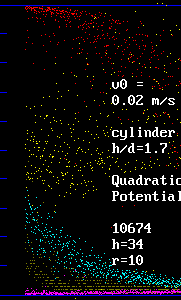
Figure 4. The horizontal scale is the reciprocal of object size. The left edge of each graph corresponds to infinite R. Red is energy ratio (0 to 1). Yellow is (tcoll/R) on a scale from 0 to 40. Blue is maximum strain during bounce (0 to 1). Brown is number of atoms in contact on a scale from 0 to 100. Purple is final maximum strain (0 to 1). (md4b.cpp dt=0.5)

References

Y. Hurmuzlu, "An Energy Based Coefficient of Restitution for Planar Impacts of Slender Bars with Massive External Surfaces" ASME Journal of Applied Mechanics, Vol. 65, pp. 952-962 (1998). pdf ::

Daniel Murray
Associate Professor
Math, Stats & Physics Unit
University of British Columbia - Okanagan
Kelowna, BC, Canada
daniel "dot" murray "at" ubc "dot" ca
Click here for a list of related articles.

Hosted by www.Geocities.ws

1