Created: Aug. 2002     Updated: January 21, 2008
Vibrational Frequency of Y2O3 Nanoparticles

The vibrational frequencies of a sphere of the anisotropic cubic crystal Y2O3 (yttria) are calculated from its bulk elastic constants in the continuum limit.

   Yttrium Oxide (Y2O3) is a body centered cubic crystal with cubic symmetry and theoretical density 5.0348 g/cc [based on 1.06018 nm lattice parameter: Ishibashi 1994] . Its elastic constants at 293 K are C11 = 223.7 GPa, C12 = 112.4 GPa, C44 = 74.6 GPa [Palko et al. 2001]. The Zener anisotropy factor of Y2O3 is

A = 2 C44 / (C11 - C12) = 1.341

A would be 1 for an isotropic material, so Y2O3 is not very elastically anisotropic.
   A C++ computer program cc3bmod.cpp (now updated to cc4b16.cpp) is available [Murray 2002] to accurately compute the vibrational frequencies of an elastic sphere to within the order of 1% provided that it consists of a elastic material with cubic symmetry and Zener anisotropy factor of 2 or less.

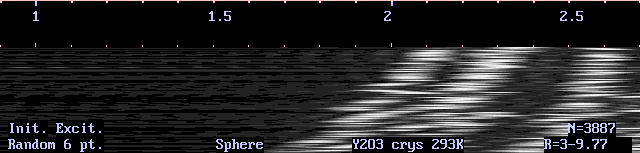
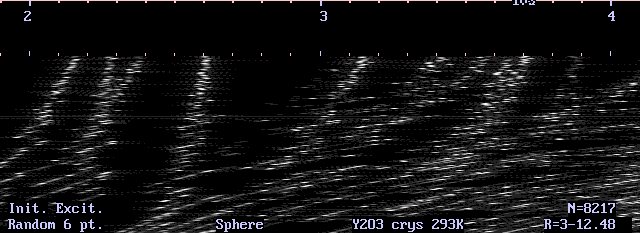
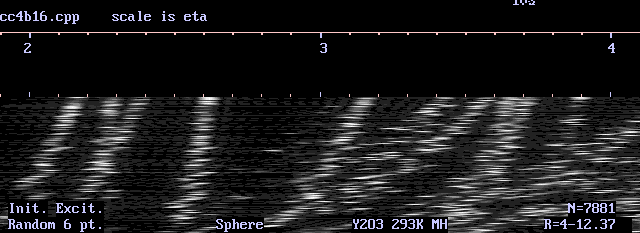
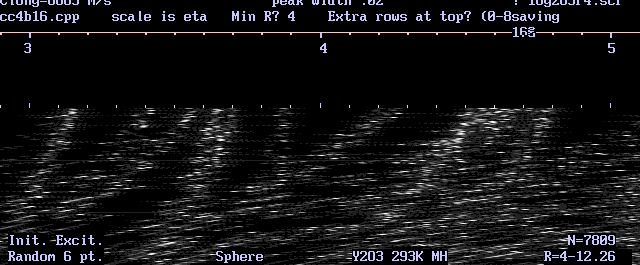
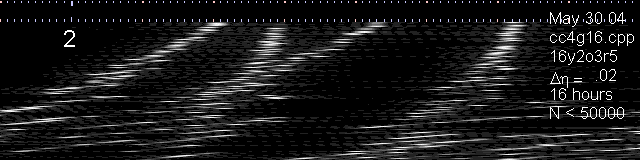
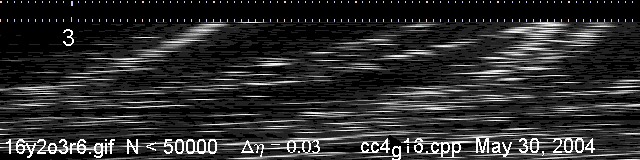
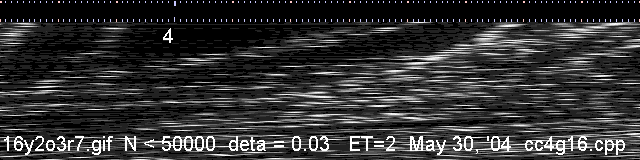
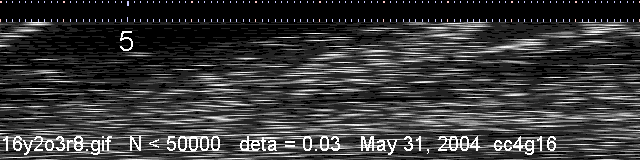
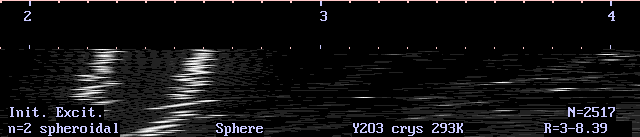
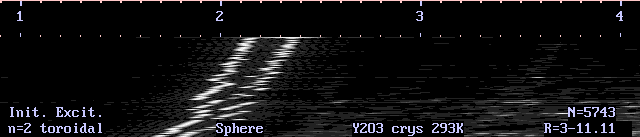
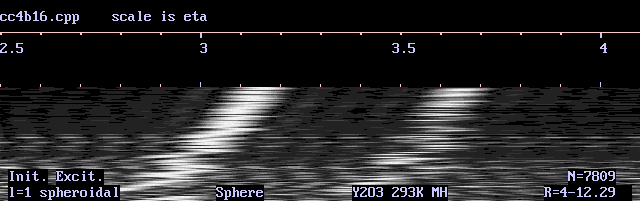
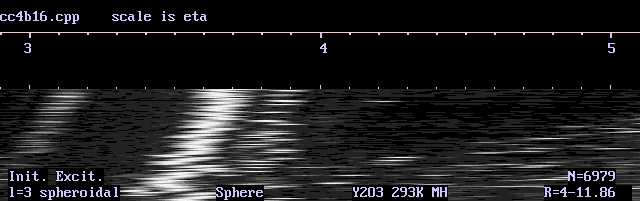
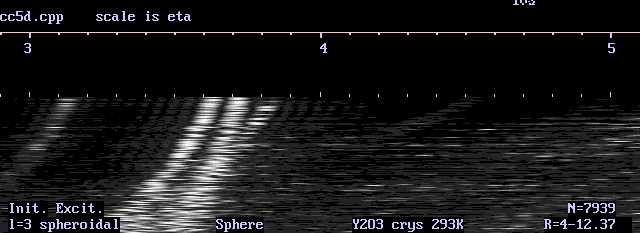
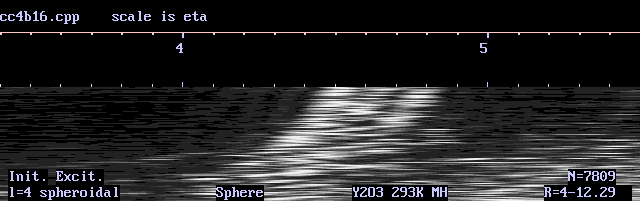
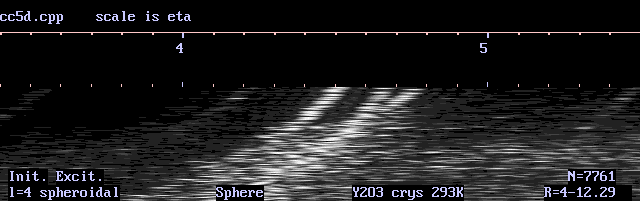
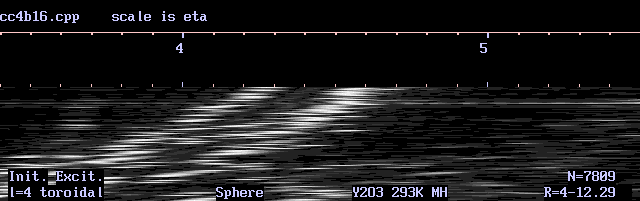
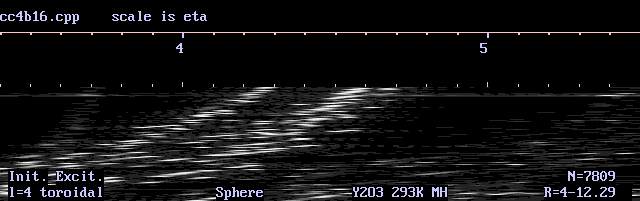
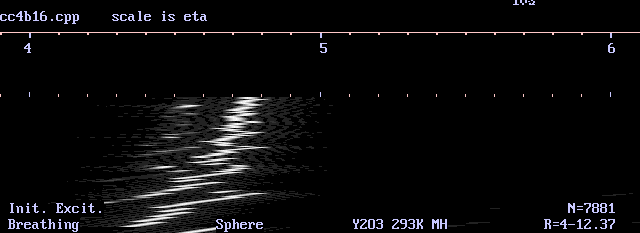
Figure 1. Fourier transforms of lattice simulations of Y2O3 spheres are shown. The initial disturbance of the lattice is random. For each plot, the horizontal axis is η = ω R/vT100. (Note: vT100 = 3849 m/s) The vertical axis is 1/R, with infinite R at the top. R at the bottom is 3 or 4. The maximum radius and number of atoms, N, used is shown at the lower right. (cc3bmod.cpp )
Warning: This figure based on old density of 5.01 g/cc.
16y2o3r1.gif
Warning: This figure based on old density of 5.01 g/cc.
16y2o3r2.gif
Δη = 0.05
6 rows at top
Min R = 4
16y2o3r3.gif
η = 2.27, 2.30, 2.49, 2.63, 3.26, 3.6?, 3.73, 3.74, 3.79, 3.96
Δη = 0.02
16y2o3r4.gif
η = 3.27, 3.6, 3.74, 3,76, 3.80, 3.90, 4.58
Δη = 0.02
N < 50000
16 hours
1.9 < η < 2.8 16y2o3r5.gif
η = 2.260, 2.295, 2.500, 2.635
Δη = 0.03
2.9 < η < 3.8
N < 50000
7 hours
16y2o3r6.gif
η = 3.260, 3.60, 3.69, 3.78, 3,80
Δη = 0.03
3.7 < η < 4.8
N < 50000
16y2o3r7.gif
η = 3.94, 4.60, 4.66
Δη = 0.03
4.8 < η < 5.8
N < 50000
16y2o3r8.gif
η = 4.91, then big gap until 5.6

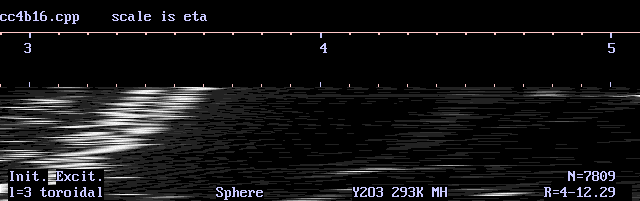
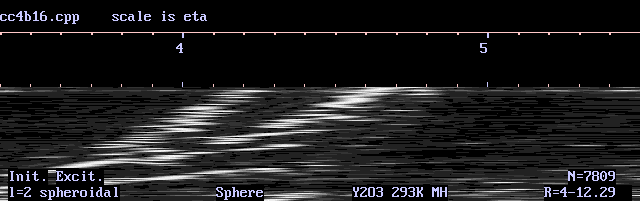
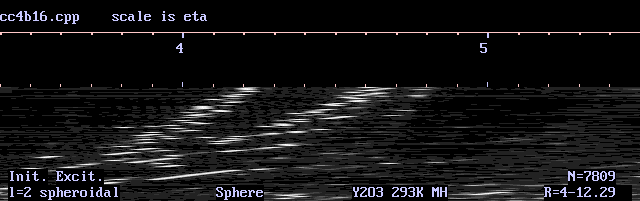
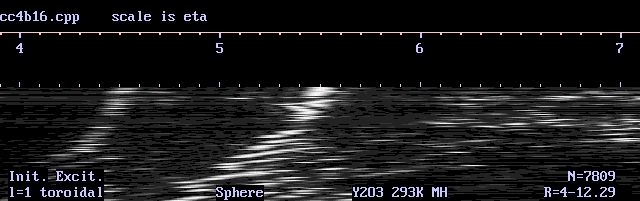
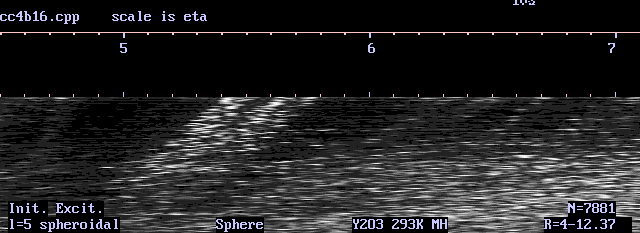
Figure 2. Fourier transforms of lattice simulations of Y2O3 spheres are shown. The initial disturbance of the lattice is as shown at lower left. For each plot, the horizontal axis is η = ω R/vT100. The vertical axis is 1/R, with infinite R at the top. R at the bottom is 3 or 4. The maximum radius and number of atoms, N, used is shown at the lower right. (cc3bmod.cpp )
Warning: This figure based on old density of 5.01 g/cc.
y2o3sph2.gif
Warning: This figure based on old density of 5.01 g/cc.
y2o3tor2.gif
May 28, 04
Δη = 0.1
16y2o3s1.gif
η = 3.25, 3.73
May 28, 04
Δη = 0.1
16y2o3s3.gif
η = 3.25*, 3.77, 3.95
[* The weak 3.25 is suspected to be better associated with (SPH,L=1) ]
May 30, 04
Δη = 0.05
16y2sp3b.gif
η = 3.70, 3.78, 3.97
Same as previous figure, but with smaller Δη
May 28, 04
Δη = 0.1
16y2o3t3.gif
η = 3.57, 3.75
May 29, 04
Δη = 0.1
16y2s2hi.gif
η = 4.55, 5.05
May 29, 04
Δη = 0.1
16y2sp2c.gif
Like previous, but Δη = 0.05
May 28, 04
Δη = 0.1
16y2o3s4.gif
η = 4.63, 4.80, 4.95
May 30, 04
Δη = 0.05
16y2sp4b.gif
η = 4.68, 4.77, 4.95
Like previous, but Δη = 0.05
May 28, 04
Δη = 0.1
16y2o3t4.gif
η = 4.64, 4.8
May 30, 04
Δη = 0.05
16y2tr4b.gif
η = 4.6, 4.9
May 28, 04
Δη = 0.05
6 rows at top
Min R = 4
16y2o3s0.gif
η = 4.87
May 29, 04
Δη = 0.1
16y2o3t1.gif
η = 4.6, 5.60
May 31, 04
Δη = 0.04
16y2o3s5.gif
band η 5.7 -- 6.0

Table I. Lowest vibrational frequencies of an Yttrium Oxide sphere, from lattice simulation (cc3bmod.cpp, etc.)
[Note: η in this table is referenced to vT100 = 3849 m/s. To get angular frequency (in rad/s), use ω = 3849 η / R]
type, l η ω R 
tor 2 2.260 --- ---
sph 2 2.295 --- ---
tor 2 2.500 --- ---
sph 2 2.635 --- ---
sph 1 3.260 --- ---
tor 3 3.60 --- ---
sph 3 3.69 --- ---
sph 3 3.78 --- ---
tor 3 3.80 --- ---
sph 3 3.95 --- ---
sph 2 4.55 --- ---
sph 4 4.63 --- ---
tor 4 4.65 --- ---
sph 4 4.80 --- ---
tor 4 4.8 --- ---
sph 0 4.87 18745 ---
sph 4 4.95 --- ---
sph 2 5.05 --- ---
tor 1 5.60 --- ---

   The speed of sound in Y2O3 in various special crystal directions is as given in Table II:

Table II: Speed of Sound
vL [100] 6665 m/s
vT [100] 3849 m/s
vL [110] 6942 m/s
vT [110] 3849 m/s
vT [110] 3324 m/s
vL [111] 7032 m/s
vS [111] 3508 m/s

   The directionally averaged speeds of sound in Y2O3 are 3640 m/s and 6891 m/s. These are calculated using dspre7h.cpp. Based on the directionally averaged speeds of sound, ω R for the (SPH,0) mode is (5.082)(3640) = 18499. This is only 1.3% above the MD result. As usual, elastic anisotropy doesn't affect the breathing mode frequency as long as directionally averaged speeds of sound are used.


References:

L. Saviot, D. B. Murray and M. del C. Marco de Lucas, Phys. Rev. B 69 (2004) 113402   cond-mat/0307634

[1.06018 nm lattice parameter] H. Ishibashi, K. Shimomoto, K. Nakahigashi, "ELECTRON DENSITY DISTRIBUTION AND CHEMICAL BONDING OF LN(2)O(3) (LN=Y, TM, YB) FROM POWDER X-RAY DIFFRACTION DATA BY THE MAXIMUM-ENTROPY METHOD" J. Phys. Chem. Solids, 55 (1994) 809

O. Yeheskel and O. Tevet, "Elastic Moduli of Transparent Yttria" J. Am. Ceram. Soc., 82 (1999) pages 136-144
(reports density of 5020 ± 18 kg/m3 and the sound velocities vl=6931 ± 65 and vt=3712 ± 49 m/s)

H. S. Yang, K. S. Hong, S. P. Feofilov, B. M. Tissue, R. S. Meltzer and W. M. Dennis "One phonon relaxation processes in Y2O3:Eu3+ nanocrystals" Physica B Volume 263-264 (1999) pp.476-478.

D. B. Murray "Eight Point Force Molecular Dynamical Estimates of Vibrational Frequencies of an Isotropic Elastic Sphere" 2002 link to article

D. B. Murray "Breathing Mode Vibrations of an Isotropic Elastic Sphere Surrounded by a Fluid Medium" 2002 link to article

D. B. Murray "Vibrational Frequency of Silicon Nanoparticles" 2002 link to article

JW Palko, WM Kriven , SV Sinogeikin, JD Bass, A Sayir "Elastic constants of yttria (Y2O3) monocrystals to high temperatures"   J. Appl. Phys. 89 (2001) pages 7791-7796
Room temp: C11=223.7(0.6) C12=112.4(1.1) C44=74.6(0.7) GPa
K = 149.5(1.0) GS=66.3(0.8) [Voigt-Reuss-Hill average]

Formula for Voigt and Reuss for cubic crystal (in french; has error in C' definition)
http://www.ens-lyon.fr/LST/WEBHP/elasticite/node2.html
GV = (2C'+3C44)/5 = Voigt Bound
GR = 5C'C44/(2C44+3C') = Reuss Bound
GS = (GV + GR)/2 = Voigt-Reuss-Hill average
C' = (C11 - C12)/2
Also, for a cubic crystal, the VRH bulk modulus is (C11+2C12)/3


H. S. Yang, M. R. Geller, W. M. Dennis, "Noninertial Mechanism for electronic energy relaxation in nanocrystals" Phys. Rev. B vol. 62 (2000) 9398. ::


Daniel Murray
Associate Professor
Math, Stats & Physics Unit
University of British Columbia - Okanagan
Kelowna, BC, Canada
daniel "dot" murray "at" ubc "dot" ca

For a list of related articles click on the link.
Hosted by www.Geocities.ws

1