












NOTE: Nothing is illegal on this page. While every care is taken in the compilation of these pages, I shall not be liable and shall be held harmless from any error of the calculation & information contained herein.
Copyright of BruAstronomy © 2000-2001
Created on 23rd Sept 2000
| Why Do Transits Happen? | |
|
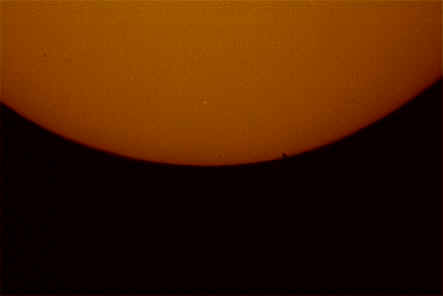
Above: Mercury is seen here as it crosses the edge of the sun to begin a solar transit. The photo was taken shortly after ingress and the famous "black-drop" phenomenon is visible.
A transit occurs whenever a planet comes between the the earth and the sun. At that time we see a small black disk crawl across the face of our star. Obviously, only the planets Mercury and Venus can ever do this because those are the only planets with orbits smaller than the earth's, and hence the only planets that can get between us and the sun. Although the outer planets (Mars through Pluto) can be seen in the same direction as the sun, they are always on the far side as seen by us. Both Mercury and Venus can appear on the far side too, but no transit will occur in that case. When Mercury or Venus passes between us and the sun, we call that event an inferior conjunction. If they are on the far side of the sun (but seen in the same area of the sky), we call that a superior conjunction. Mercury moves one complete revolution around the sun every 88 days. Since we view this from the moving earth, it takes a little extra time (28 days!) for Mercury to catch up with us so it can be at inferior conjunction again. The time from one inferior conjunction to the next inferior conjunction is therefore 116 days.
The black-drop effect occurs when two limbs, such as the edge of Mercury and the edge of the Sun, are very close together. It is caused by atmospheric scintillation, or "seeing", the same effect as objects in the distance shimmering when viewed through heat waves rising off the hot pavement in the summer. The black-drop effect during a transit of Mercury was first observed in 1677. A transit occurs when a planet passes directly between the viewer on Earth and the Sun. The only two planets in our solar system that can transit the sun are Mercury and Venus because their orbits around the Sun are inside of the Earth's orbit.
In its orbit around the sun, Mercury passes the Earth every 116 days. But only about one out of every 23 of Mercury's passages between the Earth and the sun result in a transit because Mercury's orbit is tilted seven degrees in respect to the Earth's orbit. Only 13 other transits of Mercury have taken place this century.
This transit was unusual however because it combined a total transit with a partial transit. As viewed from some locations on Earth, Mercury was not completely in front of the Sun's disk, but skimming just along the inside edge of the sun. This type of transit is called a partial or grazing transit. For other locations on Earth, Mercury was completely in front of the Sun's disk, which is the traditional type of total transit. This rare combination of total and grazing has not occurred since the invention of the telescope and will not occur again until the year 2391.
At the time of the transit, Mercury was only 9.9 arc seconds across, dwarfed by the Sun, which had an apparent size of 1940.47 arc seconds, some 196 times larger. Historically, transits of Mercury have been used to determine the planet's orbits and size more precisely. Today, transits are used to measure the exact diameter of the Sun, which may vary with the solar cycle and affect weather on Earth.
|