
















NOTE: Nothing is illegal on this page. While every care is taken in the compilation of these pages, I shall not be liable and shall be held harmless from any error of the calculation & information contained herein.
Copyright of BruAstronomy © 2000-2001
Created on 23rd Sept 2000
 |
|

|
On the first day of January 1801, Giuseppe Piazzi discovered an object which he first thought was a new comet. But after its orbit was better determined it was clear that it was not a comet but more like a small planet. Piazzi named it Ceres, after the Sicilian goddess of grain. Three other small bodies were discovered in the next few years (Pallas, Vesta, and Juno). By the end of the 19th century there were several hundred.
Several hundred thousand asteroids have been discovered and given provisional designations so far. Thousands more are discovered each year. There are undoubtedly hundreds of thousands more that are too small to be seen from the Earth. There are 26 known asteroids larger than 200 km in diameter. Our census of the largest ones is now fairly complete: we probably know 99% of the asteroids larger than 100 km in diameter. Of those in the 10 to 100 km range we have cataloged about half. But we know very few of the smaller ones; perhaps as many as a million 1 km sized asteroids may exist.
The total mass of all the asteroids is less than that of the Moon.
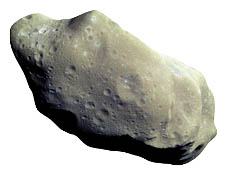
243 Ida and 951 Gaspra were photographed by the Galileo spacecraft on its way to Jupiter. The NEAR mission flew by 253 Mathilde (left) on 1997 June 27 returning many images. NEAR (now renamed "NEAR-Shoemaker") entered orbit around 433 Eros in January 1999 and has so far returned a wealth of images and data. They are the only asteroids which have been studied closely so far.
The largest asteroid by far is 1 Ceres. It is 933 km in diameter and contains about 25% of the mass of all the asteroids combined. The next largest are 2 Pallas, 4 Vesta and 10 Hygiea which are between 400 and 525 km in diameter. All other known asteroids are less than 340 km across.
There is some debate as to the classification of asteroids, comets and moons. There are many planetary satellites that are probably better thought of as captured asteroids. Mars's tiny moons Deimos and Phobos, Jupiter's outer eight moons, Saturn's outermost moon, Phoebe, and perhaps some of the newly discovered moons of Saturn, Uranus and Neptune are all more similar to asteroids than to the larger moons. (The composite image at the top of this page shows Ida, Gaspra, Deimos and Phobos approximately to scale.)
Asteroids are classified into a number of types according to their spectra (and hence their chemical composition) and albedo:
Because of biases involved in the observations (e.g. the dark C-types are harder to see), the percentages above may not be representative of the true distribution of asteroids. (There are actually several classification schemes in use today.)
There is little data about the densities of asteroids. But by sensing the Doppler effect on radio waves returning to Earth from NEAR owing to the (very slight) gravitational tug between asteroid and spacecraft, Mathilde's mass could be estimated. Surprisingly, its density turns out to be not much greater than that of water, suggesting that it is not a solid object but rather a compacted pile of debris.
Asteroids are also categorized by their position in the solar system:
Between the main concentrations of asteroids in the Main Belt are relatively empty regions known as the Kirkwood gaps. These are regions where an object's orbital period would be a simple fraction of that of Jupiter. An object in such an orbit is very likely to be accelerated by Jupiter into a different orbit.
There also a few "asteroids" (designated as "Centaurs") in the outer solar system: 2060 Chiron (aka 95 P/Chiron) orbits between Saturn and Uranus; the orbit of 5335 Damocles ranges from near Mars to beyond Uranus; 5145 Pholus orbits from Saturn to past Neptune. There are probably many more, but such planet-crossing orbits are unstable and they are likely to be perturbed in the future. The composition of these objects is probably more like that of comets or the Kuiper Belt objects than that of ordinary asteroids. In particular, Chiron is now classified as a comet.
4 Vesta has been studied recently with HST (left). It is a particularly interesting asteroid in that it seems to have been differentiated into layers like the terrestrial planets. This implies some internal heat source in addition to the heat released by long-lived radio-isotopes which alone would be insufficient to melt such a small object. There is also a gigantic impact basin so deep that it exposes the mantle beneath Vesta's outer crust.
Though they are never visible with the unaided eye, many asteroids are visible with binoculars or small telescopes.
|
|
List of some Asteroids |
|
|
A few asteroids and comets are listed
below for comparison. (distance is the mean distance to the Sun in thousands
of kilometers; masses in kilograms). No. Name Distance Radius Mass Discoverer Date ---- --------- -------- ------ ------- ---------- ----- 2062 Aten 144514 0.5 ? Helin 1976 3554 Amun 145710 ? ? Shoemaker 1986 1566 Icarus 161269 0.7 ? Baade 1949 951 Gaspra 205000 8 ? Neujmin 1916 1862 Apollo 220061 0.7 ? Reinmuth 1932 243 Ida 270000 35 ? ? 1880? 2212 Hephaistos 323884 4.4 ? Chernykh 1978 4 Vesta 353400 265 3.0e20 Olbers 1807 3 Juno 399400 123 ? Harding 1804 15 Eunomia 395500 136 8.3e18 De Gasparis 1851 1 Ceres 413900 466 8.7e20 Piazzi 1801 2 Pallas 414500 261 3.18e20 Olbers 1802 52 Europa 463300 156 ? Goldschmidt 1858 10 Hygiea 470300 215 9.3e19 De Gasparis 1849 511 Davida 475400 168 ? Dugan 1903 911 Agamemnon 778100 88 ? Reinmuth 1919 2060 Chiron 2051900 85 ? Kowal 1977
|