
















NOTE: Nothing is illegal on this page. While every care is taken in the compilation of these pages, I shall not be liable and shall be held harmless from any error of the calculation & information contained herein.
Copyright of BruAstronomy © 2000-2001
Created on 23rd Sept 2000

|
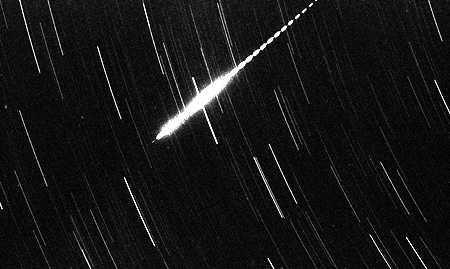
It is a meteor shower or any meteoriod or particle that enters the earth’s atmosphere. When it comes into contact with our atmosphere at speeds up to 72 km (45 miles) per second the particle of sand usually gets worn out due to friction before it reached the earth’s surface. If they are big enough and are not worn out when they fall on the earth’s surface are known as meteorites. These are called fire-balls as they are exceptionally brillant. There are many such meteoriites found all over the world. There are many meteoriods left behind by passing comets. Such comets are Halley, Tempel-Tuttle and Encke. When a comet passes by part of its ice melts and with it particles of sand and dust are left behind its trail. And if its trail happens to cross our earth’s orbit then we will have meteors falling. If the number is big we call it a shower.
|
|
| You can usually see more meteors after midmight and the best time is towards
morning at about 4 am. Onwards. This is because at this time our earth is moving
along its orbit traveling towards the particles left behind by the comet. A dark
sky or moonless (newmoon) night will give an excellent prospects
on observing the shower.
|
|
| Almost every month there is a meteor shower.
Table 1 shows the period a
certain shower can be seen and also its date of maximum number of meteors per
hour. The Leonid meteor shower which is on 17th November. Its parent comet,
Tempel-Tuttle has just
passed by leaving a trail of particles behind. This comet has a 33 years’ orbit
so every 33 years we will expect to see a good shower.
|
|
| Each shower seems to radiate from a constellation. Example Leonids shower radiates from Leo and Perseids from Perseus and Orionids from Orion. Meteor showers are best seen with your naked eyes on nights when the Moon is not bright. Any dark spot with no buildings or trees blocking your view of the sky will do. The best location to view the shower is on a high ground such as Bukit Ambok or costal area such as Pantai Seri Kenangan, Bukit Agok, where there are less light pollution. Locate the constellation concern by referring to a star chart. It is more interesting and exciting to watch meteor showers in the company of friends. So do join in any organized observations. | |
|
|
Sources: 1. Patrick Moore (1988) Amateur Astronomy, Bloomsbury Books, London. 2. Susan Goodman (1993) Spacefacts, Oxford University Press. 3. Valerie Illingworth (ed)(1994) Dictionary of Astronomy, HarperCollins Publishers.
|
|||||||||||||||||||||||||||||||||||||||||||||||||||||||||||||||||||||||||||||||||||||
| Links | |||||||||||||||||||||||||||||||||||||||||||||||||||||||||||||||||||||||||||||||||||||
| International Meteor Organization (IMO) |