The B-36 Peacemaker
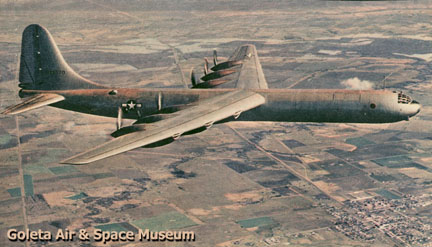
If there was ever a plane that was obsolete before it was ever produced, many would say that the B-36 is that plane. Because it was made with propellers during the dawn of the jet age, many never accepted it and it was doomed for retirement.
In 1941, World War II was not going very well for the Allies in Europe. The U.S. was afraid that the Germans might capture England. If that happened, the U.S. would not have anyplace to fly from to bomb targets in Europe. The military needed a bomber that would be able to fly from the mainland U.S., bomb a target in Europe, and return safely to the U.S. This was no easy task, but the government gave several companies what they wanted in this new bomber, just to see if anyone could meet the requirements.
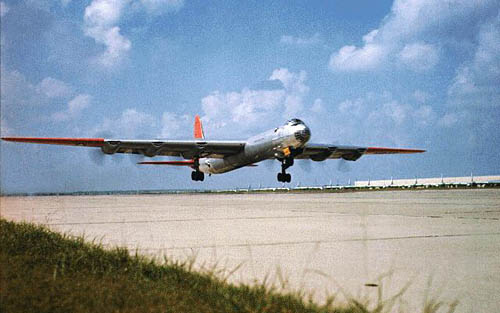
After many of years of trying to meet the military's strict requirements, a prototype was made that would meet all of the requirements. This experimental plane looked so weird that dismissed it as soon as they saw it. This was because of the plane's 6 pusher engines, like nothing anybody have ever seen before. The first prototype of the B-36 flew on August 8, 1946, almost a year after World War II ended. Nevertheless, work on the plane continued until the first B-36's were delivered to be used in the military's arsenal.
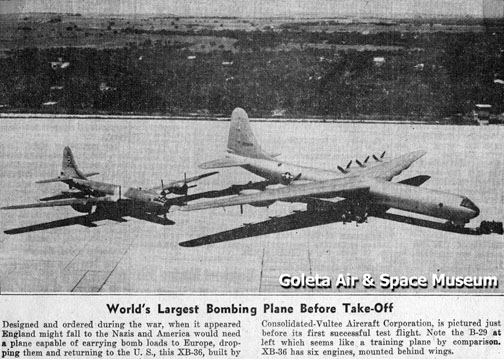
Right from the beginning, the B-36 was under attack by many people. The critics said that the engines were too small on the plane. Therefore, the cruising speed was too slow and it took far too long to take off. In addition, the first B-36's had no defensive armament. They were all designed to, but early troubles in the development of the guns meant that the guns were not ready for the first planes. So they had a plane that went too slow with no defensive guns. Plus, by this time, development of the B-52 had begun, which looked far superior to the B-36 in every way.
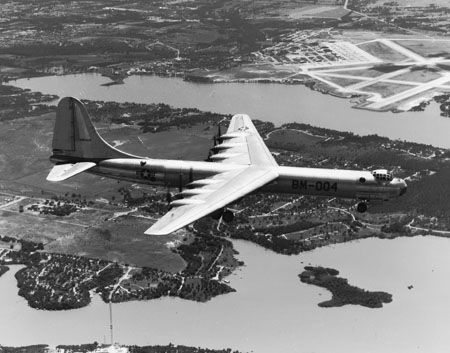
To try to fix some of these problems, new models of B-36's were introduced. Among the improvements were defensive guns, larger engines, and the ability to carry even more bombs, bringing the total amount of bombs carried to 86,000 pounds. One idea was to change the engines to that they would all be tractor engines instead of pusher engines. But that was decided that that would be changing the entire aircraft too much. Also on later models, small turbojets were added under the wingtips to provide extra power during takeoffs and bombing runs.
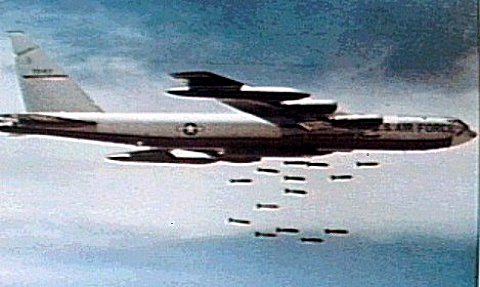
Despite all of these changes and improvement, the B-36 never saw combat. In was phased out between 1958 and 1959 for the more technologically advanced B-52. Only 385 B-36's were ever built and only 3 are still on public display today. A fourth plane has been restored but never displayed publicly. Even though the B-36 was never used for what it was intended to be used for, it served as a lesson to everyone. They learned what would and would not work for future generations of aircraft.
Powerplant: Six Pratt & Whitney R-4360-25 Wasp Major air cooled radial engines, each rated at 3250 hp for takeoff and 3000 hp at 40,000 feet.
Performance: Maximum speed 345 mph at 31,600 feet.
Cruising speed 218 mph.
Stalling speed 113 mph.
Initial climb rate 1447 feet per minute.
An altitude of 20,000 feet could be attained in 53 minutes.
Service ceiling 39,100 feet.
Combat ceiling 35,800 feet.
Combat radius 3880 miles with 10,000 pound bombload.
Ferry range 9136 miles
Total mission time 35.6 hours.
Takeoff run 6000 feet at sea level. Takeoff run over 50-foot obstacle 8000 feet.
Weights: 135,020 pounds empty, 212,800 pounds combat, 311,000 pounds maximum.
Dimensions: Wingspan 230 feet 0 inches, length 162 feet 1 inch, height 46 feet 8 inches, wing area 4772 square feet.
Armament: No defensive armament initially fitted. Maximum bomb load 72,000 pounds.
 |
 |