The B-29 Superfortress
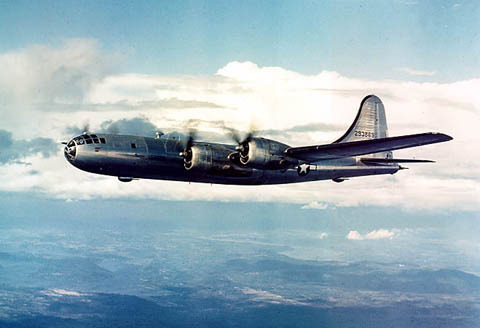
When most people think of the B-29 Superfortress, they think about the atomic bombs dropped on Hiroshima and Nagasaki. And while that was one of the defining moments of the past century, the B-29 did so much more than drop two atomic bombs on Japan in 1945. They were the main bombers for the United States in the Pacific Theater. If it had not been for the B-29, the island hopping campaign and the eventual surrender of Japan would have been dragged out for many more years and costing many more lives in the long run.
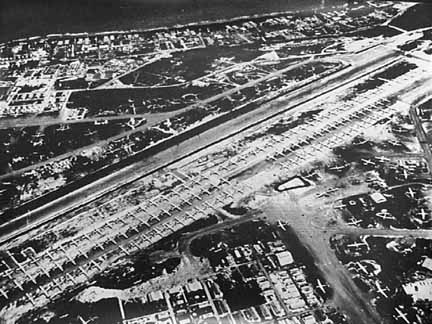
In 1940, Britain knew that war was inevitable and they were not prepared for a war of that magnitude. They liked Model #341 that was built by Boeing. However, they wanted some changes made to the aircraft. Such changes as self-sealing fuel tanks, more armor, and additional defensive armament. After these changes were made, the plane came to be known as model #345. Liking what it was seeing, the Army Air Corps ordered 250 of these new planes before a single part had been built for any plane. 1,650 had been ordered from across the world before the first test flight took place. Everyone seemed to know that this plane would change history before it was ever built.
However, such a revolutionary plane did not come about with out first overcoming some obstacles. The first major problem to overcome was the fact that there was no wing in existence that could be put on the B-29. The first wing had enough lift, but had too much drag. The second wing had little drag, but was very prone to stall. The third had little drag, didn't stall, but didn't have enough lift to be able to support the huge aircraft. Boeing finally went back to the drawing boards and came up with a completely new wing with retractable flaps. This new wing seemed to have everything just right, so they used it.
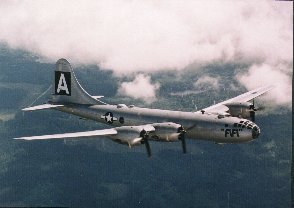
Another more serious problem arose however, after the first flight in 1942. The designers had used lightweight engines to try to conserve fuel. However, with such a large aircraft, small engines proved to be deadly. The engines had a tendency to overheat while flying. They tried to fix the problem by making small changes here and there in an effort to try to cool the engine. Sadly, in 1943 during a test flight, an engine not only got hot but burst into flames. The wing of the plane eventually burnt off and the plane crashed into a factory filled with civilians. The entire crew of the plane and dozens of the people on the ground were killed. Many questioned whether the B-29 should ever fly. However, the entire problem was fixed simply by putting on different engines.
Another question on hand was the comfort of the crew. The plane would be flying at 30,000 ft. where the temperature could reach 50 degrees below zero. This meant that the cabin of the plane would have to be pressurized. However, over 40% of the fuselage was to carry bombs. Therefore, designers made it so that the very front and very rear of the plane would be pressurized for the crew. Then, a tube would run above the bomb bay so that crew could crawl through the tube to each other.

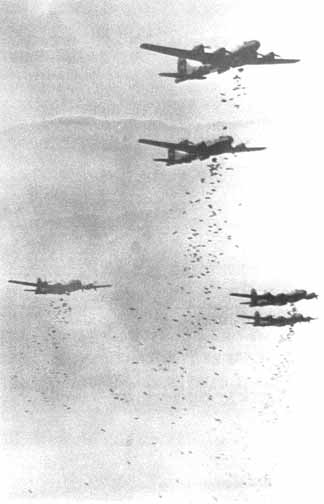
With all of these problems fixed, the B-29 went into mass production by the end of 1943. The planes awesome power soon became evident. The B-29 could carry 16,000 lbs. of bombs to a target over 2,000 miles away and return safely. There were several instances where a formation of B-29s completely destroyed a Japanese city in one raid using only conventional bombs. The plane held nearly 7,000 gallons of 100 octane aircraft fuel. And because they entered the war so late, only 3,965 B-29s were built. But of course the most famous B-29 will always be the Enola Gay, which dropped the first atomic bomb on Japan. But nobody ever seems to know what plane dropped the second atomic bomb on Japan. For the record, it was the Bockscar. And as everyone knows, it was because of the atomic bomb that Japan surrendered. So really, the B-29 won the war in the Pacific.
General Characteristics:
Wing span: 141 ft. 3 in (43.05 m)
Length: 99 ft. 0 in (30.17 m)
Height: 29 ft. 7 in (9.02 m)
Wing Area: 1,736 sq ft (529.13 sq m)
Empty: 72,208 lb (32,752 kg)
Maximum Take-Off: 140,000 lb (63,502 kg)
Maximum Speed: 399 m.p.h. (642 km/h) at 30,000 ft (9,144 m)
Service Ceiling: 23,950 ft (7,299 m)
Combat Ceiling: 36,150 ft (11,018 m)
Normal Range: 4,200 miles (6,759 km) (with 18,000 lbs. (8,164 kg) bombs)
Powerplant: Four Wright Aeronautical R-3350-57 Twin Row Radial 2,200 hp (1,640 kw) take-off, 2,500 hp (1,864) WE, Air Cooled
Armament: Eight or twelve 50-cal. machine-guns. One 20mm cannon.
Maximum bomb Load: 20,000 lbs. (9,0710 kg)
 |
 |