The B-17 Flying Fortress
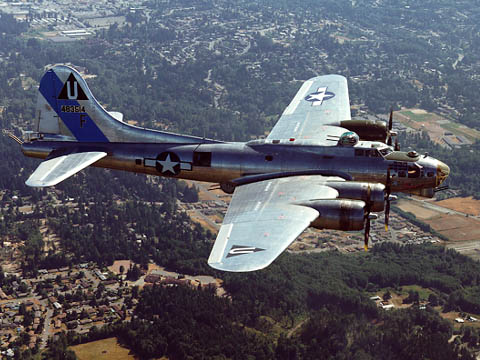
In 1934, Boeing started development of a heavy, multi-engine bomber as requested by the U.S. military. Less than 12 months later, the first test flight took place of model #299 on July 28, 1935. The military watched all of this with great interest and soon decided that they approved of the design. The military ordered 13 of the YB-17 and the first planes were delivered in early January 1936.
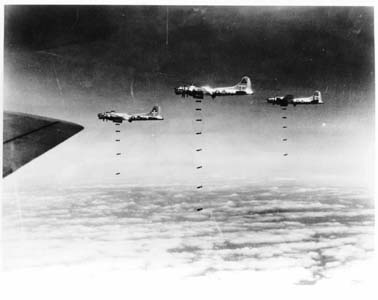
The B-17 lived in obscurity for the next few years. With no immediate need for heavy bombers, the planes were not mass-produced or modified at all, but that all changed in 1941 with the outbreak of war in Europe. England quickly started using the B-17 for the long range bombing missions deep into enemy held territory. The extreme range of the B-17 was one of the greatest things that the plane had going for it. It could go farther in German territory than any other plane in the Allied arsenal.
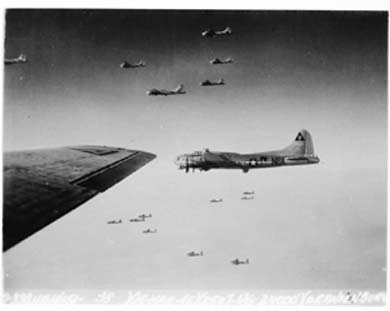
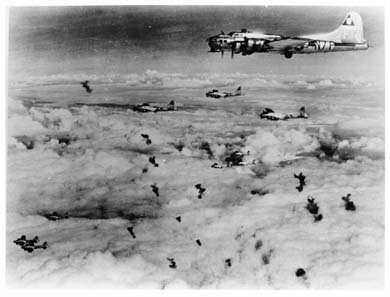
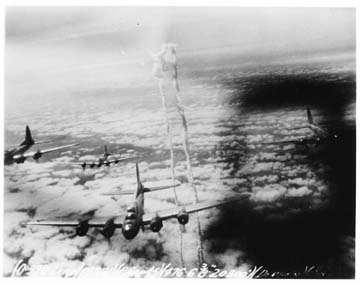
When the Eighth Air Force started to run bombing missions out of England, the true usefulness of the B-17 soon became obvious. Because of the B-17's long range, many of the missions that they flew on had to be without fighter escort. They flew in huge formations and used their 13 .50 caliber machine guns to ward off German fighters. Also, because of the incredibly thick armor plating throughout the plane, the B-17's could withstand huge amounts of damage and still be able to return to base. One of the biggest enemies of bombers at the time was FLAK. You can clearly see the FLAK in the picture below. It is the black splotches on the picture. FLAK is basically sharp pieces of metal that float in the air after being fired by guns on the ground . The idea is that when a plane hits the FLAK, the metal tears the plane apart and brings it down. Although the B-17's were hit quite of ten by FLAK, many were able to return to their base with gaping holes in the planes. After seeing what the B-17's could withstand, and seeing how many guns were mounted on them, a reported from Seattle said that the planes were like a Flying Fortress. The name stuck and the B-17's have been known as the Flying Fortress ever since.
Sadly, despite the B-17's thick armor and many machine guns, a huge number of the planes were lost over Europe. In all, 12,731 B-17's were produced from 1935 to 1945. 4,735, or about 37% of all of the B-17's, were lost during the war. After the war, the government saw little need for so many bombers if they didn't have a use for them anymore. Therefore, most of the remaining B-17's were chopped up and sold for scrap. Fewer than 100 still exist today, and it is thought that only about 15 can still fly. Despite the fact that most of the B-17's are now gone, they will never be forgotten because of the huge sacrifice that they make for their country.
General Characteristics:
Wing Span: 103 feet, 9 inches
Length: 74 feet, 9 inches
Height: 19 feet, 1 inch
Weight: Gross Weight - 54,000 lbs.
Top Speed: 300 mph at 30,000 ft.
Cruising Speed: 170 mph
Range: 1850 miles
Service Ceiling: 35,600
Power: four 1,200 h.p. Wright R-1820-97 radial piston engines
Armament: 13 .50 caliber machine guns
Bomb Load: 2,600 - 8,000 lbs.(long range) up to 17,600 lbs.(short range)
Crew: Ten (Pilot, Co-Pilot, Navigator, Bombardier, Flight Engineer (top turret gunner), Radio Operator, 2-Waist Gunners, Tail Gunner and Ball Turret Gunner
 |
 |