Dialectics
of New Vision
By Andrei Shkarubo.
Content:
1.
Nature
of dialectics
2.
Three
visions of the world
3.
Formation
of new stereotypes of vision
4.
Nature
of dualism – different levels of consciousness
5.
Objective
causes of New Dialectics
6.
Phases
and periods of time cycle distinguished by consciousness
7.
Structure
of New Dialectics
8.
Signs
of the Times – characteristics of four phases of Time cycle
9.
Conclusion.
1. Nature of
dialectics (its cognitive, epistemological origins).
Dialectics is a
universal methodology based on dualism of thinking (author).
The vision of the world is but a projection of
the mind’s arrangement and its work.
The nature of dialectics, or any other
stereotype of thinking, i.e. reception/perception of information and its
processing (analysis and synthesis) lies primarily in the mind’s structure and mechanism
of its work (for more detail read
Spiritual Rape of Russia,
parts: The Way We Interact With The
World, Structure of Consciousness, Mechanism of Consciousness’ Work).
In other words, the way we see, perceive the
world around us depends on a) what apparatus, what mechanism we use b) what
technical characteristics it possesses
.
Say, a snap-shot taken by a camera allows a
closer look at the object of your interest, making possible its analysis.
But if you want to determine time-and-space
ties of the object under study, i.e. determine how it develops in time and what
surrounds it in space, in other words, if you want to achieve synthesis and
obtain a comprehensive picture of reality, you’ll see that camera is of little
use there.
In such cases they use other mechanism: video-camera.
If we use the same mechanism, say video-camera,
for our perception of reality, in this case our ability to perceive as well as
the picture of perceived reality would depend strongly on the speed-frequency
of our perception, or on the speed-frequency of video-camera we use.
For example, the processes which are beyond
ordinary human perception, the speed-frequency of which is much higher or lower
than the frequency-speed of perception, such processes, say like opening of a
bud or movement of wings of a bumble-bee can be correctly recorded only if a
high-speed video-camera is used. If you use ordinary camcorder, you won’t get a
dynamic picture but a static one, or a picture of chaos when the image becomes
blurred beyond recognition.
So, before we start speaking of dialectics as a
universal technique of measurement, a universal methodology of analysis, before
we start speaking of dialectics’ universal measure, Time, we must stress that
every picture of our perception: images, views, notions, including those of
Time and Space; stereotypes of thinking, models and theories, including
dialectics itself, are Conditional and
Relative, being the product of interaction of our mind and reality.
All our knowledge, our picture of the world are determined by the way we perceive and process-decipher
information.
2. Three Visions Of The World.
Using the language of physics, the picture of
the world we perceive is a kind of interference pattern which emerges as a
result of an overlay of waves, frequencies of your consciousness and waves,
frequencies of reality.
As in the case of a video-camera cited above,
the picture resulting from this overlay will be of three basic patterns: Chaos,
Dynamics, Statics.
Chaos.
The picture of chaos (state of utter incomprehension)
emerges when consciousness starts perceiving something absolutely new, which is
impossible to compare-measure: either because consciousness has no such
stereotypes (they are not formed yet), or it simply cannot find them.
Everything in such picture is changing:
details, their characteristics, proportions, and so on, creating complete chaos
in which nothing can be singled out and recognized because the newly-emerged
bears no semblance to the just-disappeared.
The state of mind in such situation resembles a
person who finds himself unexpectedly and inexplicably abroad, having no
knowledge of the country he’s in, or its language, customs, laws, nor even the
meaning of objects around him.
The person in possession of all his faculties
in this situation is nonetheless completely helpless, confused and devastated.
Until he’s managed to focus his attention, i.e. to raise the frequency of his
own perception, and start singling out and recognize repetitive elements in
reality he perceives.
Dynamics and Time
It’s this singling out of a repetitive, common
element which changes perception, transforming the picture of chaos into picture of dynamics.
This common element which has its own
frequency, period of repetition turns into the first reference point , a universal measure in human perception called Time (the Sun has always been and still
is such reference point for a human being).
To be more precise, Time is an overlay of two frequencies: the frequency of perceived reality and frequency of perception - resulting in a periodical fraction.
Ability to remember, to store and retrieve the
common element, to recognize it from the perceived chaos by comparing the stored
element with the current one has made it possible to distinguish in Time its
past and present aspects.
With the emergence of thinking, ability to
actively and systematically reflect-reproduce common elements, a notion of
future has come into use.
Statics and Space
Further qualitative growth of the level of
consciousness when the speed-frequency of perception-reflection equals the
speed-frequency of the perceived process creates a static picture.
The relativity of statics
is most obvious when, for example, a transport vehicle you ride in, say, a
train picks up speed and overtakes another train and they run in the same
direction at the same speed for a while. If you spot no stationary object in
your sight (other reference point) you’ll have an impression that both trains
are motionless, static.
Static perception creates the notion of Space, first of all such aspects as
form, the inner and outer, the front and the rear.
So, passing the periods of 1) complete chaos 2)
dynamic confusion, the picture of
our perception enters a period of 3) static knowledge.
It’s during this period that such
patterns-stereotypes emerge as notions, knowledge, methodologies, including
dialectics.
Being just a stereotype of thinking,
dialectics, like any other stereotype, are relative and conditional. It’s not a
dogma, but a manual, in other words, its content and function are determined by
Time.
3. Formation of new
stereotypes of vision
say, a new theory, including dialectics,
invariably implies analysis and restructuring of old stereotypes – conditioned
by experience accumulated during the dynamic, active period when consciousness
distinguished-remembered the most frequent vital fragments of reality.
Building a new stereotype out of time-acquired
fragments of old stereotypes (experience, skills, notions and stereotypes of
thinking) could be compared to a situation in which a traveler is trying to
collect his belongings acquired over a certain period and pack them into one
whole but finds it impossible to accomplish using the old method of packing because
of the increased number of possessions.
So, the first thing one has to do in such cases
is to spread things apart and determine which of the baggage items is to be
placed with which so they could form the
closest natural link.
After the mutual position of one item against
the other is determined (linear ties), their final packaging, tying up takes
place when multi-dimensional ties and structures are defined so that a pile of
diverse items could be transformed, or rather compressed, with proportions
intact, into one whole, the baggage which is good for transportation, i.e. the
one which won’t fall apart on any external impact.
During transportation itself, it will become
evident that certain objects, items of baggage, broke under impact, or proved useless.
After which these items, the elements of the whole, will be thrown out, the
baggage will be re-adjusted and tied up
again, i.e. it’ll become more compact and homogeneous despite the diversity of
its composites. Thus a single whole emerges from a swarm of isolated separate
things.
Thus a newly emerged theory is tested and
updated by practice.
4. Nature of dualism –
different levels of consciousness
Following the above-mentioned analogy, one must
take the old baggage, the old dialectics, apart and learn where its basic
components come from, first and foremost its notion of
contradictions-polarities; in other words, why one person can perceive some
process or phenomenon, whereas the other cannot, or he can perceive it, but
sees it in a completely differing, contradictory way.
The cause of those contradictions lies in
different levels of consciousness, perception.
If the analogy of two trains to be used,
reality, or rather its specific layer, could be compared to an express train,
while human consciousness, perception – to a commuter train which can catch up
with the express, i.e. perceive reality, only for a limited period of time on a
specific section of the road.
Naturally, these specific sections of the road
and periods of time when express and commuter trains can draw level making perception
and understanding possible, they all differ for different commuter trains, which means that the perceived picture,
understanding, would differ as well.
It’s the different
levels of inadequacy of human perception which breed all sorts of
contradictions.
For example, in order to obtain at least some
picture of reality, to have at least some idea of it, the mind has to focus, to
accelerate its work, to increase the frequency/speed of its perception to equal
the frequency/speed of the reality layer under study, in other words, to catch
up with that “express” which never stops, but
there are people whose mind is too feeble, too
narrow for this, and attempts to draw their attention to certain phenomena,
processes would be as futile as taking the blind to a picture gallery.
These processes and phenomena simply do not
exist for them. These people live in a
blissful oblivion of idiots.
There are people whose minds can speed up and catch
a glimpse of some fragment of reality. But it’s only a glimpse: having
instantly drained their energy resources on it, they quickly lose the sight of
the express train of reality.
For these minds this fragment of reality is
always perceived with a certain tinge: either positive or negative – the
unbalanced view results from brevity of perception.
If the fragment was perceived while
consciousness was “catching up” with reality, its picture would be positive;
if , vice versa, the fragment was perceived while
consciousness was losing speed and
falling behind reality (which creates illusion of moving in opposite
directions) its picture would be negative.
The brevity of perception allows this type of
consciousness only a one-sided view of reality: either black or white.
This type knows no alternative,
it’s simply unaware of it. This type knows no contradictions, no doubts or
compunctions. Everything is crystal clear for them, they are always right.
Unlike the former type of blank consciousness
called the type of blessed idiots, this
type of incomplete, one-sided consciousness could be called the type of omniscient idiots.
The next level of consciousness has a grade
higher energy reserve which allows consciousness a more extended contact with
reality.
Thanks to this energy reserve, consciousness
falls behind reality not instantly but gradually (i.e. after the commuter train
draws level with the express, it loses speed gradually, and the trains
gradually move apart).
Which allows consciousness a
comprehensive perception of reality consisting of both white, positive, and
black, negative, experience. A contradictory experience which lacks awareness of
the unity and wholeness of positive and negative.
Fragmentary, contradictory nature of such
consciousness is manifest in all its judgments and acts, which are marked by
doubts and hesitations characteristic of this type of consciousness, called the doubting, thinker idiot, a complete opposite of its
predecessor, the omniscient idiot.
The next level of consciousness has such a high
reserve of energy that it is capable of not simply seeing reality in all its
contradictions-polarities, but it’s also capable of seeing, understanding the
relative and conditional nature of these contradictions.
Which is possible only if this
consciousness can accelerate so it can perceive the new layer of reality
completely, in other words, if consciousness can acquire a new reference point,
a new dimension.
For example, the relativity of two trains
moving apart becomes obvious if the observer is shifted from the window of a
commuter train to the porthole of an airplane, and thereby discovers that the
trains actually are still moving in the same direction, but at differing speed.
It’s a new reference point which allows
consciousness to have a whole and complete view of the proceedings, i.e. to see
not just all, but all at once, in other words, to have the grasp, to
understand.
Such type of consciousness could be called the idiot who’s learned his own folly
(in the East they call it Enlightened One).
It’s this type of consciousness which possesses
truly dialectic approach, i.e. perceives reality not just as struggle of opposites,
but as their unity too, being able to see the relativity and conditionality of
those opposites.
5. Objective causes of
New Dialectics
The evolutionary growth of the level of
consciousness (its main technical characteristic, frequency, is gradually
rising the same way computer processors evolve) triggers similar changes in the
mind’s faculties: first of all, its ability to discriminate increases, so does
the fullness of perception and its level of integration – which inevitably
creates new stereotypes-programs.
For example, dialectics as a program can no
longer be limited to only those features common to any process or phenomenon which
were already outlined in the dialectics of Karl Marx, which are:
1)
presence
of contradictions-polarities in a process or phenomenon;
2)
unity
and inter-conditionality of those contradictions;
3)
struggle
of opposites, producing tension between them and rise of quantitative changes;
4)
a shift of accumulated quantitative changes into qualitative ones.
The modern historical period, new level of
consciousness (primarily improved ability to discriminate) require a new, a
fuller and more integrated, methodology which could both explain and predict; a
methodology based on a universal measure, Time and its derivatives, as well as
notions of space, energy, matter and information.
6.
Phases and periods of Time cycle distinguished by
consciousness
Although notion of Time is only relative and
conditional, it’s nonetheless the only factor which determines any process or
phenomenon – that’s why the whole theory of new dialectics, or Dialectics of
New Vision, will be built on Time and its derivatives, like frequency, period, phase.
Using this single, universal measure, one can
state that all processes and phenomena
(human perception including) are of
cyclical, repetitive nature: the end of one cycle triggers the start of the
other.
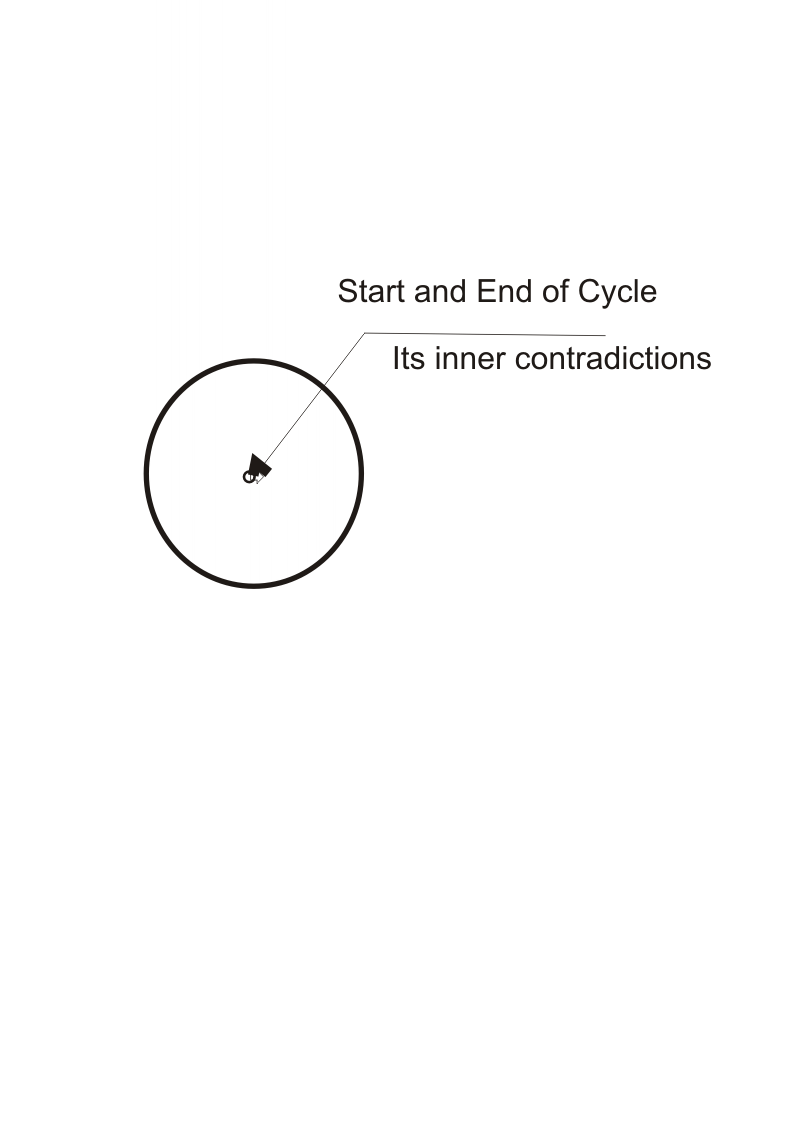
This cyclical nature can be illustrated by a circle with a dot in its center which signifies the start and end of a process; opposites-contradictions which determine its development.
If one were to estimate by the level of
discrimination, one could single out in each cycle, distinguish, two opposite
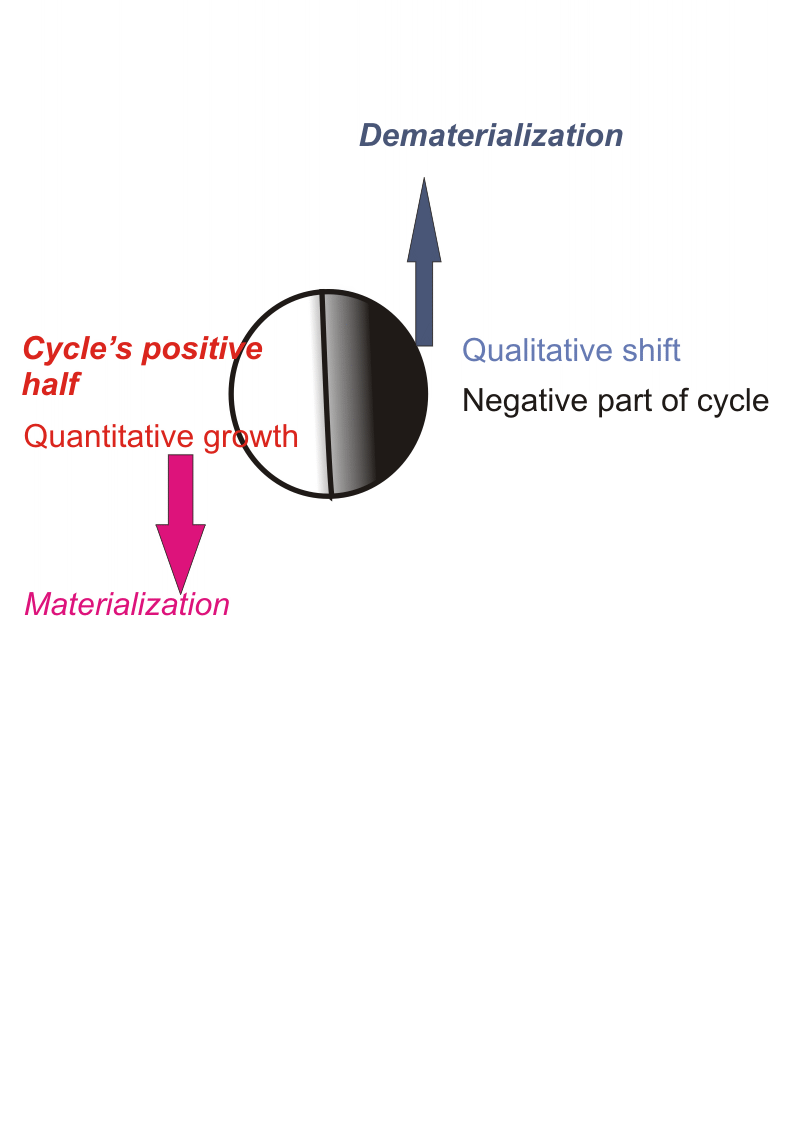
processes: 1) a phase of quantitative, external changes; 2) a phase of their
decline, and/or rise of qualitative, internal changes.
The first process results in creation of a new
form, opposite to the old initial one, i.e. “negation”takes
place;
The second process results in a qualitative
shift, and return to the old form, but with a new, opposite content, i.e.
“negation of negation”, synthesis, takes place, closing thereby the old cycle
and creating inner, informational, preconditions for the new one.
To illustrate this we divide the circle by a
vertical line drawn through its center.