 |
 |
 |
 |
 |
 |
 |
|
|
|
|
|
|
|
 |
 |
 |
 |
 |
 |
 |
 |
|
[Editorial]
[Featured
Breed]
[Featured
Rider]
[Featured
Equine]
[Featured
Equine Hazard]
[Book
Review]
[Winter
Riding]
[Summer
Camp Preparations]
[Glossary]
["Ask
The Trainer"]
["The
Help Desk"]
[Poetry]
[Contests]
[Writing
for the E-Zine]
[Submission Tips & Guidelines]
|
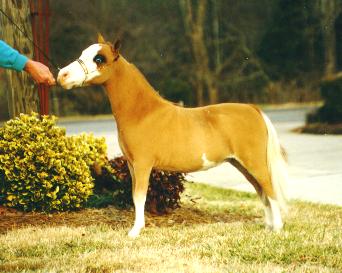 Origin
The smallest equine breed in the world, legend has it that the Falabella family first bred the Falabellas at their ranch, Recreo de Roca Ranch, which was located near Buenos Aires. The basis of the Falabella was the Shetland and a small Thoroughbred. The Falabella evolved from deliberate down breeding with crosses of the smallest horses. Unfortunately, its strength, vigor, and the toughness passed down from the Shetland, were lost in the process. Another anecdote is that the origin of the Falabella horse is linked to the origin of a horse in Latin America, the Andalusian. The Spaniards, choosing this breed for their rusticity and resistance, brought these horses with them to Latin America to conquer the area's inhabitants. The Andalusians were later left to survive on their own after several unsuccessful attempts at war. Thus deserted, the surviving horses underwent a series of biological processes and structural changes so as to adapt to their new, different environment. They were compelled to move great distances to find water and pasture, and this gave them enormous resistance. Due to persecution from predators, their keen instincts and ability to sense danger were sharpened. These factors, added to the horses' continuous inbreeding and isolation, caused genetic mutations in successive generations, resulting in the type of horse that the Falabella family saw in the herds of Mapuche Indians of the Southern Buenos Aires province in Argentina. After years of experimenting and breeding, the Falabella family eventually managed to achieve a herd of well-structured horses that had the size of ponies, but the conformation and temperament of horses. The knowledge of breeding these miniature horses was passed from Patrick Newell to his son-in-law, Juan Falabella, who in turn passed it to his son, Emilo Falabella, who passed it to his son, Julio. Though the exact method of this breeding remains unknown, we do know that no chemicals were used in the miniaturization process. These miniature horses then
became known as the Falabellas.
|
