 |
 |
 |
 |
 |
 |
 |
|
|
|
|
|
|
|
 |
 |
 |
 |
 |
 |
 |
 |
|
[Editorial]
[Featured
Breed]
[Featured
Rider]
[Featured
Equine]
[Featured
Equine Hazard]
[Book
Review]
[Winter
Riding]
[Summer
Camp Preparations]
[Glossary]
["Ask
The Trainer"]
["The
Help Desk"]
[Poetry]
[Contests]
[Writing
for the E-Zine]
[Submission Tips & Guidelines]
|
 Characteristics
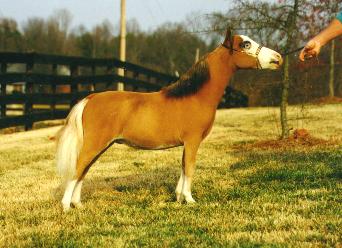
In contrast to other breeds, the Falabellas' manes are short and straight, falling on both sides of the neck, while their hooves are narrow and oval in shape. Their thin and supple skins are covered with coats that span a wide variety of colors, although they are generally black or brown. In winters, Falabellas produce thick coats as protection against the cold, but in summer, however, their coats are as sleek and fine as that of a Thoroughbred. Due to their spontaneous, energetic gait, they are extremely popular with small children who use them as riding horses. Unfortunately, the limbs of the Falabellas are often common in deficiencies such as bow-legged front legs. Their hocks, too, tend to be weak and cow-hocked. Their breeders are currently attempting to eliminate these deficiencies from their stock. The approximate gestation period of Falabella mares is 11 months and 10 days. At birth, the foals are generally 15 to 20 inches in height, with a weight of one pound per inch. Once a foal turns a year old, it may reach up to 90 percent of its mature height. In this breed, full maturity is considered to be at age four. Falabellas, if given good care, can live as long as even 45 years. One common error in the discussion of this breed is to confuse it with Shetland ponies. Shetlands are generally ponies of a stockier build, and do not possess either the Falabellas' thin, silky coats or the good nature of the Falabellas. Though a gregarious and rustic animal in the wild, the Falabella is in actual fact a gentle and docile animal that accepts petting, hosing off, walking with a halter and sundry other routines in a short period of time.
|
