Index
|
 |
|
Passing Strategies
Having a good passing game opens up more options for your offense. You can use screen passes and short yardage tosses mixed with crossing and deep routes to work the ball all over the field. If you combine this with a strong running attack, play action can burn defenses for long yardage.
There are five broad categories of passing plays. Following are explanations of when to utilize each type of pass play.
|
|
Short Yardage/Screens
Short-yardage and screen passes can be used instead of a run to chip away at the first down. They're also good plays if the defense is consistently putting pressure on your QB. Overagressive defenders can be burned badly by screen passes.
|
|
Slants
Crossing routes send receivers farther down the field, but they're good for quick passes underneath the defense. Passes thrown to a receiver on a slant route are more likely to be knocked down at the line, so lob the pass rather than firing the ball.
|
|
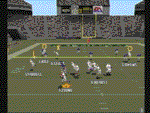 Sidelines
Sideline routes send receivers toward the outside of the field, allowing them to catch the ball and quickly step out of bounds if you need to stop the clock.
|
|
Timing
Timing routes are the toughest routes to master. Posts, curls, and outs have predetermined movements along the receiver's route. Practice mode is useful for getting the timing down on these types of plays. Wait for the receiver to make his cut that separates him from the defender, then drill him between the numbers.
|
|
Deep
Having a deep threat can keep the defense honest, but throwing deep on every play is seldom successful. Hail Marys and deep fly patterns can get you good chunks of yardage if the defense has put everyone on the line and your offensive line gives you enough time to wait for your receivers to get down the field. If you want to base your offense around going deep often, you'll need excellent offensive linemen, excellent receivers, an excellent QB, and a good deal of luck. Of course, if you're on the 50-yard line, down by a TD in the fourth quarter with only 10 seconds to go, your choices are limited. In that situation, chuck and duck away.
|
|
Tips When Throwing/Receiving
- Hit the receivers right as they make breaks along their routes.
- Look for outlet receivers running free in the flats if no one else is open.
- Don't drop back too far (never more than 10 yards). You increase the risk of a holding penalty or a big loss if sacked.
- If you roll out, avoid throwing back across the field. If you do, more often than not you'll be picked off.
- Try to let your QB set his feet before throwing the ball. Throwing off the back foot reduces your chances of completing the pass.
- Scramble if no receivers are open. Once they've completed their routes, they'll come back toward the line of scrimmage.
- If your receivers are getting jammed at the line, wait as long as possible for them to get open. If no one is open, take off if you have room, or throw the ball away.
- Make sure you're outside the tackles if you need to throw the ball away. Otherwise, you'll get called for intentional grounding.
- For play action, don't touch the controller after you hike the ball. The QB will fake the handoff, then you can activate the pass routes and throw the pass.
- Avoid throwing into double or triple coverage. The more defenders around the ball, the more likely it will get knocked away or intercepted.
- Turn a receiver's route into a streak or a slant if the defense crowds the line.
- Put a man in motion to load one side of the line. Do this to force the defense to react and take advantage of the resulting man-to-man coverage.
|
|